
Shia Muharram Procession in Kashmir Permitted After Several Years, Passes Without Any Anti-India Slogan Shouting After Three Decades
By
New Age Islam Staff Writer
31 July
2023
30,000
People Gathered to Witness the Event
Main
Points:
1. Shias of Kasmir had long been
seeking permission to hold Ashura procession.
2. The procession was permitted on Guru
Bazar Dalgate Road.
3. The LG Manoj Sharma was present.
4. The procession was permitted to show
that normalcy had returned in the valley.
------
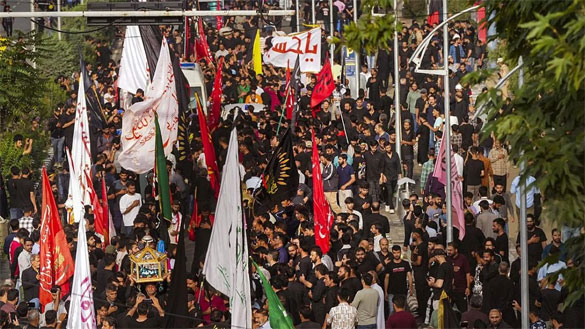
Muharram procession in Kashmir
--------
Shias, one
of the most persecuted Muslim communities had the reason to rejoice in Kashmir
as they were allowed to hold Moharram processions on the 8th and 10th of
Muharram after three decades. The organisers had sought permission every year
but the situation in the valley was not conducive to such events in the
backdrop of centuries of Shia-Sunni clashes in the region.
Praveen
Swami gives an account of the long history of Shia-Sunni divide in Kashmir
where the Shias were a dominant community after the Sufi Syed Sharfuddin Abdul
Rahman Shah brought Islam to Kashmir. But the Mughals turned the region into a
Sunni dominated country. This sowed the seed of enmity between the two
communities. The rivalry became so intense that both bayed for each other's
blood. Sunnis would kill Shias and burn their villages if Shias would kill a
Sunni. Not only that, they would drink the blood of their opponents. The region
came under the Mughal empire during Akbar's reign and Shias became the minority
community. Zadibal, a Shia majority village has been the target of Sunni
aggression and has been looted and burned a number of times. Their women were
raped by Sunnis. The ears and noses of Shias were cut off.
There have
been anti-Shia riots in Kashmir since 1793, 1801 and 1872. In 1801, Shias had
killed a Sunni boy and the Sunnis had attacked Zadibal and killed Shias.
The region
witnessed peace only after Ranjit Singh established his rule in Kashmir in
1821. However, after the Independence, Shias were again subjected to
discrimination and hostility by the Shaikh Abdullah government. He did not give
them appropriate representation. In 1983, Shias were massacred in Gilgit
Baltistan as well as as in Zadibal which was again set on fire.
During the
insurgency in the 80s, the Shias maintained distance because it was run by the
Sunni Islamists though occasionally some sections of Shia showed solidarity
with them to appease the minority community. For example, in 2018, some Shias
showed sympathy for Burhan Wani.
Shia
processions on Muharram are also a cause of tension between the two communities
because the Shias sing Tabarrah against some holy companions of the holy
prophet pbuh whom Sunni Muslims revere. Because of this, the administration
hesitates to give permission for Shia processions. Therefore, the Kashmir
administration held three weeks of meetings and negotiations with all the
stakeholders before granting them permission. The administration also gave the
permission to show to the world that normalcy has returned to Kashmir after
three decades of unrest and insurgency. Though the procession was symbolic, it
marked the beginning of a new era in the history of Kashmir where stone
pelting, strikes and terror strikes had become the order of the day with the
Pakistan-backed political players losing control on the people of Kashmir, the
valley is coming closer to normalcy. The leaders who sent their sons and
daughters to study and live in Pakistan and forced the boys of Kashmir to take
part in stone pelting and strikes have now gone into hiding. They sold false
dreams of Nizam-e-Mustafa to the common Kashmiris while their sons got
employment in the state government with the help of educational degrees from universities
of Pakistan. The pro-Pakistan leaders would release monthly calendars of
strikes in schools and colleges of Kashmir and deprived the Kashmiris of
education.
Hopefully,
this Muharram ushers not only the Shias but all the Kashmiris into a new era of
peace, progress and harmony.
-----
Oppressed
for Centuries—Kashmir’s Shias Get Their Due as Muharram Procession Restored

By
Praveen Swami
30 July,
2023
Lit up by
the fire from torches, the majlis congregation would gather at the home of the
great merchant Mirza Muhammad Ali. From there, in the darkness before dawn, the
Muharram procession of Zuljanah—the loyal and courageous stallion which fought
with Husayn ibn Ali at the great, tragic battle of Karbala—would slowly draw
out. Ten men, or so, would lead the way, softly reciting the profession of
their faith. There was no reading of Marsiyas, elegiac poems which
commemorate the martyrdom of Ali, nor rhythmic beating of chests.
Muharram
procession in Srinagar on Thursday. | PTI
-----
Then,
architect and historian Hakeem Saleem Hamdani records, in his magisterial
telling of the Shia community’s history in Kashmir, a defiant gesture that
changed the course of history. Two mourners, Mian Ghulam Muhammad Khan and
Yusuf Ali Khan, began beating their chests and reciting Noha
lamentations as they reached the main road. They were joined by many others,
and the procession ran to dusk.
Exactly a
century ago, in 1923, Kashmir’s Shia community emerged from centuries of having
to cloak its faith in the cover of darkness.
Late on
Saturday morning, Kashmir Lieutenant-Governor Manoj Sinha waited at the home of
a local notable to join the procession marking Ashura, the tenth day of
Muharram, on which Husayn ibn Ali was beheaded at Karbala in 680 CE. Two days
earlier, the procession of the eighth day of Muharram had been restored to its
traditional route from Srinagar’s Gurubazaar to Dalgate, after 34 years—a
gesture demonstrating decades of poisonous clashes and curfews surrounding
congregation worship are ending.
Kashmir’s
small Shia minority is estimated to make up just 10 per cent or so of its
population and played only a marginal role in the long jihad which began in
1988. In 2018, though, two men displayed posters of slain jihadist pop icon
Burhan Wani at an Ashura procession, sparking florid speculation the community
would join Kashmir’s jihadists.
The irony
is almost self-evident: in Kabul, an Islamist regime is savagely repressing
Shia, while in Pakistan jihadists have massacred the community for decades.
For
historians, contrafactual speculation is not always a useful exercise. No one
can know with any certainty what might have happened if humans had never tamed
fire, or invented gunpowder. But in this case, it’s hard not to engage in just
such idle speculation. What would the lives of Kashmir’s Shia have been like,
had it never become part of the framework of Colonial India?
Libel And
Blood
Early
colonial travellers to Kashmir were often struck by the reach and intensity of
communal propaganda against the Shias. Large-scale riots had broken out in
1801, Geofrey Vigne was told, when he visited Kashmir some twenty-five years
later, because the Shias “compelled a boy of the Sunni persuasion to eat salt;
then tantalised him with water; and when he was about to drink, they shot him
to death with arrows, so that he might die like Husayn, in the desert of
thirst”.
The
governor, Abdullah Khan, ordered Shia properties razed. Women were raped, and
men killed. Later, dozens of Shia prisoners were paraded through the streets,
dragged by a rope running through their noses.
Late
medieval accounts gathered by Hamdani, it is clear blood libels—of the kind
used to malign Jews in medieval Europe—suffused popular culture. The Shia were
rumoured to use the Yandir-i Sitzhen, or tip of the spindle, to draw
blood from Sunni children. Faith was also, however, enmeshed with power. The
Turkistani mystic Syed Sharf-Ud-Din Abdul Rehman Shah, who is said to have
introduced Islam to Kashmir in the 1300s, is claimed by both Shias and
Sunnis—but elites would soon instrumentalise faith.
Emperor
Humayun who first forayed into Kashmir in the mid-sixteenth century, through
his uncle Mirza Ḥaidar Dughlat, oversaw the beginning of an effort to construct a
theocratic identity for the region. Like other Mughal regions, Kashmir was to
be a Sunni state, governed by Hanafi law. The chronicler Sayyid Ali smugly
recorded that Dughlat had destroyed the shrine of the Shia mystic Mir
Shams-ud-Din Muhammad al-Iraqi, and suppressed the community’s religious
practices.
Kashmiri
king Ghazi Shah Chak, who ascended to the throne in 1561, a decade after
Dughlat’s death, restored the Shia faith to the heart of the court—provoking
the enmity of Sunni nobles. In one case, a Shia soldier, Yusuf Inder, was
executed for killing a Sunni cleric. “The flesh of his body was cut into pieces
which people carried as gifts for their womenfolk, and many people drank his
blood as sharbat,” records the contemporary Baharistan-i-Shahi chronicle.
Husayn
Shah, Ghazi Shah’s successor, was however later compelled to order the trial of
the cleric who sentenced Yusuf Inder for giving false judgment. Three Sunni
clerics were now condemned. Elite Sunni courtiers began petitioning the Mughals
for help, casting the Chaks as a threat to their religion.
Liberal and
cultured, the next Chak Sultan, Yusuf Shah, realised his fractured court could
not survive and switched sides to Emperor Akbar. Yusuf Shah’s son, Yakub Shah,
tried to rally the faithful by ordering his clerics to read Friday prayers in
the name of the first Shia Imam, Ali ibn Abi Talib. The Qazi refused and was
executed.
Akbar’s
army conquered Srinagar in 1586—extinguishing Shia power forever.
Long Persecution
From the
middle of the eighteenth century, Kashmir fell under the power of the Durrani
kings of Kandahar. Faith became a fraught political issue. Two subedars, or
provincial governors, Amir Khan and Sukh Jiwan sought to secede from the court
at Kabul. The fact that the first was Shia and the second Hindu did not pass
unnoticed. Like the Mughals before them, the Durranis saw heresy as a political
threat and worked to brutally impose religious order.
Governor
Buland Khan, following claims that the Shia of Zadibal had used indecent
language against a Sunni preacher, ordered the neighbourhood burned down. The
ears and noses of some of the survivors were cut off.
Frenzied
mobs attacked Zadibal again on Muharram in 1801, killing, looting and raping
their way through the largely Shia neighbourhood. The provocation, by some
accounts, was an effort by the Shias to take out a procession from their closed
shrine and recite martyrdom elegies. A dispute between merchants in 1793 had
led to similar large-scale violence in 1793.
The
crushing of the Afghan power by Maharaja Ranjit Singh in 1821 saw Kashmir come
under Sikh rule. Though the new rulers enforced several anti-Muslim measures,
for the Shia this was to prove a turning point. For the first time in
centuries, the state itself was no longer controlled by Sunni élites. In 1841,
Sheikh Ghulam Mohiuddin, an ethnic-Punjabi Shia, was appointed to govern
Kashmir by the Lahore court, followed by his son Sheikh Imam ad-Din.
In spite of
its expressly Hindu ideological moorings, the Dogra state which succeeded the
Sikhs was nudged by British India to follow a policy of religious indifference,
if not tolerance. In 1872, large-scale rioting broke out in Zaidbal again,
amidst simmering tensions between Sunni shawl artisans and Shia factory owners.
This time, though, Shia imam Bara in Srinagar, destroyed in the violence, was
rebuilt with support from the state.
The Shia,
Hamdani notes, were also able to capitalise on expanding opportunities in trade
that opened up during the colonial period. Early in the twentieth century, both
Shias and Sunnis were able to join together, in the pursuit of independence.
Then came that day in 1923, when the Shia faith revealed itself in the light of
the sun.
Fearful Silence
Even as the
long jihad exploded in Kashmir, Shias watched events across the border with
fear. In Gilgit, just across the Line of Control in Pakistan-occupied Kashmir,
General Muhammad Zia-ul-Haq’s military regime massacred hundreds of Shia,
following a rising trend of killings since 1983. Ten years later, the Taliban,
backed by Pakistan, would slaughter hundreds more Shias in Mazar-e-Sharif. For
the most part, Shias in Kashmir maintained a wary distance from the Islamists
who were fighting to tear the state out of India.
Even though
Shias had limited political space in post-independence Kashmir—Sheikh Muhammad
Abdullah’s governments did not include a single minister from the
community—memories of life under Sunni authority tempered any enthusiasm for
secession.
Low-level
communal did, and does, of course, survive. In the course of Akbar Jehan
Abdullah’s election campaign to the Lok Sabha in 1977, her workers appealed to
Sunni voters not to allow her to be humiliated by the Shia, a reference to her
rival’s faith. And in 1983, some Shia homes in Zadibal were set on fire by
National Conference workers, after the Congress’ Iftekhar Husain Ansari won an
assembly seat from Pattan.
The single
Shia jihadist group, the Hizb-ul-Momineen, was set up by the Inter-Services
Intelligence Directorate “to claim responsibility for the assassination of
pro-Indian Shiites who were actually being killed by Sunni jihadis,” journalist
Arif Jamal has recorded. The last major incident of violence against Shias was
carried out by one of those Sunni groups, the Hizb-ul-Mujahideen, which killed
twelve civilians in the course of an attempt to assassinate Ansari.
Like all
religious communities in Kashmir, the Shia know their long-term prospects are
dependent not just on the state, but coexistence with all communities, and the
construction of a durable peace. This month’s Muharram processions are a
significant step in that direction.
-----
Praveen
Swami is National Security Editor, ThePrint. He tweets @praveenswami. Views are
personal.
(Edited
by Theres Sudeep)
Source: Oppressed
for Centuries—Kashmir’s Shias Get Their Due as Muharram Procession Restored
URL: https://newageislam.com/islam-politics/shia-muharram-kashmir-anti-india/d/130337
New Age Islam, Islam Online, Islamic Website, African Muslim News, Arab World News, South Asia News, Indian Muslim News, World Muslim News, Women in Islam, Islamic Feminism, Arab Women, Women In Arab, Islamophobia in America, Muslim Women in West, Islam Women and Feminism