
State Funeral of Ali Khamenei — 2026
By Mohammed Khaku, New Age Islam
06 July 2026
The World Witnessed the Biggest Funeral of the Century, Donald Trump then goes to say to Axios: “I was shocked to see Iranians crying at Khamenei’s funeral, as I thought people hated him.”
The state funeral for Ali Khamenei, Iran’s second Supreme Leader, is set to be held from July 4 to 9, 2026, with ceremonies taking place in Tehran, Qom, Iraq, and Mashhad.
Iranian officials estimated that over 30 million people mourned across Iran and Iraq, with more than 10 million expected in Tehran alone. The funeral was seen as a “renewal of allegiance” to the ideals of the Islamic Revolution, Islam, and the martyrs.
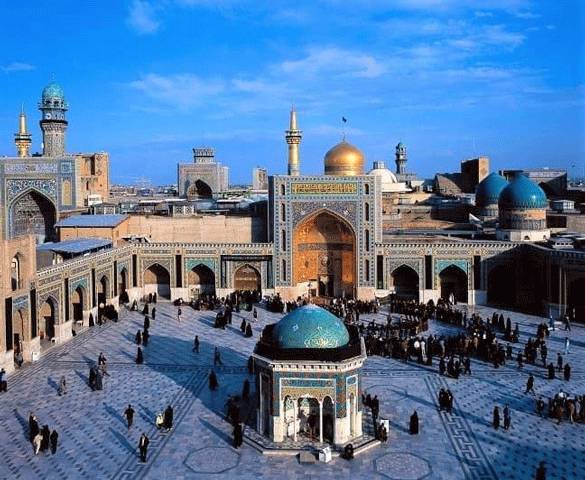
On Sunday, July 5th, a funeral ceremony will take place in the Shia holy city of Qom. On Monday, July 6th, ceremonies will be held in Najaf and Karbala, Iraq. The final funeral will be on Tuesday, July 7th, at the Imam Reza Shrine.
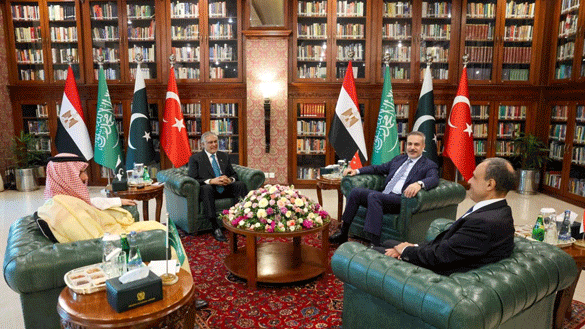
Representatives from over 100 countries took part, including Russia, China, India, Pakistan, Turkey, Saudi Arabia, Afghanistan, Bangladesh, and Iraq.
Millions gather in Tehran to mourn slain supreme leader Ali Khamenei
https://thecradle.co/articles-id/38601
Thousands of mourners gathered in Tehran for the funeral of Supreme Leader Ayatollah Ali Khamenei. The ceremony began with the Iranian national anthem, Quran recitations, and religious tributes at the Imam Khomeini Grand Mosallam. Khamenei’s coffin, draped in the Iranian flag, was placed beside relatives who died in the conflict. The procession will travel through Iran and Iraq before his burial in Mashhad.
Watch the latest updates from Tehran. #iran #khamenei #tehran #funeral #middleeast #irannews #worldnews #live
Ayatollah Sayyed Ali Khamenei’s influence reaches well beyond his positions since the 1979 revolution, leaving a lasting mark on West Asia’s geopolitical scene. His role has been key in steering global trends toward a multipolar world and a more diverse currency system.
Ayatollah Khamenei started from modest roots and became an active young revolutionary, enduring multiple imprisonments and exiles for opposing the Western-backed Pahlavi monarchy. The principles he formed early on deeply influenced his leadership. The eight-year war in the 1980s against Saddam Hussein left a lasting mark on his perspective. As Iran’s president during that time, he often visited the frontlines in Khorramshahr and Khuzestan.
Living among soldiers and everyday people during the war sparked a lifelong commitment to social justice. Ayatollah Khamenei shaped a vision that combined domestic leadership, resistance to foreign interference, and the protection of cultural identity. Seeing Western powers arm Iraq while holding Iran to double standards left him deeply cautious of outside involvement. This outlook drove long-term strategies that reshaped the regional power balance through alliances across the Global South and by fostering the China-Iran-Russia partnership.
A deep, almost tangible silence has settled over Iran—the kind that signals a turning point in history, weighted with grief, remembrance, and expectation. From the bustling streets of Tehran to the sacred shrines of Mashhad and Qom, from Tabriz’s lively bazaars to Isfahan’s storied boulevards and Shiraz’s blooming gardens, the country readies itself to say goodbye to a man seen by millions not just as a political figure, but as the guiding spirit of a generation.
In the coming days, Iran will host one of the largest funeral ceremonies in its modern history, a period of national mourning expected to draw millions and delegations from over a hundred countries worldwide, excluding the US, Canada, Zionist entities, and Europe. Streets have turned into avenues of remembrance, with black banners waving from bridges and government buildings, portraits watching over city squares, and mosques, seminaries, universities, and public institutions serving as hubs for prayer, reflection, and preparation.
Centuries ago, the Persian poet Saadi wrote, “The children of Adam are limbs of one another.” Today, that enduring message seems alive across Iran, as people from all walks of life come together in a shared expression of grief.
For many Iranians, the upcoming funeral feels like more than just the end of an era; it marks the final chapter of four decades of leadership that deeply influenced the nation’s politics, strategy, and religious life. Across cities and villages, talk has shifted from daily routines to shared memories, with families planning trips to Tehran and other host cities to be part of what many see as a historic moment for the country.
…
Mohammed Khaku of Allentown, PA, USA. Born in Mombasa, Kenya, and currently residing in the United States.
URL: https://newageislam.com/islam-politics/state-funeral-ali-khamenei-2026/d/140678
New Age Islam, Islam Online, Islamic Website, African Muslim News, Arab World News, South Asia News, Indian Muslim News, World Muslim News, Women in Islam, Islamic Feminism, Arab Women, Women In Arab, Islamophobia in America, Muslim Women in West, Islam Women and Feminism