
The Massacre of Bosnian Muslims Is Still Denied by Serbs

The
Economist
Jul 11th
2020
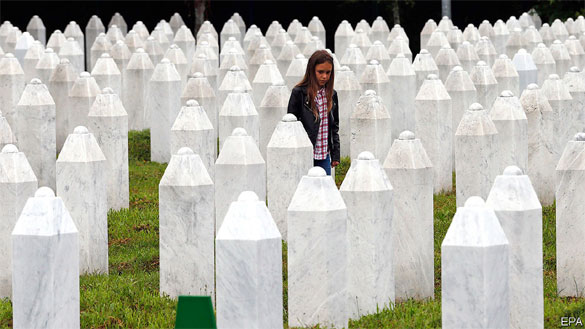 They will
pour 8,372 commemorative cups of coffee in Srebrenica on July 11th. A quarter
of a century after the fall of the Bosniak (Bosnian Muslim) enclave at the end
of the Bosnian war, when that number of men and boys are reckoned to have been
massacred by Bosnian Serb soldiers, this year’s ceremony will feature videos
sent by princes, presidents and leaders from all over the world. But one
prominent local figure will be conspicuously absent: Srebrenica’s own mayor.
They will
pour 8,372 commemorative cups of coffee in Srebrenica on July 11th. A quarter
of a century after the fall of the Bosniak (Bosnian Muslim) enclave at the end
of the Bosnian war, when that number of men and boys are reckoned to have been
massacred by Bosnian Serb soldiers, this year’s ceremony will feature videos
sent by princes, presidents and leaders from all over the world. But one
prominent local figure will be conspicuously absent: Srebrenica’s own mayor.
Like most
Bosnian Serbs, MladenGrujicic will ignore the event. He denies that an act of
genocide took place. Other theories widely believed by Serbs and promoted by
their politicians and media are that the scale of the crime has been wildly
exaggerated, or that the cemetery, where more than 6,600 of the victims are
buried, contains the remains of those who had no connection to Srebrenica,
which was besieged for three years before it fell to the Serbs in 1995.
Ever since
the months after the massacre, when the Bosnian Serb leadership arranged the
exhumation of the mass graves in an attempt to hide the corpses in dozens of
smaller ones, “Srebrenica denial” has been one of the ugliest legacies of the
war. Like Holocaust denial or Turkey’s denial that its troops committed a
genocide of Armenians in 1915, it is damaging to the reputation of Serbs.
The un’s
Yugoslav war-crimes tribunal in The Hague convicted the leading perpetrators of
the Srebrenica crime and concluded that it was the single act of genocide
committed in the Balkan wars that followed the break-up of Yugoslavia. Chuck
Sudetic, an American former war-crimes investigator, says it is incredible how
much information has been collected, perhaps in greater detail than for any war
crime ever committed. Every order has been recorded. We know what happened in
virtually “every minute” of those days, he says.
In 2004 the
Bosnian Serb president acknowledged what had happened—and apologised. But since
then, Serb leaders in Serbia and Bosnia have back-pedalled. Milorad Dodik, the
Bosnian Serbs’ representative in Bosnia’s current three-man presidency, says
the genocide was “a fabricated myth”. In Serbia government officials admit that
a crime took place, but fiercely deny it was an act of genocide.
Across the
former Yugoslavia, says MarijaRistic of the Balkan Investigative Reporting
Network, a regional group of ngos that promotes freedom of speech and human
rights, the bloody conflicts of the 1990s have given way to “memory wars”.
Serbs reject the label of genocide for Srebrenica because “everyone in the
Balkans wants to be seen as the ultimate victim”.
After the
second world war Germans gradually faced up to the horror of the Holocaust, but
a similar process is not yet happening in the Balkans. By the middle of the
1960s, says Eric Gordy, a sociologist, most of those Germans who would be most
shamed by an open discussion of the past were dead or retired. Yet in the
Balkans the same people are still in power or are competing for it.
A common
argument is that almost everyone involved in the war committed crimes. In
Bratunac, near Srebrenica, Bosnian Serbs commemorate their own dead. But most
of those were soldiers who died in combat, not civilians. Attempts to deny or
minimise the crime of Srebrenica fuels bitterness. Emir Suljagic, who runs
Srebrenica’s memorial centre, says that “a culture of denial…lays the
groundwork for future genocides.” He wants Bosniaks to remember “what our
destiny is going to be if we are ever as weak as we were in July 1995”. ■
Original
Headline: A genocide denied, 25 years on
Source: The Economist
URL: https://newageislam.com/islam-politics/the-massacre-bosnian-muslims-still/d/122331
New
Age Islam, Islam Online, Islamic Website, African
Muslim News, Arab
World News, South
Asia News, Indian
Muslim News, World
Muslim News, Women
in Islam, Islamic
Feminism, Arab
Women, Women
In Arab, Islamophobia
in America, Muslim
Women in West, Islam
Women and Feminism