
The Priority of Ritualism over Scientific Endeavors in Contemporary Islam

By T.O. Shanavas, New Age Islam
4 May 2023
Muslims believe that the Quran is a book of guidance not a
book of science. “This is the Book
about which there is no doubt, a guidance for those conscious of Allah”
(Qur’an 2:2). But epistemologically,
God’s knowledge of objective reality (cosmos, nature and society) is infinite
and perfect, while human knowledge is finite and deficient. Hermeneutically,
human meaning of God’s revelation to human is contingent, subjective, and
mutable.
The meaning of the divine messages depends on background
knowledge of the people who interpret it. So it is important to approach the
Qur’an with a cognitive understanding of reality that is deeply rooted in the
most advanced discourse on nature, cosmos, and human society. Unfortunately
contemporary Muslims blindly follow Ulama (Muslim scholars) who designate and
prioritize ritualism over critical enquiry and marginalize scientists and
philosophers. As a result of the enforced ritualism and marginalization of
scientists and philosophers the Muslim contributions to science halted after
1,400 AD.
As stated earlier, the Qur’an is a book of guidance for
humanity. The Qur’an guides Muslims to study nature and learn the divine
process of creation. “Say [Muhammad to your people]: ‘Travel through the
earth and see how Allah did originate creation; so will Allah produce a later
creation: for Allah has power over all things” (Quran: 29:20). If it is
humanly inconceivable to discover and explain God’s process of creation,
Alll-knowing God would not have decreed to research and learn “how Allah did
originate creation … will produce a later creation.” Moreover, the verse
affirms that all tools vitally needed to unveil the divine process of creation
is provided on the earth (“travel through the earth and see how …”). Although
Almighty God’s means to act is infinite, based on the above verse, whatever
method God applies to create is discoverable by humans. Let me show a couple of
examples on how Muslims lost the opportunity to leave footprints in the
advancement of science due to their focus only on ritualism and the neglect of
guidance (Quran 29:20) on the scientific exploration of the process of
creation.
God reveled, “(remember) when the angels said: O Mary!
Lo! Allah giveth thee glad tidings of a word from him, whose name is the
Messiah, Jesus, son of Mary, illustrious in the world and the Hereafter, and
one of those brought near (unto Allah)” (Qur’an 3:45). “She said, ‘My Lord, how
will I have a child when no man has touched me?’ [The angel] said, ‘Such is
Allah; He creates what He wills. When He decrees a matter, He only says to it,
'Be,' and it is” (Qur’an 3:47.
The above divine message is a guidance to humanity to
research and discover genomics. There are three different types of artificial
cloning: gene cloning, reproductive cloning and therapeutic cloning. Gene
cloning produces copies of genes or segments of DNA. Reproductive cloning
produces copies of whole animals. Therapeutic cloning produces embryonic stem
cells for experiments aimed at creating tissues to replace injured or diseased
tissues. Gene cloning, also known as DNA cloning, is a very different process
from reproductive and therapeutic cloning. Reproductive and therapeutic cloning
share many of the same techniques, but are done for different purposes. There
are no significant presence of Muslim scientific contribution.
There is yet another potential method of cloning, the
quantum mechanics based cloning. Such a method is yet to be discussed in
scientific literature. The Quantum
theory Neil Bohr gave birth to a new chemistry that explained how atoms are
bonded together to form molecules. When two atoms that are initially separated
are brought together in a chemical reaction, the electrons in their outermost
shell (electrons the farthest from the nucleus) share one orbit. Such a sharing
in a chemical reaction is called a covalent bond (Figure 1). In covalent
bonding, atoms share electrons to form all molecules, including ordinary
substances such as water, methane, and so forth. In some cases, covalent
bonding can lead to the formation of huge, extended macromolecules such as
polymers. One example of such a polymer is deoxyribonucleic acid (DNA), the
basic building block of life.
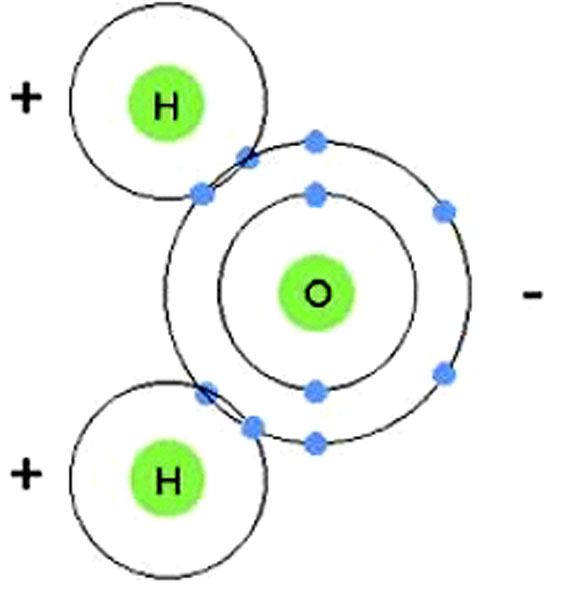
Figure 1.
Water Molecule with covalent bond
All components of the physical universe, including genes,
are made of atoms arranged in different fashions. Genes are made of DNA. DNA is
a collection of nucleotides. Phosphate, sugar, and four amino acids (thymine,
cytosine, adenine, guanine) are chemically connected with covalent chemical
bonds to form nucleotides.
The mutation means the change of the structure of a gene
caused by the alteration of single base units in DNA, or the deletion,
insertion, or rearrangement of larger sections of genes or chromosomes.
Mutations depend on changes in individual molecules due to the breaking or
making of specific atomic covalent bonds that involve quantum mechanical processes.
The physicist-theologian Robert J. Russell pointed out that “this is ultimately
a quantum process at the atomic level initiated by the breaking of a single
hydrogen bond.”1 In other words, God built life around the chemistry that
provides “the amplifying mechanism for quantum events.”2 The physicist William
Pollard remarked that if macro-level chemistry is the physical appearance of an
organism (phenotype), the quantum fluctuation is the driving force (genotype).
A mutation can create health problems such as cancer. A
genetic mutation can produce also a major effect on the outward physical
features of an organism. So, is it unrealistic to hypothesize that God
transformed one of Mary’s the XX chromosomes into a Y chromosome by quantum
mechanical process, and let this diploid cell to develop in Mary’s uterus and
result in miraculous birth of Jesus.
The second example where Muslims failed to leave footprints
is quantum entanglement. According to the Qur’an, the universe and its micro
and macro components—the animate and inanimate in human vocabulary—are alive
and have independent existence, self and subjectivity. Unfortunately we Muslims
and our scholars read the verses on the presence of self and subjectivity in
“inanimate objects” without paying no attention to the deeper meaning of these
messages. So, we have to fall back on our non-Muslim brothers and sisters to
understand it’s deeper meaning and its importance in our daily life soon.
Let me quote, one verse out of many, to show the presence of
the self and subjectivity in “in-animates” of human vocabulary. The verse pertaining to the beginning of
creation (The Big Bang) enlightens that the elementary particles are alive with
its own psyche and individuality: “Then
He directed Himself to the heaven and it is a vapor, so He said to it and to
the earth: Come both, willingly or unwillingly. They both said: We come
willingly.” (Qur’an 41:11). According to
the verse quoted, the “vapor” (a plenum of elementary particles such as quarks,
z particles, atoms etc., after the Big Bang) responded to divine command by
saying “We come willingly.”
Very recently the experimental science showed that atoms
communicate even when they were separated by 20 miles apart. Science Daily
summarizes the report: “You could see
this as a giant group chat in which atoms are continuously exchanging quantum
information. Researchers have now been able to intercept a chat between two
atoms.”3 In physics the communication
between atomic and subatomic particles
is called quantum entanglement. Even though the Qur’an pointed out the
communication capabilities in “in-animates” such as atom and subatomic
particles in the verse, Muslims totally overlooked and focused on rituals.
What is the importance of the Quantum Entanglement and its
use? Several applications can take advantage of this unique physical property
that will change our present and future.
Entanglement can enable quantum cryptography, super dense coding, may be
even faster than light speed communication. Because of its potential, multiple
industries, including finance and banking, hope to solve time and processing
power-consuming problems with quantum computers. Quantum entanglement is a phenomenon that can
potentially aid such computers, cutting down on time and computing power needed
to process information transfer between their qubits.
For example, a team of Japanese researchers at Hokkaido
University developed the world’s first entanglement-enhanced microscope.
Notes
1. Russell,
Robert J. “Special Providence and Genetic Mutation: A New Defense of Theistic
Evolution,” Evolutionary and Molecular Biology, p. 202.
2. Miller, Kenneth.
Finding Darwin’s God. New York: HarperCollins Publishers Inc., 1999 p.206
3..https://tildesites.bowdoin.edu/~naculich/3140scans/dice.pdf
-----
T.O.
Shanavas is a native of Kerala, but is now based in the USA. He is the author
of “Islamic Theory of Evolution The Missing Link Between Darwin and The Origin
of Species.” Co-author of the book, And God Said, "Let There Be
Evolution!": Reconciling The Book Of Genesis, The Qur'an, And The Theory
Of Evolution. Edited by Prof. Charles M. Wynn and Prof. Arthur W. Wiggins.
URL: https://newageislam.com/islam-science/ritualism-scientific-endeavors-contemporary/d/129699
New Age Islam, Islam Online, Islamic
Website, African
Muslim News, Arab World
News, South Asia
News, Indian Muslim
News, World Muslim
News, Women in
Islam, Islamic
Feminism, Arab Women, Women In Arab, Islamophobia
in America, Muslim Women
in West, Islam Women
and Feminism