
Time: The New Physics and The Qur’an
By T.O. Shanavas, New Age Islam
27 December 2023
Human Beings Since The
Beginning Of Civilization Have Pondered The Concept Of Time. The Unyielding
Irreversibility Of The Passage Of Time Is Borne In Human Beings By The
Certainty Of Death. Unlike Other Life Forms, We Know That Our Life Could End At
Any Moment, And Even If We Attain All Our Earthly Expectations, Our Success Is
Inevitably Followed By Eventual Decay And Death…
------
This enquiry focuses on the key role of time in reconciling
the scientific theories regarding the universe and life with religious beliefs
about divine creation. It suggests that a thorough exploration of the nature
and characteristics of time could provide insights into how the gradual process
of evolution of life and the narrative of divine creation might coexist or be understood in relation to
each other. Time can be a bridging concept between the scientific and religious
narratives of the time-lapsed origin and evolution of the universe and life.
Human beings since the beginning of civilization have
pondered the concept of time. The unyielding irreversibility of the passage of
time is borne in human beings by the certainty of death. Unlike other life forms,
we know that our life could end at any moment, and even if we attain all our
earthly expectations, our success is inevitably followed by eventual decay and
death. The notion of time in ancient civilizations was much different from that
of today. People did not perceive time as a linear continuum that stretches
into a continuous future. They pictured it as cyclical in nature and therefore
believed that historical events also followed a cyclical pattern. Greek
philosophers, including the Orphics, Pythagoreans, and Plato, held the view
that people are reborn in the flow of time. They taught that our perception of
one lifetime per human being is an illusion due to the loss of memory about
past lives upon rebirth. Greek philosophers, such as Pythagoras and Empedocles,
were said to be able to recollect their previous lives. Buddha also recollected
all his previous lives. Hindus believe that people repeat cycles of birth and
death until they break the succession through their vigorous ascetic
performance. On observing repetitive earthly phenomena such as rotation of day
and night or the four seasons, the ancients inferred that time and everything
else, including human birth and death, is also cyclic. Pre-Islamic Arab pagans
considered time a deity (ad-dahr) that exists from eternity to eternity and
dispenses good and ill fortune to humankind.
The monotheistic religions--Judaism, Christianity, and
Islam--led the way to the concept of linear time. The chronology in the Jewish
and Christian scriptures implies that the universe was created in 4,004 BC.1
The Muslim scripture does not reveal a specific time for its creation, even
though Westerners hold that the Muslims also believe in a young universe. For
example, Professor Stephen W. Hawking, one of the greatest minds of the
twentieth century--hailed as an “equal of Einstein” by Time magazine--states:
“According to a number of early cosmologies and the Jewish/Christian/Muslim
tradition, the universe started at a finite and not very distant time in the
past.”2 Hawking accurately reads the three monotheistic religions when he
declares that the universe was created at a finite time, but he errs in
assuming that the Muslim estimation of the age of the universe is the same as
that held by the Jewish and Christian traditions. Muslims believe that the
universe was created in a finite distant past, but they also believe that it
will be destroyed sometime in the future. The agreement among the three
monotheistic religions on the concept of resurrection, whereby humans live from
eternity to eternity, is based on a linear rather than a cyclical chronology.
The invention of the clock in the thirteenth century
reinforced the notion of linear time. Since then, time has been broken down
into units of hours, minutes, and seconds, and conceived of as something that
progresses from the past to the future. Measuring time affected the lives of
people of all faiths. For example, during the fourteenth century, workers in
the cities set up specific times for the beginning and the close of a workday.
Isaac Newton believed that he knew what time was. At the beginning of his
Principia Mathematica, he wrote: Absolute, true and mathematical time, of
itself, and from its nature, flows equably without relation to anything
external.”3This was the dominant belief among scientists until the twentieth
century. Today we know that Newton was mistaken on several grounds. Time is not
absolute or universal but relative. As physicist Paul Davies observes:
“Einstein demonstrated that time is in fact elastic and can be stretched and
strung by motion. Each observer carries around his own personal scale of time,
which does not agree with anybody else’s. Our individual perception of time
does not appear distorted to us, but for observers who move in different time
frames than ours, we seem to be out of step with their time.”4 The time between
two events at two different locations is greater for the earthbound observer,
but for space travellers moving at speed of the light would the events appear
as happened at same time. The Theory of Relativity states that one day for a
space traveller, depending on his velocity, can equal a few years or more for
an earthbound person. This startling prediction of relativity can be
illustrated by the following science fiction anecdote:
A twenty-year-old astronaut takes a trip to a faraway star
in a spacecraft that can fly close to the speed of light. His twin brother
remains on the earth. After fifty years on earth, the earthbound twin goes to
the spaceport to receive his astronaut brother. Both brothers are amazed and
startled. The earthbound brother is aged fifty years. He now has grey hair and
wrinkled skin. But the astronaut brother has aged only one year. The clock, the
calendar, and the biological aging process on the spacecraft slowed down to
one-fiftieth of its normal speed. The twins agree that the adventurous space traveller
is now forty-nine years younger than his earthbound twin is!5 Carl Sagan, an eminent astrophysicist,
comments on the twin paradox as such: “This is not an experience of our
everyday life, but it is an experience of nuclear particles, which have clocks
built into them (their decay time) when they travel close to the speed of
light. Time dilation is a measured and authenticated reality of the universe in
which we live.”6
The US Naval Observatory in Washington D.C. is responsible
for maintaining our time standard. In 1972, a physicist evaluated the concept
of time dilation by carrying along four cesium-beam atomic clocks during his
round-the-world trip on a scheduled airline. These clocks could be trusted to a
few billionths of a second over the time span of such a voyage. When compared
with matching ones that remained in the observatory, the clocks lost time. The
lost time agreed exactly with Einstein’s predictions.7 Until few years ago,
scientists thought that protons and electrons were indivisible 'elementary
particles,' but when the particles collided at high speeds, scientists
discovered that they were made up of yet smaller units. In particle-physics
laboratories, the time interval for short-living particles like muons to decay
into electrons and neutrinos can be recorded. Experiments have shown that the
faster muons take longer to die than the slow-moving ones. This is precisely
what the special theory of relativity states. Based on such experiments, the
twin paradox will not be a paradox at all when we are able to travel close to
the speed of light. However, the theory of relativity also suggests that
nothing can travel faster than light.
According to the general theory of relativity, in a field of
extremely high gravity, time will grind to a halt. Such high gravity exists in
black holes and their peripheries. A black hole is formed when a dying star
implodes or shrinks into itself under the relentless and unforgiving influence
of gravity, becoming smaller and smaller until the entire star is crushed out
of existence at a single point. Physicists refer to this point of extinction as
a Singularity. At this singularity, the density of matter becomes infinite, and
space-time is reduced to a mathematical point. During the shrinking process,
the gravity around the imploding star becomes so strong that even the rays of
light cannot escape. As a result, the star disappears from our vision as it
vanishes from the universe, leaving behind what is called a black hole. The
periphery of the black hole is called the event horizon. We have no way of
knowing what occurs inside the event horizon.8 Theoretically, time would be
frozen for a person in an extremely high gravitational field such as the event
horizon, while events continue to unfold in time for the observer on the earth.
The gravitational freezing of time could have interesting
effects. Suppose, for example, that an astronaut started to sing the US
national anthem while entering the event horizon of a black hole. According to
the general theory of relativity, observers on Earth (and anywhere outside the
event horizon) would perceive the astronaut as singing the first note of 'The
Star-Spangled Banner' indefinitely, even after billions of years have passed.
However, this prediction is flawed because time dilation would slow the sound
vibrations to such an extent that observers outside the event horizon would no
longer be able to hear the note.9 While time appears frozen for the astronaut,
events would continue on Earth and elsewhere. The astronaut would be unable to
leave the event horizon, as from his perspective, history outside has already
advanced beyond his own space and time. He would be, in a sense, coming out
before he went in. Similarly, according to the theory, two spatially separated
events may be perceived differently by observers traveling at different speeds.
One observer may claim Event A happened before Event B, another might assert
Event B occurred first, while a third could argue that Events A and B happened
simultaneously." The astronaut near a black hole’s Event Horizon
elaborates on the theoretical implications of time dilation. It explains how
these extraordinary gravitational effects would impact the perception of
events, both for an astronaut near the event horizon and observers far from it.
The passage also touches on the relative nature of event sequencing in
different frames of reference, a fundamental aspect of relativity theory.
The Qur’an and Time
When the Qur’an was revealed fourteen hundred years ago,
people did not measure time as we do today. They did not wear watches that
divided the day into time units, because clocks had not yet been invented.
Their lives were not regulated by hours and minutes in abstract time but by the
natural rhythms of nature, such as the changes in the seasons and the position
of the sun. A day was the shortest span of time that had meaning and importance
in the lives of the early Muslims, although the length of a day varied. Work
began at sunrise and ended at sunset. Before the invention of the modern clock,
water clocks, sundials, and other devices divided the day into five variable
periods to mark the time for mandatory prayers.
The study of the Qur’an guides us to understand the concept
of time among early Muslims. Muslims believe that God is timeless. For example,
Muhammad Asad, a contemporary Muslim scholar, states: 'What men conceive as
time has no meaning with respect to God because He is timeless, without
beginning and without end, so that “in relation to Him a day and a thousand
years are alike.”10 This Muslim belief is based upon the verses: “This is
God, your Lord; there is no god but He, the creator of all things. So, pay
homage to Him for He takes care of everything.” (Qur’an 6:102) “He
begets not, nor has He been begotten.” (Qur’an 112:3) “Originator of the
heavens and the earth...”(Qur’an 2:117)
Time as a separately identifiable entity within the
framework of the universe came into existence with the beginning of the
universe. If God is the only entity that has no beginning, God exists without a
clock that divides time into past, present, and future. Muslims posit that God
sees, hears, and knows all things in a perpetual Now or timeless state . This
conclusion is supported by the Qur’anic verse: “Verily a Day in the sight of
thy Lord is like a thousand years of your Reckoning.” (Qur’an 22: 47)
Therefore, the Qur’anic description of time and the Muslim concept of time are
that time is relative."
The human understanding of time in the Hereafter Universe
(Al-Akhirah) also suggests a relative nature of time. The Qur’anic verses
depict a paradox of the twin like the twin astronaut scenario described
earlier. The person resurrected in Al-Akhirah feels that their earthly life and
the time between death and resurrection have condensed into a moment. The
Qur’an illustrates this concept with verses such as:
- “The day these people see
seems to them as though they had stayed (in the world or in the state of death)
only for an afternoon of a day or its forenoon.” (Qur’an 79:46)
- “On the Day when He shall
gather them, it will seem to them as if they had not tarried longer than an
hour of a day, knowing one another...” (Qur’an 10:45)
- “On a Day when He will call
you, and you will answer by praising Him, thinking all the while that you
tarried but a little while.” (Qur’an 17:52)
Upon resurrection, humans will perceive their lives on Earth
as lasting only a day or part of a day, indicating a dissolution of the earthly
concept of time. This is expressed in the verse:
- “Then Allah will inquire
from them, ‘for how many years did you live on earth?’ They will say, ‘We
stayed there for a day or part of the day; but ask those who count time.’”
(Qur’an 23:112-113)
Like the astronaut twin, resurrected beings will feel that
earthly time has shrunk to a moment known only to God. They will feel to exist
in a state beyond conventional time-space relationship, challenging the very
notion of expressing time in Hereafter Universe (Al-Akhirah). Thus, the
Qur’anic portrayal of time presents the idea that time, as understood in the
afterlife, transcends conventional measurements, aligning with the notion that
time is relative and subjective, where each observer experiences time
differently.
Why Did God Create Time Relative?
Why did God create time with the material universe? Why did
He make time relative? In the construction of a rational universe for
humankind, God knew the logical problems worldly existence would cause for His
intelligent creature, the human being. The major logical problem is the
appearance of a contradiction between attributes such as God’s Omnipotence and
Omniscience, and His Will to create humans with the faculty to discriminate and
choose either goodness or evil. For example, if God chooses to alter the future
course of an event, do not His omniscience and omnipotence stand in the way of
human free will? Omniscience is a tribute of God according to the Qur’an. For
example, chapter 2:255 states:
“God, there is no God but He,
the Living, the Eternal Sustainer. Neither slumber takes Him, nor sleep. His is
what is in the heavens and what is on the earth. He knows what lies before them
and what is behind them. And they grasp naughty His knowledge, but of what He
wills. His Throne embraces the heavens and the earth, and it tires Him not to
uphold them both. He is the Sublime, the Grand.”
The verses like this and many more suggest that God always
knows all things. Hence, atheists and logicians may argue that God’s knowledge,
being absolute, cannot go wrong. He knew what Timothy McVeigh was going to bomb
Oklahoma City on April 19, 1995, even before he was created. In short, they
posit that God “programmed” Timothy McVeigh to kill innocent Americans in
Oklahoma City. They argue that McVeigh and other evildoers cannot be considered
guilty of any sin because they are only pre-programmed machines. Because
All-knowing God anticipated these logical problems for humans, He created time
as a factor in our universe. He made time relative for all earthly creatures,
including humankind; but all events in all time-frames, from the beginning of
Creation to the end of the current universe are current events as far as God is
concerned.
Jewish physicist-theologian Gerald L. Schroeder clarifies
the above scenario using the true story of a star that exploded, producing a
sudden burst of light 170,000 light years from the earth. Astronomers call such
a sudden burst of light from an exploding star a supernova. The world came to
know about the supernova when a Chilean astronomical laboratory recorded the
arrival of the light on earth after 170,000 light years of travel. Between the
time of the supernova and the arrival of light from it, a multitude of events
occurred. Neanderthals came and went; we, modern Homo Sapiens, took control of
the earth; Indus valley, Maya, Greek, Roman, and other civilizations peaked and
vanished; the Qur’an was revealed; Muslims developed the scientific method and
trained European scientists, ending the Dark Ages and engendering the Renaissance;
the Muslim empire crumbled; and the United States of America took the
leadership of the world--all before the arrival of the light from the supernova
on earth. Schroeder describes an imaginary consciousness without mass that
travels with the light from the supernova. Let us assume also that our super
consciousness carries an internal clock with no mass as its companion. How long
of a time would this super consciousness have experienced? How many ticks would
the super-consciousness’s clock have made? Schroeder answers: “No time would
have passed. Not a few years, not a few hours, or a few seconds. Zero time.”11
In this scenario there is no lapse of time for the super-consciousness, in
spite of 170,000 years of recorded history.
An analogous situation of Perpetual Now or Present exists in
an environment with extremely high gravity, as in the case of a black hole. The
170,000 years of the earth, its epics, individual events, Timothy McVeigh and
his atrocious bombing of the Alfred P. Murrah Federal Building as well as your
and my life histories are experienced simultaneously by the
super-consciousness. The super-consciousness would reject our claim that there
is a history as well as a past and future series of events on earth. He would
say that he sees everything that the primitive twenty-first-century human
described as the past and the future. All happened in no time in his frame of
reference. There is no post- or pre-knowledge for the super-consciousness, only
omniscience, because all knowledge occurred at the same time. Physicist Gerald
L. Schroeder freely admits, “I don’t pretend to understand how tomorrow and
next year can exist simultaneously with today and yesterday. But at the speed
of the light, they actually rigorously do. Time does not pass.”12
If gravity, speed, black holes, and other material factors
can affect and freeze time, is it conceivable for human beings to perceive the
timeless world of God, who created the universe and time from nothing with His
Enormous Infinite Power? A reasonable person would not deny the absence of time
in the presence of God, the source of all forces of the material world.
Accordingly, Islamic theology describes a perpetual Now that pervades in the
spiritual domain of God, a state of being/consciousness that is more accurate
than the “now” of our super-consciousness. Allah experiences all events of the
material world in a perpetual Now without the linear flow of time that pervades
the material world. God eternally knows all events as well as all their
potential directions, deviations, and modifications occurring in the time-frame
of the material world. Until we fully understand physics’ mathematical mystery
of a concurrent yesterday, today, tomorrow, and next year, existing together at
the speed of light as described by Schroeder, the coexistence of human free
will and omniscience of God will remain incomprehensible because humankind has
no experience of timeless existence.
According to the theory of relativity, nothing can travel
faster than light; the theory negates any physical communication at a speed
faster than light. This limitation in communication between two points is
irrelevant from the Qur’anic point of view. The Qur’an states: “To God belong
the East and the West. Wherever you turn the glory [face] of God is everywhere:
All-pervading is He and all-knowing” (Qur’an 2:115). 40 God, being
“All-pervading,” is present at all points and at all events. He is present in
every frame of reference, whether on the earth, in the light from a supernova,
in black holes, or in the time-frame of the astronaut of the twin paradox. God
extends His presence even to our subconscious mind, as made clear in the verse
“Whether you loudly avow the utterance (or not), surely, He knows the secret
and what is concealed behind that. (Qur’an 20:7)41 God’s pervading presence in
all frames of reference implies instant communication at any point we can
imagine. When God comes through a particular frame of reference--for example,
the earth--human beings experiences that He is communicating in our local time.
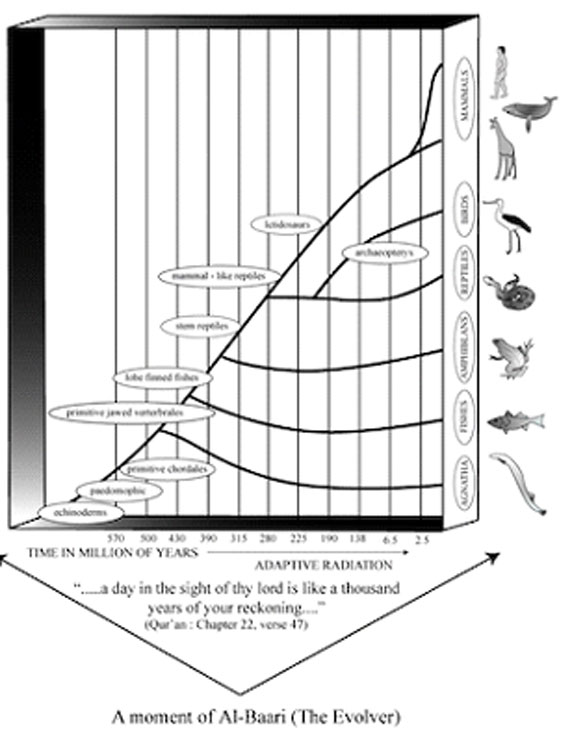
Based on the physical characteristics of time, the harmony
of the Quranic narrative of creation with the theory of evolution can be
depicted in this figure. It highlights the integration of the perspective of an
earth-bound scientist who perceives the creation of the entire body of life as
a process spanning billions of years with the creation. A decree from the
timeless reign is appears as events happened over billions of years for a
bound.
A diagram of a graph/Description automatically
generated
----
Notes
1. Morris,
Richard. Time’s Arrows. New Yorks: Simon and Schuster, Inc. 1986. Page 66-67
2. Hawking,
Stephen W. A Brief History of Time. New York: Bantam Books. 1988. Page. 7.
3, Morris,
Richard. Time’s Arrows, p. 27., In.
4. Davies, Paul.
God and the New Physics, Simon and Schusterp. 1990. Page 120.
5. March, Robert
H. Physics for Poets, Chicago:
Contemporary Books, 1978. Page. 124.
6. Sagan, Carl.
Cosmic Connections, p. 246.
7. March, Robert
H. Physics for Poets, p. 125.
8. Morris,
Richard. Time’s Arrows, p. 66-67.
9. Ibid. 180-181
10. Asad, Muhammad. The Message of the Qur’an.
Gibralter; Dar Al Andalus. 1980. Page .
513.
11. Schroeder, Gerald L. The Science of God:: the
Convergence of Scientific Biblical Wisdom. New York: Free Press. Page. 164.
12. bid. p. 164
----
T.O.
Shanavas is a native of Kerala, but is now based in the USA. He is the author
of “Islamic Theory of Evolution The Missing Link Between Darwin and The Origin
of Species.” Co-author of the book, And God Said, "Let There Be Evolution!":
Reconciling The Book Of Genesis, The Qur'an, And The Theory Of Evolution.
Edited by Prof. Charles M. Wynn and Prof. Arthur W. Wiggins.
URl: https://newageislam.com/islam-science/time-physics-quran/d/131394
New Age Islam, Islam Online, Islamic
Website, African Muslim News, Arab World News, South Asia News, Indian Muslim News, World Muslim News, Women in Islam, Islamic Feminism, Arab Women, Women In Arab, Islamophobia in America, Muslim Women in West, Islam Women and Feminism