
Hazara Community in Quetta is Asking Imran Khan– Where is the State?

By
Khurram Husain
07 Jan 2021
AS of
writing this, my city, the largest in the country, is seeing protest camps
spring up in multiple locations (at least 11 as of last count) in solidarity
with the mourners from the Hazara community in Quetta who have refused to bury
their dead from a ghastly terrorist attack last Sunday.
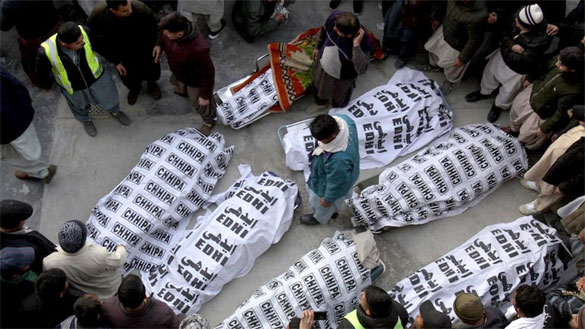
People gather around the bodies of the coal mine workers killed near
Machh coal field on Sunday (Photo Credits: AP)
-------
The last
time this happened was in February 2013, when a mass casualty terrorist attack
left around 90 people dead as a bomb was smuggled into Hazara Town in a water
tanker and detonated. A month earlier, a suicide bombing at a snooker club
killed around 96 people (according to a tally compiled by Human Rights Watch)
and left around 156 injured.
Those twin
bombings were the pinnacle of a rising arc of sectarian attacks across
Balochistan. In 2012, for example, HRW documented 450 sectarian murders, and
another 400 in 2013. Since 2008, HRW counted around 500 Hazaras had been killed
till 2014.
The
protests that broke out after the February bombing in Hazara Town spread like
wildfire across Pakistan. “Anger and outrage replaced shock and grief as tens
of thousands of people took to the streets across the country on Monday to
protest over the mass killing of Shia Hazaras in the suicide attack in Quetta
three days ago,” went a report in this newspaper on Feb 18, 2013. “From Karachi
to Parachinar, and Hyderabad to Multan, Rawalpindi and Islamabad, people staged
sit-ins, blocking main thoroughfares.”
That
evening, when those protests spread, Imran Khan tweeted, “I wish I could
physically be at all the countrywide protests against the killings in Quetta.
PTI is present everywhere as am I in spirit.”
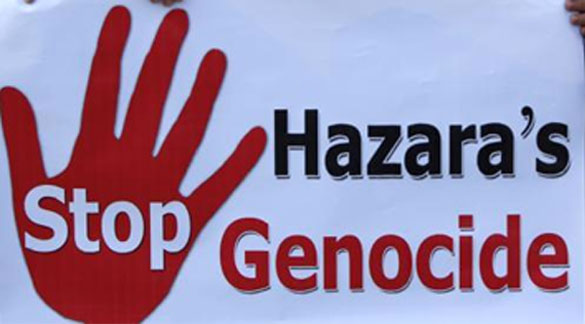
After the
first mass casualty attack in January, then prime minister Raja Pervez Ashraf
visited the mourners within days, sat in a mosque not far from the site of the
attack, and listened quietly as the leaders of the Hazara community spoke about
their plight and fears against the rising arc of violence directed against
them.
Among the
demands of the protestors was the sacking of the provincial chief minister,
Aslam Raisani, who had issued the most insensitive and outright vile statements
in response to an earlier attack in Mastung in which a bus was stopped, the
Hazara members among the travellers were filtered out, and shot dead on the
roadside. “I will send them a truckload of tissue paper,” Raisani had said,
adding that among the millions of people who live in Balochistan, “40 dead
Hazaras are not a big deal”.
“When you
will awake in the morning,” Ashraf said in a statement after his meeting,
“Governor rule would have been imposed in Balochistan province.” Raisani was
sacked the same day, and squealed out a few protests over the phone from
England, where he was at the time, complaining about why other chief ministers
were not dismissed when terror attacks occurred in their provinces.
Raisani was
possibly the most crass and insensitive leader on Pakistan’s political
landscape at the time. By contrast, Imran Khan offered his condolences, and
specifically mentioned the Lashkar-e-Jhangvi as the culprits, demanding strict
action against the group. “Terrible tragedy in Quetta,” he tweeted on the night
of Jan 10, 2013, when the first mass casualty attack happened. “Over 50 dead
including a courageous cameraman. Complete failure of govt. Deep sympathies
with the bereaved.”
Three days
later, he went to Quetta to join the protesters. “Went to Quetta today to
express my profound grief and sympathy with the Hazara community and take part
in their dharna,” he tweeted that afternoon.
During his
visit, he had an opportunity to speak to the cameras, and in his characteristic
style, he did not hold back to use the opportunity to also attack the
government. “Asif Zardari is responsible for this,” he said. “Asif Zardari is
the president of this country, he has made a corrupt man, who is involved in the
rental power scam, the prime minister… How many times has he come to
Balochistan? Why doesn’t he come at this time and look at the people who are
sitting with the dead bodies… All the parties are in power in Balochistan, the
N League has two ministers, the People’s Party has its ministers, the Q League
has theirs, what are they doing? All these parties are responsible… .”
Then a
reporter asked him whether he has a plan to end the terrorism and he said, “We
will end terrorism, you will see, I have said it before, it can be ended in 90
days… .” Then he goes on about how you need an independent police force, punish
the culprits, “Who is behind this terrorism? Who stands behind them? Who is
behind the terrorists in Karachi?”
A reporter
interrupts him and asks, “Who is behind Aurangzeb Farooqui, sir?” He does a
double take, asks “Who?” and the reporter repeats “Aurangzeb Farooqui, sir”. He
shakes his head, “I have no knowledge of any of that.”
Please
recall that in June 2020 an accountability court acquitted Ashraf and all other
accused in that rental power cases. NAB filed an appeal, but in November their
prosecutor removed himself from the case. Nothing further has happened.
A few years
later, when another terror attack targeted the lawyers’ community of Quetta and
Justice Qazi Faez Isa issued the report from his inquiry into that incident,
Khan tweeted the following: “The Justice Isa Report on 8 Aug Quetta carnage is
an unequivocal indictment of the govt’s failure to enforce ATA & NAP
[against] militant groups”.
We all know
what happened to Justice Isa once Khan came to power and his government tried
to unseat the judge via a presidential reference. The night of the snooker club
bombing in 2013, Khan had asked, “Where is the state?” in a tweet. Today the
Hazaras are asking the same question, as they endure yet another cold and
bitter Quetta night surrounded with the bodies of their loved ones killed
mercilessly by terrorists.
-----
Khurram
Husain is a member of staff.
Original
Headline: Quetta calling
Source: The Dawn, Pakistan
URL: https://newageislam.com/islam-sectarianism/hazara-community-quetta-asking-imran/d/124005
New Age Islam, Islam Online, Islamic Website, African Muslim News, Arab World News, South Asia News, Indian Muslim News, World Muslim News, Women in Islam, Islamic Feminism, Arab Women, Women In Arab, Islamophobia in America, Muslim Women in West, Islam Women and Feminism