
Baghdad's Junaidi Silsila: A Path of Balanced and Sober Sufism

By Sahil Razvi, New Age Islam
08 March 2026.
Junaidi Silsila is a foundational Sufi tradition rooted in balance, Shariah, and inner spirituality. Originating in Baghdad, it spread to South Asia and shaped many Sufi orders. Its teachings emphasize sincerity, humility, and serving humanity while maintaining deep spiritual awareness.
Main points:
· Founded on the teachings of Hazrat Junaid al-Baghdadi, emphasizing Shariah and spiritual balance.
· Known as the “sober” school, combining inner spirituality with outward religious duties.
· Spread to South Asia through Hazrat Ali al-Hujwiri and flourished in the Deccan.
· Focuses on Tawhid, Fana-Baqa, sincerity, humility, and service to humanity.
· Influenced major Sufi traditions and remains active through khanqahs and spiritual lineages.
“Sufism is not achieved by much praying and fasting, but it is the security of the heart and the generosity of the soul.”
Junaidi Silsila, also known as the Junaidiyya or Junedi order, stands as one of the foundational lineages in Sufism. It traces its spiritual chain directly to the teachings and life of the celebrated 9th–10th century mystic, Hazrat Abu’l-Qasim al-Junaid al-Baghdadi (c. 830–910 CE). Popularly called the “sober” (sahw) school of Sufism, in contrast to the more ecstatic traditions, the Junaidi path lays strong emphasis on strict adherence to the Shariah (Islamic law), intellectual discipline, humility, and a harmonious blending of inner spiritual experience with outward religious duties. Though not always organised as a separate tariqa like the Qadiri or Chishti orders, it has deeply influenced numerous later Sufi silsilas and found a vibrant expression in the Indian subcontinent, especially in the Deccan region.
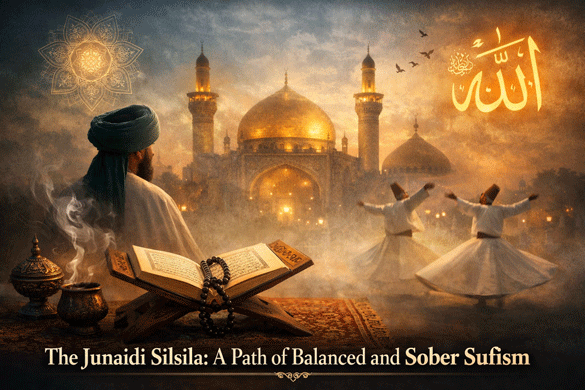
Junaidi Silsila took shape in Baghdad, the intellectual and spiritual centre of the early Abbasid Caliphate, during the classical age of Islamic mysticism. Hazrat Junaid al-Baghdadi, a Persian-born scholar and mystic brought up under the care of his uncle Sari al-Saqati, rose as a central figure in the Baghdad school of Sufism. Orphaned at a young age, he mastered fiqh (jurisprudence) under Shafi’i scholars even as he pursued rigorous asceticism, dhikr (remembrance of God), and muraqaba (contemplation). After years of intense spiritual training, he began guiding disciples openly and earned titles such as “Sultan of the Gnostics” and “Sayyid al-Ta’ifa” (Master of the Sufi Order) for his balanced yet firmly orthodox approach.
When someone asked the spiritual guide of Hazrat Junaid (may Allah be pleased with him), “Can a disciple excel his teacher in spirituality?” the teacher of Junaid replied, “My disciple Junaid has risen higher than me in spirituality.”
Junaid’s tradition is often set against the “intoxicated” (sukr) Khurasani school represented by Hazrat Bayazid al-Bistami. While the latter stressed ecstatic union and self-annihilation without return, the Junaidi way advocated “sobriety, a conscious return to ordinary life after fana (annihilation of the ego) so as to serve society while staying firmly rooted in the Shariah. This “Mesopotamian” or Iraqi lineage became the common spiritual ancestor for many tariqas, including the Suhrawardiyya, Rifa’iyya, and important strands of the Qadiriyya. Some scholars even regard the Qadiri order as a later popular form of the Junaidi Silsila, with Hazrat Abdul Qadir Jilani as its most prominent representative.

The silsila spread eastward through saints like Hazrat Ali al-Hujwiri (Data Ganj Bakhsh), author of Kashf al-Mahjub, who carried Junaidi principles to the Indian subcontinent. By the 14th century, during the Tughlaq and Bahmani periods, Junaidi Sufis moved south to Daulatabad and the Deccan. A key figure was Hazrat Syed Alauddin Hussaini Javeri (pre-Bahmani era), a khalifa linked to Delhi-based saints. His disciples, Hazrat Shaykh Ruknuddin Tola, Hazrat Shaykh Ainuddin Ganj-ul-Ilm, and Khwaja Shamsuddin Uraizi, established khanqahs in Gulbarga, Bijapur, and Bidar. The silsila’s most iconic Deccani exponent was Hazrat Shaykh Sirajuddin Mohammad Junaidi (1271–1380 CE), a direct spiritual descendant of Junaid. He mentored Bahmani rulers, promoted universal compassion, and his dargah in Gulbarga continues to be a living centre of the tradition. His successors, including Tajuddin Junaidi, kept the order alive across the region.
At its heart, the Junaidi Silsila regards Sufism as inseparable from orthodox Islam. Junaid himself declared: “Our knowledge of Tasawwuf is defined by the Book and the Sunnah. Whoever does not memorise the Quran, nor write down the prophetic teachings, nor study their understanding, he is not to be followed in it.” The path firmly rejects isolation or any deviation from religious law, insisting that full observance of the Shariah is the very foundation of ihsan (spiritual excellence).
Tawhid (Divine Oneness) is understood not only in a theological sense but also realised experientially through four progressive stages, moving from ordinary affirmation to the profound ma’rifa (gnosis) of the elect. Along this spiritual journey, the concepts of Fana (Annihilation) and Baqa (Subsistence) play a central role, where the seeker dissolves the ego (nafs) in God and then returns renewed, serving creation with balance and sobriety. This path is deeply connected to the idea of Mithaq (Primordial Covenant), rooted in Quran 7:172 (“Am I not your Lord?”), which recalls the soul’s pre-eternal pledge to the Divine. Furthermore, the teachings emphasise Ikhlas (Sincerity), humility, and service, encouraging the avoidance of show, the cultivation of compassion, and a harmonious balance between inner purification and outward ethical conduct.
Later manuals, such as the 13th-century treatise on dhikr by the Maliki jurist Hazrat Ibn Ata Allah al-Iskandari, list eight guiding principles of the Junaidi way. These include ritual purity (wudu), fasting, silence, seclusion, constant dhikr (especially “La ilaha illa Allah”), heart-connection to the shaykh, and rejection of impure thoughts. In the Deccan branch, saints like Sirajuddin Junaidi further highlighted ikhlas, tawazu (humility), and rahmah (universal compassion).
Notable Sufis Associated with the Branch
Hazrat Junaid al-Baghdadi, the eponymous master and “Sheikh of the Way,” stands at the center of this spiritual lineage, with disciples such as Hazrat Abu Bakr al-Shibli carrying forward his teachings. His uncle and first guide, Hazrat Sari al-Saqati, played a crucial role in shaping his early path. The silsila was later transmitted to South Asia by Hazrat Ali al-Hujwiri, a key figure in spreading Sufi thought. In the Indian context, Hazrat Syed Alauddin Hussaini Javeri emerged as a vital link between North and South Indian Sufism, particularly in the Deccan. This tradition was further strengthened by Hazrat Shaykh Sirajuddin Mohammad Junaidi, founder of the prominent Gulbarga line and spiritual advisor to the Bahmani rulers. His successors, including Hazrat Tajuddin Junaidi and Hazrat Ruknuddin Tola, expanded the network across regions such as Bijapur, Solapur, and Bidar.
Many Junaidi saints were also accomplished jurists (faqih), scholars (‘alim), and qazis, seamlessly uniting mysticism with public service.
Hazrat Junaid left behind no large collection of poetry, but his letters (Rasail al-Junaid) and aphorisms, preserved in hagiographies, serve as the tradition’s profound “verses.” Some of the most quoted are:
“Sufism means that Allah causes you to die to yourself and gives you life in Him.” “The Sufi is like the earth: both the righteous and the sinners walk upon it. He is like the clouds: they give shade to all things. He is like the raindrop: it gives life to everything.” “A Sufi is like the earth; even if impurities are thrown on it, it will flourish with lush greenery.”
In the Deccani branch, teachings were mostly passed on through oral discourses on sincerity and selfless service rather than formal poetry, yet the tradition fully shares the wider Sufi language of love and remembrance.
The Junaidi Silsila remains a shining model of balanced, Shariah-grounded mysticism, from the scholarly circles of Baghdad to the living dargahs of Gulbarga. It gently reminds every seeker that true spiritual ascent calls not only for ecstasy but for sobriety, not only for annihilation but for responsible subsistence in the service of God and humanity. Its legacy lives on through khanqahs, urs celebrations, and the quiet devotion of followers who still trace their chain back to the “Sultan of the Gnostics.”
…
A regular contributor to New Age Islam, Sahil Razvi is a research scholar specialising in Sufism and Islamic History. He is an alumnus of Jamia Millia Islamia.
New Age Islam, Islam Online, Islamic Website, African Muslim News, Arab World News, South Asia News, Indian Muslim News, World Muslim News, Women in Islam, Islamic Feminism, Arab Women, Women In Arab, Islamophobia in America, Muslim Women in West, Islam Women and Feminism