
Hazrat Iftikhar Ali Shah Chishti - A Guidance and Legacy That Still endures the People of Hyderabad

By Adnan Faizi, New Age Islam
07 July 2026
Hazrat Iftikhar Ali Shah Chishti Watan was born on 9 Ramadan 1249 AH in Golconda and became a renowned Chishti-Qadri-Naqshbandi Sufi, scholar and author. He spent 77 years in worship, teaching and writing before passing away on the same day, month and time as his birth, leaving behind thousands of disciples and a lasting spiritual legacy in Hyderabad, India.
Main points:
· Born in Golconda in 1249 AH, Hazrat excelled in learning despite losing his father early.
· He received Chishti, Qadri and Naqshbandi training and devoted himself to Allah.
· He passed away in 1326 AH, exactly matching his birth's day, date and time.
· His elder son succeeded him, while Chishti Chaman remains under his descendants' care.
· Author of four books, Hazrat devoted his life to worship, teaching and guiding thousands.
Introduction
In Hyderabad's historic Chishti Chaman, the memory of Hazrat Iftikhar Ali Shah Chishti Watan Sahib continues to inspire generations. Born on 9 Ramadan 1249 AH (c. 1833–34 CE) inside Golconda Fort on a Sunday at the time of iftar, he spent 77 years in worship, teaching, writing and guiding thousands of disciples. In a remarkable coincidence remembered by devotees, he passed away on 9 Ramadan 1326 AH (1907 CE), also on a Sunday at the time of iftar, making his birth and death identical in day, month and time. Through his four works—Safar Dar Watan, Diwan Watan, Irshad Watan and the unpublished Subhah Watan—he preserved the teachings of the Chishti tradition for future generations. His shrine at Chishti Chaman, Razdarkhanpet, Hyderabad, India. where the annual 9 Ramadan Urs is observed, continues to welcome devotees from all walks of life, keeping alive a spiritual legacy that remains deeply woven into Hyderabad's religious and cultural heritage.
Early Life, Education and Spiritual Formation
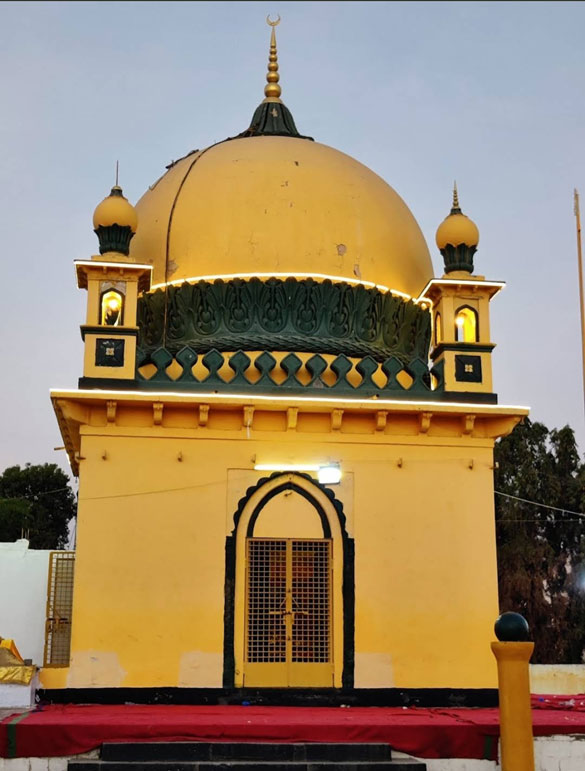
Hazrat Iftikhar Ali Shah Chishti Watan was born on 9 Ramadan 1249 AH (1833–34 CE), on a Sunday at the time of iftar, inside the historic Golconda Fort, where he spent his early years. Before he reached the age of seven, his father, Mir Kazim Ali, passed away, leaving his upbringing and education entirely in the care of his devoted mother. Despite this early loss, she ensured he received a strong religious and intellectual foundation, shaping the character that later distinguished him as a renowned Sufi scholar. As he matured, Hazrat pursued higher learning under some of the leading scholars of his time. He studied Rumi's Masnavi under Hazrat Hilal Uddin Hashmi, mastered prosody under Hazrat Hafiz Mir Shamsuddin Faiz, and learned the deeper realities of Tasawwuf under Mir Fath Ali Qadri. Combining rational and religious sciences with remarkable ability, he soon gained recognition as a respected scholar and researcher. His search for spiritual perfection eventually led him to Hazrat Akbar Ali Shah, the khalifa of Hazrat Noor Absar, whose khanqah at Takia Akbar Ali Shah, Sultan Shahi, was an important centre of Chishti spirituality. After years devoted to the worship of Allah and inner discipline, Hazrat took bay'ah in the Chishti order under Hazrat Akbar Ali Shah and was later granted khilafat, authorising him to guide others on the Chishti path. This marked the beginning of a lifelong mission devoted to spiritual guidance, scholarship and service.
Spiritual Leadership and Lifelong Service
After receiving khilafat in the Chishti order, Hazrat Iftikhar Ali Shah Chishti Watan also became a disciple and khalifa of Hazrat Mahboob Ali Shah Allahabadi in the Qadri and Naqshbandi silsilas, earning recognition in three respected Sufi traditions. While he benefited from the spiritual wisdom of all these lineages, his personal mission and guidance remained centred on the Chishti tradition, and he guided disciples into the Chishti path throughout his life. His approach reflected the Chishti ideals of love, compassion, humility and service, values that enabled him to connect with people from different backgrounds and guide them towards a life of faith and devotion. From his residence at Chela Pura, Hyderabad, India, Hazrat emerged as one of the city's most respected Sufi masters and religious scholars. His spiritual life was firmly rooted in the Sharia, while constant dhikr, daily recitations, Tahajjud, i'tikaf, and regular worship shaped every aspect of his routine. Alongside his outward observance of Islamic teachings, he cultivated deep inner purification through remembrance of Allah and unwavering devotion to his spiritual master.
His love and obedience reached the stage of Fana fi'l-Shaykh, reflecting complete trust in his Murshid and total commitment to the path of spiritual refinement. Hazrat spent his days and nights teaching, writing, compiling books and guiding seekers. Thousands of disciples and devotees benefited from his knowledge, gentle character and practical spiritual guidance. Through his sermons, personal instruction and literary works, he encouraged people to combine Islamic knowledge with sincere worship, good character and service to humanity. His life demonstrates that lasting spiritual growth is achieved through discipline, humility, devotion to Allah and the guidance of a righteous teacher. Even today, his example continues to inspire those seeking inner peace, stronger faith and a deeper relationship with Allah, making his legacy a living source of guidance for the people of Hyderabad and beyond.
Literary Legacy and Continuing Spiritual Lineage
Alongside his spiritual leadership, Hazrat Iftikhar Ali Shah Chishti Watan had a deep love for poetry and literature, writing under the pen name "Watan." He authored several well-known works, including Safar Dar Watan, Diwan Watan and Irshad Watan, while his final work, Subhah Watan, remains unpublished. Through these writings, he presented the Chishti message of sincere worship, self-purification, love of Allah, and moral discipline in a language that ordinary seekers could understand. His books continue to remind readers that spiritual progress is achieved through knowledge, remembrance of Allah, humility and righteous character rather than outward appearances alone. Hazrat was blessed with two sons, Hazrat Khwaja Moinullah Hussaini and Hazrat Khwaja Fareedullah Hussaini. After his passing, his elder son Hazrat Khwaja Moinullah Hussaini became his spiritual successor as well as the caretaker and custodian of the shrine, continuing his father's mission until his death in 1338 AH. Today, this legacy continues through Syed Wali Allah Hussaini Chishti, who occupies the seat of spiritual instruction, delivering sermons, discourses and religious guidance. A respected orator, he continues the tradition established by Hazrat, ensuring that the Chishti message reaches new generations.
More than a century after Hazrat's passing, his writings and spiritual legacy continue to speak to modern seekers. His life teaches that true success lies in combining knowledge with humility, worship with service, and devotion with compassion. At a time when many struggle with distraction, materialism and spiritual uncertainty, his example encourages people to strengthen their relationship with Allah, seek guidance from authentic scholarship, and live with sincerity, patience and kindness towards others. This enduring message is what continues to draw devotees to his shrine and keeps his legacy alive in the hearts of the people of Hyderabad and beyond.
Death, Shrine and Continuing Reverence
Hazrat Iftikhar Ali Shah Chishti passed away on 9 Ramadan 1326 AH (1907 CE), a Sunday at the time of iftar, in his residence at Chela Pura, Hyderabad, India at the age of 77. In a remarkable coincidence remembered by his devotees, he was born and passed away on the same day, month and time—9 Ramadan, on a Sunday at iftar. He was buried the following day at Chishti Chaman in Razdarkhanpet, Hyderabad, India and the locality itself gradually became known by the name of his shrine. Since then, people from all walks of life have continued to visit the dargah seeking spiritual peace and blessings. The shrine stands on the northern side of Razdarkhanpet, Hyderabad, India. Its spacious structure is built on a raised platform with an inner chamber measuring about 15 feet 5 inches square, finished with fine lime-and-mortar work. The mausoleum has three entrances on the north, south and east, with a western window and electricity for the convenience of visitors. At its centre is Hazrat's grave, built permanently with mortar upon a marble platform measuring approximately 8 feet 5 inches by 3 feet 2 inches, while the grave itself measures about 6 feet 5 inches by 3 feet 4 inches and is enclosed within a protective wooden frame, carefully preserved in good condition.
Adjacent to the eastern side of the shrine stands a small mosque where the five daily prayers and congregational worship continue to be held. Every year on 9 Ramadan, Hazrat's Urs is observed with Sama, recitation of the Holy Qur'an and the participation of a large number of disciples, devotees and visitors, alongside a small traditional fair. The shrine remains under the care of Hazrat Syed Shah Wali Allah Hussaini Sahib, who resides within the shrine complex and oversees its religious activities. More than a century after his passing, Hazrat's dargah continues to serve as a living centre of worship, remembrance and spiritual guidance, reflecting the enduring influence of his life and teachings.
____
Adnan Faizi is a Peace and Harmony activist based in Delhi. He is an alumni of CCS University, Meerut.
New Age Islam, Islam Online, Islamic Website, African Muslim News, Arab World News, South Asia News, Indian Muslim News, World Muslim News, Women in Islam, Islamic Feminism, Arab Women, Women In Arab, Islamophobia in America, Muslim Women in West, Islam Women and Feminism