
My Tryst With Bipolar And My Own Clan

By Moin Qazi, New Age Islam
30 April 2026
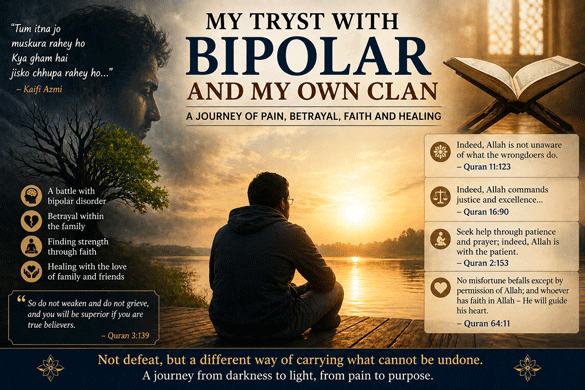
Tum Itna Jo Muskura Rahey Ho
Tum itna jo muskura rahey ho
Kya gham hai jis ko chhupa rahey ho
Aankhon mein namin hansin labon par
Kyaa haal hai kyaa dikhaa rahe ho
Ban jaaengey zahr piite piite
Yeh ashk jo piite jaa rahe ho
Jin zakhmon ko vwaqt bhar chalaa hai
Tum kyuun unhein chhedey jaa rahe ho
Rekhaon ka khel hai muqaddar
Rekhaon se maat khaa rahe ho
(You are smiling so much
What’s the sorrow you are hiding?
Dampness in your eyes, a smile on your lips
What’s your state and what are you showing?
They will turn into poison if you keep drinking
These tears that you are constantly gulping down
The wounds that time has begun to heal
Why do you insist on scraping them
Fate is a game of the lines on your palms
You are being defeated by mere lines)
Kaifi Azmi, Kaifiyat: Verses on Love and Women
It all started forty years ago. Or maybe before, or perhaps earlier. I don't know. I don't know for sure when my early symptoms of bipolar disorder started. But I never experienced full-blown mania until I was 31, seven years ago. I vaguely (probably by choice) remember the racing dots I connected for three days and nights, and the psychosis grew into a huge, dark cloud eating me.
I didn't realise it was a bipolar episode then. Even my doctor had the same opinion—an oversight in hindsight. I thought it was due to disillusionment with a political organisation I had spent more than a decade with, whose ideas were close to my heart.
I got more and more moody for the next few years. Since it has been my everlasting companion since childhood, I really couldn't see what was coming. I decided to move on, forgetting the episodes as an exception.
Then one day, the monster came like a roaring whirlwind, tossing me into the air. This time, my doctor confirmed that it was mania, and I got admitted to a psychiatric hospital. I still remember the grand delusions when I was sitting before the new doctor. He was explaining what bipolar disorder is all about, and I was wondering if he was part of the state, and that's why he was attacking me, by putting up a large religious deity image on his wall.
Did I say, "I did"? Does someone really "do" everything when they're undergoing a manic psychosis? If not, how come we remember certain things while others are completely blacked out, without a trace of memory? Maybe my consciousness was, at times, swinging—and at times flipping—between on and off states. That's the only logical explanation I could arrive at in all these years.
It was the worst period of my life—some people who loved the world.
I cried (boys do cry) for days. Nights. There was no hope in sight.
And one day, a dear friend, asked me to read the Quran and pointed out how my negative imagination had been pulling me down forever. I was frantically searching for a log to swim across the sea when that video came as a lifeboat. I composed myself, went back to my job, and started visualising getting reunited with my \world.
That made me realise the power of positive imagination, the law of attraction, and how positive thoughts can help you realise positive things.
But old habits die hard.
After some years, I was slowly moving away from positivity, and the urge for negative attention from the in-built poisonous tree was tempting. And due to various reasons, my sleep pattern started changing, and I didn't realise a storm was brewing.
And, as expected, it was déjà vu.
The mania hit me this time with much more intensity. It was (must have been) a testing period for everyone close to me. When I felt better, I sat at home for two long weeks, and now I've been there all day. Or should I say—stare?
I didn't want my brain to think. I didn't want to say anything to anyone. Hear anything from anyone. I guess I went numb.
Eventually, one question started bothering me:
Why the heck did I have a manic episode even when I was taking my pills religiously?
Bottom line—Lithium Carbonate wasn't some weird chemical name to me anymore. I know who it is and how it cares for me when I need it. Terms like altered behaviour, rapid cycling, and hypomania got added to my vocabulary. Also, I understood that identifying your own symptoms and triggers, and sticking to your circadian rhythm, are equally important in tackling the disorder, along with the medicines. And the learning curve still goes on.
It put mania in check, but Bipolar needed therapy.
For some, it's asthma. For others, it's diabetes. For us, it's bipolar disorder, schizophrenia or major depressive disorder. It's as simple as that. So, we are not "mental", "psycho", "loon", "nutcase", "crack", or any derogatory label in any language. We are real people who can learn, love, care, work, and live—just like any 'normal' person, despite our challenges.
Thus, I made a tryst with bipolar disorder almost two years back, and I have been redeeming a pledge to myself to date:
I won't run away from you.
I won't deny or pretend that you don't exist.
You're there, walking with me, waiting to push me down.
But you know, buddy—I know your tricks. I know how to protect myself and where to hit you.
And then the most ferocious monster emerged.
Few wounds cut as deeply, or endure as quietly, as betrayal within the family. It is not merely the injury that devastates, but the collapse of an assumed moral order—the delicate architecture of trust, continuity, and belonging that usually goes unquestioned. When those entrusted with one's emotional refuge become sources of harm through conduct both cruel and deceitful, the rupture extends beyond feeling into thought itself, unsettling one’s very sense of reality.
I have lived through such betrayal not in the abstract, but within the intimate terrain of family disputes—where trust is presumed, and therefore most easily misread. What unfolded came cloaked in familiarity and false assurances, drawing me, almost imperceptibly, into a web of decisions and narratives that gradually eroded my position. It was not a single act, but a quiet, cumulative design that left me deceived and displaced.
Such betrayal leaves a lingering trauma. It fractures the foundations of safety and trust, replacing them with anxiety, subdued despair, and a slow erosion of self-assurance. What is lost is not only love, but the unspoken covenant of care that gives kinship its meaning. In its absence, grief becomes both intimate and disorienting—one mourns not only what was, but what ought to have been.
The deeper wound, however, is psychological. The experience does not remain in the past; it lingers—replaying conversations, questioning motives, unsettling one’s judgment. Living with bipolar disorder, this did not remain contained. It seeped into emotional cycles, intensifying both withdrawal and agitation. I came to see that familial betrayal does not merely alter circumstances—it reshapes perception itself, creating a vigilance that can harden into suspicion.
Yet within this altered landscape, a different reckoning emerges. With great pain—and with the support of loyal professional colleagues—I have made peace both with bipolar disorder and with the treachery of members of my extended family. I have also made peace with my nephew, my sisters, my cousins, and the family elders. This peace is neither forgetfulness nor denial; it is a refusal to remain bound to injury.
Such resolution does not arise in isolation. It is sustained by those who stand quietly, steadfastly, beside us. I write this only because of the people who held me through the dark: my son, whose love is unguarded; my wife, who stands by me with quiet courage; my sister, who recognises when I falter; my doctor, who knows how and when to intervene; and my friends, who listened with patience. And above all, my late mother—who never named my condition, yet understood it instinctively—who asked what she could cook to restore me, and gently reminded me, with affection, whether I had taken my medication.
In such constellations of care, one learns that suffering, though isolating, is never entirely solitary.
Faith, too, offers a language for endurance that neither denies pain nor allows it to define existence. The Qur’anic voice does not dismiss grief; it situates it within a wider moral horizon: “So do not weaken and do not grieve, and you will be superior if you are true believers” (3:139). Grief is acknowledged, yet one is called not to be overcome by it. Likewise, “Let not their speech grieve you. Indeed, honor belongs to Allah entirely” (10:65).
These injunctions do not erase suffering; they discipline response. One is asked to endure—not passively, but with inward steadiness: “Seek help through patience and prayer; indeed, Allah is with the patient” (2:153). Patience here is not resignation, but vigilance—a refusal to let injustice dictate one’s inner life.
There is also a profound recognition of human limitation: “Allah does not burden a soul beyond that it can bear” (2:286). What appears overwhelming is, within a larger frame, something one has been entrusted to endure. And with endurance comes the promise—repeated for emphasis—that “after hardship, there is ease” (94:6). Not the denial of hardship, but its eventual transcendence.
Even misfortune is reframed: “No misfortune befalls except by permission of Allah; and whoever has faith in Allah—He will guide his heart” (64:11). Guidance here is not the removal of difficulty, but clarity within it—the ability to see without distortion, to respond without bitterness.
In time, the horizon shifts toward a state in which sorrow itself is no longer inhabited: “Praise be to Allah, who has removed from us all sorrow. Indeed, our Lord is Forgiving and Appreciative” (35:34). This is not immediate reality, but promised perspective—a reminder that grief is not ultimate.
Within this framework, forgiveness assumes a different character. It is no longer merely psychological release, but moral discipline. To forgive is not to deny wrongdoing or blur the line between justice and injustice. It is to refuse to let injury dictate the terms of one’s inner life—to reclaim agency from the past.
Yet forgiveness remains a paradox. It demands clarity without hardness, memory without resentment. It asks that harm be fully acknowledged, yet not allowed to govern us. In doing so, it unsettles the instinctive division between victim and offender, compelling recognition of shared fallibility.
This does not imply the restoration of trust. Trust, once broken, may require distance, evidence, and time—if it can be restored at all. Forgiveness operates inwardly; it reshapes one’s relation to the past without necessarily altering present boundaries.
What it offers is not resolution, but a different way of carrying what cannot be undone.
Such recognitions do not remain confined to the present. They reorganise memory itself. Scenes once held in warmth acquire an aftertaste of uncertainty; continuity begins to resemble performance. Trust, once invisible, becomes perceptible only through its absence. What is altered is not merely a relationship, but the terms on which one understands both the past and the self.
And yet, from this disturbance emerges a quieter clarity. One learns to see without embellishment, to remember without distortion, and to carry forward a moral attention no longer dependent on inheritance, proximity, or expectation.
If there is resolution, it lies not in restoring what has receded, but in refusing to misname it.
One day, I shall set down this journey in its fuller measure—not merely as a personal chronicle, but as a witness to truth tested in the crucible of betrayal. What is written here is only a fragment; the fuller account awaits its appointed hour.
For now, I entrust my cause to a justice that does not falter. “Allah is not unaware of what the wrongdoers do” (11:123), and “Indeed, Allah commands justice and excellence…” (16:90). In these assurances, I find both patience and resolve.
I seek neither vengeance nor spectacle. I ask only that الحق (truth and right) prevails, and that I am granted release from the ظلم (injustice) that has weighed upon me.
May I be freed not only from those who wronged me, but from the lingering shadow of their actions. May my heart find tranquillity), and my path open toward a future unburdened by the past.
And when the final account is written—by hands far greater than ours—may it affirm what no distortion can erase: that truth stands, عدالت (justice) endures, and no ظلم remains unanswered.
…
Moin Qazi is an Indian author and development leader who advanced dignity-centred, community-led change. A pioneer of microfinance and grassroots institutions, he fused ethics with social innovation. With deep interdisciplinary scholarship, he bridged policy, justice, and lived realities. His legacy affirms ethical leadership and people’s agency as drivers of India’s progress…
URL: https://newageislam.com/islam-spiritualism/my-tryst-with-bipolar-and-my-own-clan/d/139850
New Age Islam, Islam Online, Islamic Website, African Muslim News, Arab World News, South Asia News, Indian Muslim News, World Muslim News, Women in Islam, Islamic Feminism, Arab Women, Women In Arab, Islamophobia in America, Muslim Women in West, Islam Women and Feminismen and Feminism