
Sufism in Delhi: Love, Service, and Timeless Harmony

By Sahil Razvi, New Age Islam
07 May 2026
Delhi, honoured as Hazrat-e-Dehli, stands as a timeless centre of Sufism. Chishti saints and poet Hazrat Amir Khusrau shaped its spirit of love, service and harmony. Its historic dargahs and qawwali traditions continue to inspire millions across faiths
Main Points:
· Delhi became India’s Sufi heart during the Sultanate era as a safe haven for saints fleeing Mongol invasions.
· The Chishti order, led by saints like Hazrat Qutbuddin Bakhtiyar Kaki and Hazrat Nizamuddin Auliya, taught selfless service and divine love.
· The city is called Bais Khwaja ki Chaukhat, home to 22 majors Sufi dargahs that welcome all faiths.
· Hazrat Amir Khusrau, disciple of Hazrat Nizamuddin, created qawwali and called Delhi “paradise on earth.”
· Sufi khanqahs and dargahs still promote Hindu-Muslim harmony, peace and cultural unity today.
Sufism is the spiritual tradition of Islam that emphasises direct experience of God, love known as ishq, selfless service to humanity called khidmat-e-khalq, and the unity of all people. Delhi, which served as the heart of the Delhi Sultanate from 1206 to 1526, grew into the most important centre of Sufism in India. The city is fondly called Bais Khwaja ki Chaukhat, the threshold of twenty-two Sufi saints, and is home to hundreds of dargahs. The Sufi khanqahs provided food, education and shelter to the poor, fostering a beautiful Hindu-Muslim cultural harmony that earned Delhi the title of Hazrat-e-Dehli, the venerable Delhi. When Mongol invasions devastated Central Asia, Sufi saints fled to Delhi and made it their sanctuary, with the Chishti order laying the foundation of an inclusive culture here.
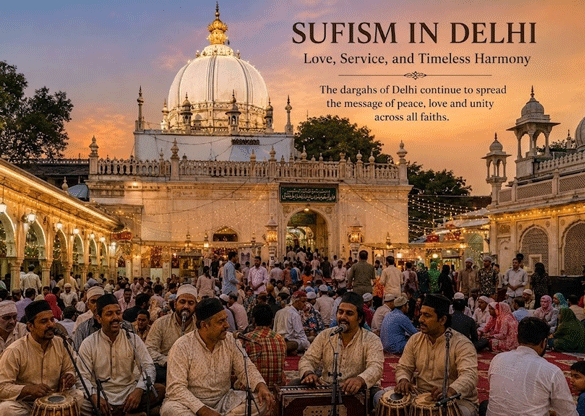
Sufism arrived in Delhi along with the Delhi Sultanate in the twelfth and thirteenth centuries. After the second battle of Tarain in 1192 and the establishment of the Sultanate, Sufi saints began to settle in the region. The Mongol attacks from 1206 onwards destroyed great centres like Bukhara and Baghdad, turning Delhi into a hub for Muslim migrants and intellectual traditions. The Chishti silsila became the most influential, originating from Hazrat Khwaja Moinuddin Chishti in Ajmer and spreading in Delhi through Hazrat Khwaja Qutbuddin Bakhtiyar Kaki. He arrived from Central Asia and established the first major Sufi centre in Mehrauli during the reign of Sultan Iltutmish. The Chishti Sufis deliberately kept distance from royal power, yet their khanqahs remained open to people of every caste, religion and class, creating an inclusive culture in the city. Three great Chishti saints, Hazrat Bakhtiyar Kaki, Hazrat Baba Farid and Hazrat Nizamuddin Auliya, transformed Delhi into the Chishti wilayat, a spiritual domain. After Hazrat Nizamuddin, his successor Hazrat Nasiruddin Chiragh-e-Dehli carried the tradition forward. Delhi earned the respectful name Hazrat-e-Dehli because the graves and khanqahs of these saints turned the city into a sacred space. Later the Naqshbandi and Suhrawardi orders also arrived, but the Chishti order remained the most prominent. Even today Delhi has hundreds of Sufi sites and the dargahs of twenty-two major saints that still mark it as BaisKhwaja ki Chaukhat.
One of the earliest and most revered figures was Hazrat Khwaja Qutbuddin Bakhtiyar Kaki, who lived from 1173 to 1235 or 1236. He was the second major saint of the Chishti order, settled in Mehrauli and established the first prominent Sufi dargah near the Qutub Minar. He laid great stress on rigorous spiritual practice, renunciation and intense love for God. According to reliable Sufi records preserved on Sufinama, he taught, “The spiritual state of nearness of God is a sign of true saintliness. This ultimately results in the experience of love and longing for early union.” He also said, “Communion with God is conferred after the dervish has become alien to all else.”
The most celebrated name in Delhi’s Sufism is Hazrat Nizamuddin Auliya, known as Mahbub-e-Ilahi, who lived from 1238 to 1325. He was the leading Chishti saint of his time. His khanqah stood in Nizamuddin West and attracted disciples like the poet Hazrat Amir Khusrau. Despite occasional tension with sultans, his popularity never wavered. He declared that service to humanity was the very essence of the Sufi path. The famous collection Fawaid al-Fu’ad compiled by Hazrat Amir Hasan Sijzi records his words:
“Tariqat ba-joz-o-khedmat-e-khalq nist Ba-tasbih-o-sajaada-o-dalaq nist,”
which means the Sufi way consists of nothing but service to God’s creation; it is not about rosaries, prayer mats or the patched cloak of a dervish. He taught, “One who serves becomes the master.” He believed women possessed equal spiritual power and talent and were in no way inferior to men in spiritual discipline. He instructed his followers, “Every visitor should be served something; if there is nothing to offer, a cup of water may be offered.” In simple Hindi he once remarked, “Agar koi shakhs mere raaste mein ek kaanta rakh de aur main uske jawab mein doosra kaanta rakh doon, to duniya mein kaante hi kaante ho jayenge.” (If someone places a thorn in my path and I respond by placing another thorn, then the world will be filled with nothing but thorns.) He also said, “Khuda ki mohabbat ke bina insani zindagi adhuri aur be-kar hai,” meaning without God’s love human life remains incomplete and worthless. He considered self-criticism better than seventy years of formal prayer and taught that the real purpose of prayer was to remove self-conceit.
Hazrat Nasiruddin Chiragh-e-Dehli, who lived from 1274 to 1356 and was called the shining lamp of Delhi, succeeded Hazrat Nizamuddin Auliya. He became a disciple at the age of forty and later led the Chishti order. During Muhammad bin Tughlaq’s controversial shift of the capital to Daulatabad he stayed in Delhi, earning the title Chiragh-e-Dehli. He was also a Persian poet who contributed to the growth of early Urdu poetry. Unlike his master, he did not encourage sama or qawwali, so musical gatherings are not held at his dargah even today. His shrine in Chiragh Delhi was built by Firoz Shah Tughlaq.
Another early saint was Hazrat Shah Turkman Bayabani of the thirteenth century. He came with the army of Sultan Qutbuddin Aibak and earned the title Bayabani because he preferred solitary meditation in the forests. Known as Shamsul Arifeen, his dargah near Turkman Gate is among the oldest in Delhi and symbolises the path of seclusion and closeness to nature.
Hazrat Amir Khusrau, who lived from 1253 to 1325, was Hazrat Nizamuddin Auliya’s most beloved disciple, a Sufi poet, musician and historian. He wrote in Hindavi, the early form of Hindi-Urdu, as well as Persian. He is regarded as the father of qawwali because he blended Persian, Arabic, Turkish and Indian musical traditions into a new devotional form. His poetry overflows with love for his master. One of his immortal compositions sung even today at Hazrat Nizamuddin dargah is:
“Chhaap tilak sab chheeni re mose naina milaaike
Chhaap tilak sab chheeni re mose naina milaaike
Prem bhati ka madhwa pilaaike
Matwaali kar leeni re mose naina milaaike
Khusrau Nizam ke bal bal jaiye
Mohe suhaagan keeni re mose naina milaaike.”
It means: You have stolen my seal and my beauty spot by meeting my eyes; you made me drink the wine of love and left me intoxicated; Khusrau is ready to sacrifice everything for Nizam, who has made him a bride. Another beautiful Persian couplet expresses divine union.
“Mun tu shudam tu mun shudi, mun tun shudam tu jaan shudi Ta kas na goyad baad az in, mun digaram tu digari.” It means I have become you and you have become me; I have become your body and you my soul; now let no one say that I am separate and you are separate. Khusrau lovingly called Delhi “Firdaus bar ru-e zameen,” paradise on the face of the earth.
It was Amir Khusrau who popularised sama, the musical gathering that later became qawwali. The Chishti Sufis saw sama as a powerful means of spiritual elevation. This tradition is still alive at Hazrat Nizamuddin dargah where qawwals sing every Thursday and during the annual urs.
The dargahs of Delhi continue to shape the city’s culture. The Qutub Sahib dargah in Mehrauli is the oldest major one. Hazrat Nizamuddin Auliya’s dargah draws lakhs of devotees during his urs in Rabi-ul-Awwal, filling the air with qawwali. Chiragh-e-Dehli dargah and Shah Turkman dargah near Turkman Gate are equally revered. Sufism influenced Delhi’s architecture, music, literature and even festivals such as Basant. The dargahs became shared spaces for people of all faiths where the message of service and equality echoes continuously.
Delhi remains a living symbol of Sufism where love and service have joined religion with humanity. In the words of Hazrat Nizamuddin Auliya, service itself is the Sufi path. Even today these dargahs spread the message of peace, inclusion and cultural harmony. Standing at the threshold of Bais Khwaja one can still feel the spiritual heritage that has illuminated the city for centuries.
…
A regular contributor to New Age Islam, Sahil Razvi is a research scholar specialising in Sufism and Islamic History. He is an alumnus of Jamia Millia Islamia.
URL: https://newageislam.com/islam-spiritualism/sufism-in-delhi-love-service-timeless-harmony/d/139925
New Age Islam, Islam Online, Islamic Website, African Muslim News, Arab World News, South Asia News, Indian Muslim News, World Muslim News, Women in Islam, Islamic Feminism, Arab Women, Women In Arab, Islamophobia in America, Muslim Women in West, Islam Women and Feminism