
Egypt's Grand Imam of Al Azhar Appoints Dr Nahla Al Saeedy, His First Female Adviser
New
Age Islam News Bureau
21
September 2022
• Iranian
Women Burn Hijabs as Protests over Mahsa Amini’s Death in Morality Police
Custody Continue
• Iranian
Activist, Melika Qaragozlu, Gets 3-Year Sentence in Prison for Sharing Video
without Hijab
• Rights
Group Relaunches App That Helps Iranian Women Avoid ‘Morality Police’
• ‘Sin
Under Islam,’ Taliban Bans Women Students From Taking Videos, Photos On
University Campus
• Saudi
Shura Urges Equal Opportunities in Employing Females and Males
• Angelina
Jolie Lands in Pakistan to Aid Flood-Affected Victims, Hollywood Star Hears
Women in Makeshift Tents
Compiled
by New Age Islam News Bureau
URL: https://newageislam.com/islam-women-feminism/egypt-imam-azhar-nahla-saeedy/d/127997
--------
Egypt's
Grand Imam of Al Azhar Appoints Dr Nahla Al Saeedy, His First Female Adviser
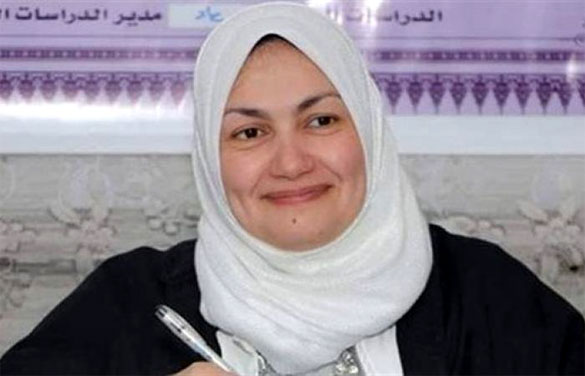
Dr.
Nahla Al-Saeedi
----
Kamal
Tabikha
Cairo
Sep
20, 2022
Sheikh
Ahmed El Tayeb, the Grand Imam of Al Azhar — Egypt’s highest authority on Sunni
Islam — has appointed his first female adviser.
Dr
Nahla Al Saeedy confirmed her appointment as the Imam’s adviser on expatriate
affairs in a Facebook post on Monday.
She
becomes the first woman to hold an advisory position to the Grand Imam in Al
Azhar’s 1,000-year history.
Ms
Al Saeedy previously held two positions at Al Azhar; Dean of the College of
Islamic Sciences for Expats and Head of the International Student Education
Development Centre.
She
made the talk show rounds on Monday night following her historic appointment.
During a phone-in with the TV channel CBC she described her appointment as a
responsibility and an honour of which she was very proud.
“Through
this decision, the sheikh underscored his appreciation of the role women play
in Al Azhar’s work. This appreciation is something Al Azhar’s women have grown
accustomed to under the sheikh’s leadership,” she said.
She
said her appointment comes as part of a 10-year strategy by Al Azhar, which is
running in tandem with the Egyptian government’s Vision 2030 plan to update
many of the country’s sectors to make them more effective, sustainable and
reflective of the Sisi administration’s modernisation scheme.
Ms
Al Saeedy said Al Azhar’s role in the country’s future would be instrumental as
it is the main disseminator of Islam’s values and the correct use of the Arabic
language in Egypt.
She
lauded the institution’s moderateness during the phone-in.
Backlash
over clerics' comments
Though
it has generally been considered a moderate Islamic institution, Al Azhar has
received some criticism over the past few years following its commentary on
some of the country’s most high-profile cases.
The
Grand Imam was condemned by women’s rights groups and activists over his claim
in a 2019 televised interview that “equality between men and women goes against
nature”, and that in some cases husbands are permitted to beat their wives
under Islamic law.
The
institution was again lambasted online in 2020 when a wave of arrests of female
content creators made national headlines, with commentary from Al Azhar clerics
described as “misogynistic” at the time.
Al
Azhar’s upholding of “Egyptian family values” in its commentary on the trials
of the content creators — since referred to as the “TikTok trials” — was also
criticised by rights groups.
In
June, Al Azhar again came under fire for comments on the murder of 21-year-old
university student Nayera Ashraf, who was stabbed to death in the agricultural
province of Mansoura by a suitor whose advances she had repeatedly rejected.
One
cleric, Mabrouk Attia, was sued in July by Egypt’s National Council for Women,
over his comment that Ashraf’s clothing choices had played a role in her
gruesome murder.
Source:
The National News
--------
Iranian
Women Burn Hijabs as Protests over Mahsa Amini’s Death in Morality Police
Custody Continue
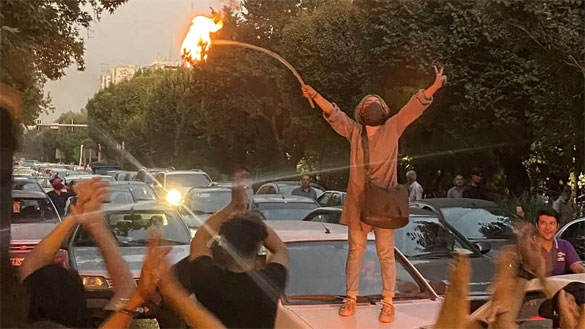
A
woman set fire to her headscarf during a protest in Tehran on Monday
------
21
September, 2022
Women
in several Iranian cities removed and burned their hijabs (headscarves) to
protest their country’s mandatory hijab law as anti-regime demonstrations
sparked by the death of a young woman in police custody continued for a fifth
consecutive day on Tuesday.
Protests
broke out in dozens of cities across Iran, according to videos shared on
Twitter by @1500tasvir, an account with over 80,000 followers that posts
protest videos received from inside Iran.
Videos
showed women removing their headscarves and, in some cases, burning them in
several cities in unprecedented scenes in a country where hijab has been
mandatory for women since shortly after the country’s 1979 revolution.
In
one video from the northern city of Sari, a woman is seen dancing with her
headscarf in her hand. She then throws her headscarf into a fire and is cheered
on by protesters.
The
protests began after Mahsa Amini, a 22-year-old Iranian Kurdish woman, was
pronounced dead on Friday. Amini fell into a coma shortly after she was
detained by the morality police for allegedly not complying with the regime’s
strict hijab rules in Tehran on September 13.
Activists
and protesters say Amini was beaten by police officers while in detention,
causing her serious injuries that led to her death. Police deny the allegations.
Protests
also broke out in two conservative cities – Mashhad and Qom. Mashhad is the
birthplace of Supreme Leader Ali Khamenei and is home to the shrine of the
eighth Shia Imam. Qom is considered Iran’s “religious capital” as many senior
Shia clerics are based there and the city is also home to the shrine of another
important Shia figure.
In
one video from Mashhad, protesters appeared to have taken control over two
police cars. “We don’t want an Islamic Republic,” a woman standing on top of
one of the cars shouted, as seen in the footage.
Videos
from several cities showed damaged police vehicles as well as protesters
clashing with security forces. As during past days, protesters across Iran
chanted against Khamenei and demanded regime change.
One
video from the city of Shiraz showed security forces opening fire on people and
other videos showed security forces firing tear gas to disperse protesters.
Iran’s
official IRNA news agency reported Tuesday’s protests but downplayed their size
and significance. It also accused protesters of damaging public property.
Deaths
and foreigners’ arrest
The
governor of Iran’s Kurdistan province confirmed on Tuesday the deaths of three
people during the protests, holding anti-regime demonstrators responsible.
Also
on Tuesday, the governor of Tehran said security forces arrested several
foreign nationals during protests in the capital, accusing foreign intelligence
services of involvement in the country’s ongoing unrest.
‘Stay
out of it’
Iran’s
foreign ministry spokesman Naser Kanani condemned on Tuesday what he described
as “interventionist stances” by the US and the EU regarding Amini’s death.
US
Secretary of State Antony Blinken earlier on Tuesday called on Tehran to “end
its systemic persecution of women and to allow peaceful protest.”
The
EU had said in a statement on Monday that what happened to Amini was
“unacceptable” and that “the perpetrators of this killing must be held
accountable.”
Source:
Al Arabiya
--------
Iranian
Activist, Melika Qaragozlu, Gets 3-Year Sentence in Prison for Sharing Video
without Hijab
September
21, 2022
DUBAI:
An Iranian rights activist has been sentenced to three years and eight months
in prison for protesting the country’s mandatory hijab rules, her lawyer said.
Activist
Melika Qaragozlu was arrested for appearing on a social media video without
wearing the mandatory Islamic headscarf, according to Radio Farda.
Qaragozlu’s
sentence was handed down as Iran was hit by widespread protests after the death
of a 22-year-old woman while in police custody for breaking hijab rules.
Her
lawyer, Mohammad Kamfiruzi, wrote on Twitter that the Islamic Revolutionary
Court of Tehran recently handed down the sentence to his client “for publishing
a few seconds of video herself without a headscarf on social media.”
In
the video, Qaragozlu protested the compulsory Islamic headscarf in Iran as part
of a nationwide anti-hijab campaign, where she was a participant, that started
in July.
The
hijab – the head covering worn by Muslim women – became compulsory in public
for Iranian women and girls over the age of nine after the 1979 Islamic
Revolution.
Iranian
President Ebrahim Raisi ordered authorities to enforce the hijab law more
strictly in July. This reportedly resulted in a new list of restrictions on how
women shall be dressed in public.
Radio
Farda reported that following the presidential order, “women judged not to be
in compliance have been barred from government offices, banks and public
transportation.”
Several
activists have launched a social media campaign under the hashtag #no2hijab,
calling on people to boycott companies enforcing tougher restrictions on women
outfits.
On
July 12, women’s rights activists posted videos of themselves publicly removing
their veils to coincide with the government’s National Day of Hijab and
Chastity.
Source:
Arab News
https://www.arabnews.com/node/2166701/middle-east
--------
Rights
group relaunches app that helps Iranian women avoid ‘morality police’
September
20, 2022
WASHINGTON:
An Iranian human rights group has relaunched a smartphone app designed to help
Iranian citizens, especially women, avoid harassment, arrest and punishment by
the strict “morality police” who enforce religious observance and public
morality, including standards of dress, in the country.
United
For Iran, an organization based in San Francisco that promotes civil liberties
and individual human rights for Iranians, is promoting the Gershad app as a
tool that can help citizens, journalists, activists and civil society groups to
monitor the whereabouts of officials from the religious police so that they can
steer clear of locations where officers are known to be active, avoiding the
risk of confrontation.
It
could help users avoid potential problems if they fail to follow rules or
restrictions imposed by the religious police based on a strict interpretation of
Shariah, in particular women who do not want to wear a hijab to cover their
head in accordance with rigid government rules.
The
Islamic Republic of Iran has been ruled by its religious establishment since
the 1979 revolution that the toppled the pro-western Shah. Women in the country
are required to conform to government restrictions on Western-style clothing
and wear the hijab in public.
Last
week, Mahsa Amini, a 22-year-old Iranian woman reportedly suffered a serious
head injury and was declared brain dead following her arrest by the morality
police in Tehran, who accused her of failing to properly follow hijab rules.
She died on Friday.
Amini
was allegedly beaten inside a police van on the way to a detention center,
according to eyewitnesses quoted in reports by Radio Farda, the Iranian branch
of the US government-funded Radio Free Europe/Radio Liberty broadcast service.
A
US government official condemned her death and demanded that the Iranian
government holds accountable those responsible.
“Mahsa
Amini’s death after injuries sustained while in police custody for wearing an
‘improper’ hijab is an appalling and egregious affront to human rights,” the
official said.
“Women
in Iran should have the right to wear what they want, free from violence or
harassment. Iran must end its use of violence against women for exercising
their fundamental freedoms.”
Muslim
women are expected to cover their hair and dress modestly in accordance with
Islamic teachings in many Islamic countries but, with the exception of Iran,
their governments do not force them to wear a hijab and is not legally
mandated.
The
Gershad app was launched anonymously in February 2016, according to rights
advocacy group United For Iran, which said that for reasons of safety and
privacy it and partner organization Article 19 did not initially publicize
their involvement in its development and release, but have chosen to do so now.
It has been downloaded more than 100,000 times.
Firuzeh
Mahmoudi, executive director of United For Iran, told Arab News that the
group’s main objective is to enable and empower Iranians, especially women, to
make their own choices about civil liberties and human rights free of
government control.
“Our
work is to support the people of Iran to have full self-agency of their own
lives,” she said
The
app is increasingly popular among young Iranian men and woman who want to live
a normal life, just like their counterparts elsewhere in the world, according
to Mahmoudi.
“Since
Gershad’s launch, we have received powerful feedback about the role the app has
played in helping to protect basic human rights and liberties, allowing
Iranians to unite in an unprecedented way, preventing arrests and providing a
platform for people to express how humiliating it is to deal with the morality
police,” she said.
The
Iranian people are modern-thinking and want to be free of government
restrictions on the way they live or dress, she added.
Source:
Arab News
https://www.arabnews.com/node/2166371/middle-east
--------
‘Sin
under Islam,’ Taliban bans women students from taking videos, photos on
university campus
ANTARA
BARUAH
20
September, 2022
New
Delhi: The Taliban government in Afghanistan has reportedly banned female
students in medical universities from taking videos or photographs while on
campus, in another instance of its continued repression of women and girls.
Afghan
journalist Bilal Sarwary posted the government’s notice on Twitter, deriding
the Taliban’s rationale that such behavior was “sinful” under Islamic law as
baseless.
“…
without evidence though,” Sarwary said of the diktat which considers taking
photographs a “big sin.” He added it was, “Another example of full scale
Talibanization of Afghanistan.”
One
of several
This
is yet another trough in the wave of repression Afghan women face in the hands
of the Taliban. Since the Taliban seized control of the country last August,
women have been systematically excluded from all forms of public life.
Women
hold no cabinet positions in the de-facto administration, and the Ministry of
Women Affairs has been abolished. At this point, women play no role in politics
and the day-to-day functioning of the country.
There
are heavy restrictions on movement as well. Women who want to travel distances
over 72 kilometers cannot do so, unless accompanied by a male relative. Amnesty
international published a report which said that women and girls have been
arrested “for minor violations of their discriminatory policies, such as the
rule against appearing in public without a mahram [male chaperone] or with a
man who does not qualify as a ‘mahram’ Those arrested are usually charged with
the ambiguous “crime of moral corruption.”
Earlier
this year, Taliban officials announced that girls’ high schools would remain
closed, just as they were set to open after over 6 months. Girls students above
the sixth grade have, therefore, not attended school since the Taliban
take-over last August. Initially, schools were said to be shut due to the
Covid-19 pandemic, but eventually opened for only boys and younger girls.
In
response
Last
month, the Taliban brutally shut up a group of 40 women protesting the
violation of such basic rights, the BBC reported.
One
women protesters said: “They acted differently than earlier protests [when we
were beaten]. They fired shots in the air. Though we’re afraid, we came out to
advocate for the rights of girls, so that at least the Taliban will open
schools for them.”
In
reference to the present Taliban rule, India’s permanent representative to the
United Nations told the Security Council, “We are particularly concerned about
the discriminatory inferior status being accorded to women in the Afghan
society, which has inter alia adversely impacted the education of Afghan girls.”
Source:
The Print
--------
Saudi
Shura urges equal opportunities in employing females and males
September
20, 2022
Ramadan
Al Sherbini
Cairo:
Saudi Arabia’s advisory Shura Council has called on the Ministry of Human
Resources to ensure equal opportunities in employing females and males, a Saudi
online newspaper has reported.
During
its meeting on Monday, the council urged the ministry to been keen on employing
both genders according to employment standards to ensure equality, Ajel added.
Moreover,
the council demanded the ministry to conduct a study on consequences of
employment based on the contracting system at government institutions.
In
recent years, Saudi Arabia has taken major strides to empower women and boost
their engagement in public life as part of dramatic changes in the kingdom.
In
2018, the kingdom allowed women to drive for the first time in its history,
ending a decades-old ban on female driving.
In
another move enhancing women’s empowerment, Saudi authorities allowed women to
travel without a male guard’s approval and to apply for a passport, easing
long-time controls on them.
Source:
Gulf News
--------
Angelina
Jolie lands in Pakistan to aid flood-affected victims, Hollywood star hears
women in makeshift tents
September
21, 2022
Angelina
Jolie has joined with International Rescue Committee to help those affected by
devastating floods in Pakistan. The Hollywood star landed in the South-Asian
country and interacted with the victims and spent time with women there. She
also hears the horrors the women are facing as Pakistan suffers from heavy
rainfall in the region.
In
order to raise awareness about the horrific situation, the 'Mr and Mrs Smith'
actress landed in Dadu, Pakistan, to hear from people affected directly about
their needs and about steps to prevent such suffering in the future. Photos of
Angelina from Pakistan have surfaced on the Internet. Some photos were also
shared by International Rescue Committee on Instagram. In the photos, Angelina
Jolie is seen sitting in a makeshift shelter with a group of women. She
carefully listens to their ordeal offering help.
Describing
the three images, the caption of the Instagram post reads: "IMAGE 1: This
elderly woman, like many others, had lost her home to the damage and was living
in a makeshift encampment that doesn't provide protection from the weather.
Amidst these devastating conditions, she wanted someone to hear her story.
IMAGE
2: Women in the village Ibrahim Chandio, Daddu Sindh recounted to Angelina some
of the horrors they continue to face. Simple needs like food, water, medical
attention are not being met.
IMAGE
3: Angelina also met a young mother in a makeshift shelter. Despite losing
their entire lives to floods these communities greeted her with a smile and
were glad of a chance to speak their heart."
The
post also shared insights about the Pakistan floods and how it has affected the
people living there. "Heavy rains and floods have impacted 33 million
people and submerged one third of the country under water. Pakistan, which has
contributed just 1% of global carbon emissions, is paying the greatest cost for
a crisis it did not cause. The climate crisis is destroying lives and futures
in Pakistan, with severe consequences especially for women and children,"
it shared adding, "Thank you, @angelinajolie, for helping us raise
awareness for this critical emergency — and call for long-term solutions to
address the multiplying crises of climate change. With more rains expected in
the coming months, we hope the world will wake up and take action. Please visit
Rescue.org to learn more about the situation, our work, and how you can make a
difference."
Source:
India TV News
--------
URL: https://newageislam.com/islam-women-feminism/egypt-imam-azhar-nahla-saeedy/d/127997
New Age Islam, Islam Online, Islamic Website, African Muslim News, Arab World News, South Asia News, Indian Muslim News, World Muslim News, Women in Islam, Islamic Feminism, Arab Women, Women In Arab, Islamophobia in America, Muslim Women in West, Islam Women and Feminism