
Hijab Has Come Full Circle in India
Hijab Was
Not Strictly Worn By Girls until Recently
Main
Points:
1. During the
19th century Muslim women of India remained in purdah.
2. Thanks to
spread of education, Muslim girls came out of purdah in India in the 20th
century.
3. Girls going
to schools and colleges did not use hijab.
4. Hijab and
Niqab among girls caught up with Muslim girls only after the 90s.
5. Muslim girls
came back to purdah in the 21st century.
-----
By
New Age Islam Staff Writer
29
September 2022
The
satirical poet of Urdu wrote in the 1020s:
Be Purdah Nazar Aayin Jo Kal Chand Bibiyan
Akbar Zameen Me Ghairat-e-Qaumi Se Gadd Gaya
Maine Jo Puchha Aapka Purdah Wo Kya Hua
Kahne Lageen Ke Aql Pe Mardon Ki Padd Gaya
(The other
day I saw some girls/ women unveiled. I was embarrassed and asked them,
"Where did you leave your veil?" They replied, "It has been cast
over the intellect of men.")
This famous
couplet gives a hint over the anxiety of the Muslim intelligentsia over the
veil during the 1920s. During this period, Muslim women had come out of purdah
to join schools, colleges and universities. It was an era of educational
renaissance among Muslims. The Aligarh Muslim University was attracting both
Muslim boys and girls who wanted to acquire "Angrezi Taalim"
despised by stalwarts like Md. Iqbal and Akbar Allahabadi because they feared
the western education would corrupt the minds of girls and will have a bearing
on their morality. This was the reason Sir Syed Ahmad Khan was at the receiving
end of both Ulema and the so-called Muslim intellectuals.
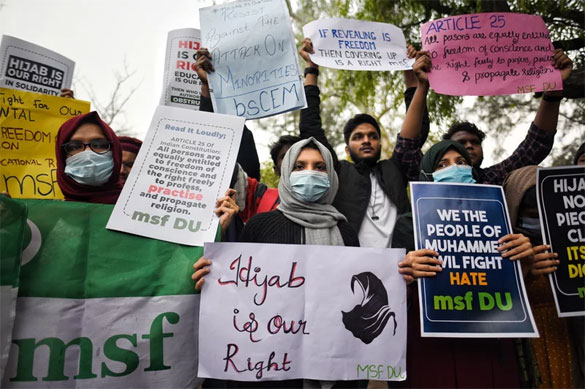
Members of the All India Muslim Students Federation protest at Delhi
University against the hijab ban in educational institutions, on Feb. 8 in New
Delhi, India.
Sanchit Khanna/Hindustan Times via Getty Images
-----
Back in
1911, Begum Rokeya had started a campaign for the education of Muslim girls.
She established a school Rokea Sakhawat Memorial Girls' School in Kolkata. But
the parents would not allow their girls to go to the school because that would
make them bepurdah (veilless). Ms Rokeya offered to make proper arrangement for
purdah in the bus so that men would not be able to see them. After that some
parents relented.
Gradually
parents shed their inhibitions and more and more girls joined schools and
college. The advancement of education was more rapid among the Bengali Muslims
of Bengal including the areas of the then Bangladesh. Dhaka University
attracted more Muslims girls where girls would go without veil. Fazilatun Nisa
was the first Muslim graduate from Dhaka University. During that time girls
would not wear hijab or Niqab to schools or colleges. Indeed, only mothers
would go out in full covering Niqab. This truth is mentioned in the couplet
quoted above. Another couplet expressing the dilemma of the Muslim
intelligentsia is as follows:
Rashida Chamki Na Thi English Se Jab Begana Thi
Ab Hai Shamm-e-Anjuman Pehle Chiragh-e-Khana
Thi.
(Rashida
had not shined until she had learnt English. Now she is a socialite. Earlier
she was merely the lamp of the house.)
These and
other couplets of that period speak of the liberation of the women. They were
participating in societal activities and making a mark in the educational
arena. They had left the veil behind. Still, a section of the society adhered
to purdah but students were not forced to wear hijab and Niqab.
The
religious leaders even those considered liberal were strictly in favour of
purdah. But another section did no object to women going in public without a
veil. During a public meeting during the Freedom Movement in Bengal, the
organisers, the Communists, wanted a Muslim lady deliver a speech from the
stage. They sought permission of the Ulema sitting in the front row of the
audience. They disapproved of it saying a lady could not appear before men on
stage. Then the organisers proposed that she might deliver her speech from a
room of the school adjacent to the venue. But the Ulema said that even a women
should follow the purdah of the voice (Awaz Ka Purdah). She was not
allowed to make her speech either from the stage or from the room adjacent to
the venue of the meeting.
This
incident shows that despite the opposition of the Ulema, Muslim women largely
participated in public affairs without hijab or Naqib.
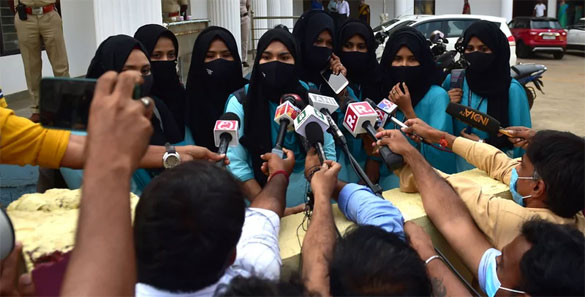
Muslim students speak to media after they were not allowed to enter
pre-university colleges while wearing the hijab, in Udupi town, Karnataka,
India, on Feb. 16.
Anadolu Agency via Getty Images
-----
After the
Independence and Partition, the country became a secular country and secular
education became universal. Muslim girls joined schools and colleges along with
non- Muslm girls. Purdah was not mandated for girl students. With time, Muslim
girls made big strides in the field of education. More and more schools for
girls were established. Girls even studied in co-ed schools with boys and
parents did not oppose and complain.
But after
the 1990s, and markedly since the 2000, an ideological campaign in favour of
purdah (veil) was started. Different Ulema and exegetes advocated the use of
veil or hijab among young girls. On this issue all the sects of Muslims were
united. They advocated for full veil for all the women irrespective of their
age or marital status. The all-pervasive means of communication helped in the
spread of hijab ideology. From India, to Afghanistan to Pakistan, women and
girls were told to remain in the house and even if they needed to go out of the
house, they had to go in full veil. Some Islamic scholars suggested women can
see through one hole in the Burqa even if they fall on the road and meet with
an accident.
The advent
of Taliban and other extremist organisations contributed to the spread of the
ideology of purdah among the Muslims of the sub-continent. In Afghanistan, they
are even killed for not wearing hijab. In Iran, girls from the age of seven are
mandated to wear hijab.
The reason
why Islamic society went backwards during the second half of the 20th century
was the volume of Islamic literature produced during the 20th century. Though
Islam had reached the southwestern coast of India during the life of the
prophet of Islam pbuh through Arab traders, Islamic literature was compiled
only in the last quarter of the 19th century. Shah Waliullah was the first to
translate the Quran in Persian during the 18h century and his son Shah Abdul
Qadir translated the Quran in Urdu in the late 18th century. Shah Waliullah
compiled hadith in India and was called Muhaddith Dehlvi. Mughal Emperor
Aurangzeb was instrumental in the compilation of Islamic jurisprudence in the
18th century.
However,
the work of exegesis and spread of sectarian ideology caught speed only in the
late 19th century. During this period more and more exegetes, Islamic scholars
and researchers emerged on the.L scene and promoted their own ideology.
However, barring a few like Maulana Wahiduddin Khan, almost all of them
propagated a hardline stand on purdah. This popularised veil in India. Now,
different organisations also campaign for purdah even for small girls. Social
and political circumstances also contributed to the popularity of veil. Girls
now wear hijab to schools and universities and working women insist on wearing
veil in office. This becomes a cause of confrontation and legal battles.
Thus, the
veil which was imposed on the Muslim girls during the 19th century has again
come into vogue in the enlightened age of the 21st century. Only the second
half of the 20th century saw the emergence of the liberated women who
contributed immensely to the development of the society and the country. Today,
hundreds of girls leave their educational career for the sake of purdah.
URL: https://newageislam.com/islam-women-feminism/hijab-niqab-veil-india/d/128062
New Age Islam, Islam Online, Islamic
Website, African
Muslim News, Arab World
News, South Asia
News, Indian Muslim
News, World Muslim
News, Women in
Islam, Islamic
Feminism, Arab Women, Women In Arab, Islamophobia
in America, Muslim Women
in West, Islam Women
and Feminism