
Why Do Muslim Theologians Need to Contemplate on the Hijab Controversy?
By Dr. Bilal Ahmad Sheikh, Nowsheena
Akhter and Muskaan Mohi-ud-din, New Age
Islam
16 January 2023
Wearing Of
The Hijab Is Relatively A Matter Of Personal Choice Keeping In View The Quranic
And Prophetic Obligations Under Considerations.
-----
Recent anti-hijab demonstrations over the
unfortunate death of Mahsa Amini following her arrest by the morality police in
Tehran for wearing an inappropriate Hijab and the opposition to the Hijab in
educational institutions in Karnataka have brought the hijab controversy back
to the forefront.
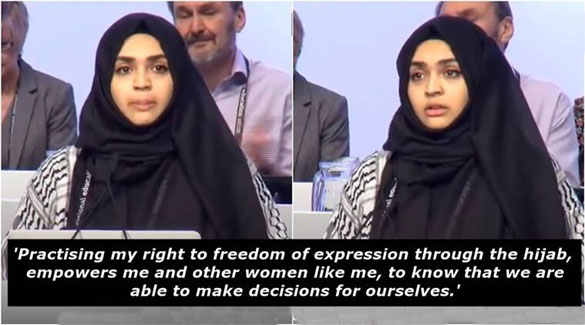
Although there are still demonstrations
taking place in Iran, the Karnataka case
has been referred to a larger-bench of the Supreme Court that will hear
and examine the case afresh as the two-Judge bench of the Supreme Court could
not reach a consensus. The Karnataka High court had already given its verdict
saying that Hijab is not an essential practice in Islam and thus upholding the
Karnataka Government’s ban on Hijab in Educational Institutions.
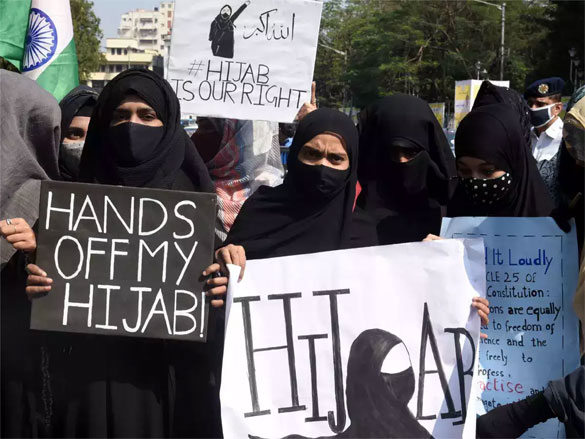
In Karnataka the objection to the Hijab is
because it is a religious symbol and as such should not be allowed in a secular
institution. The Hijab is also criticized for being a patriarchal emblem that
limits women's rights, according to some of its detractors. They firmly
advocate banning the Hijab entirely because they genuinely feel that doing so
will empower women.
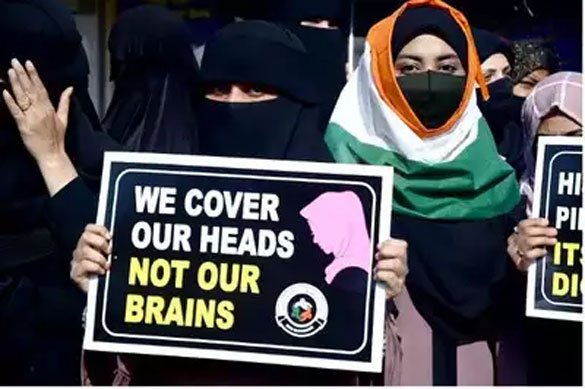
Those who support the Hijab contend that education,
rather than removing the Hijab from women's heads, will give them more power
and that, with higher education, women will be able to choose their clothing
choices consciously in the future. However, the government's detractors contend
that the prohibition on the hijab is a covert effort to eradicate the Muslim
way of life from public settings.
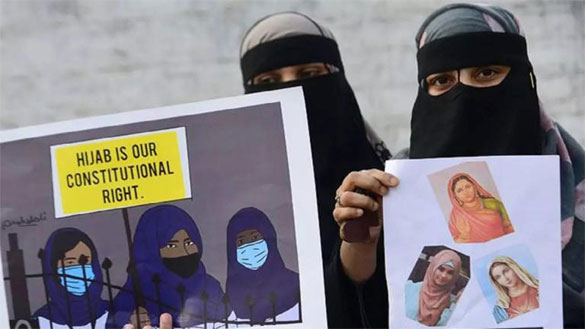
Another group strives to defend
schoolgirls' freedom of choice to wear the hijab as a justification for their
right to do so. The freedom of choice lobby, on the other hand, is criticized
for failing to acknowledge that families who adopt hijab typically make it
necessary for their female children when they are too young to make a
deliberate decision about what to wear. They accuse a rigid culture and obscure
interpretations of religious laws for making it so difficult for Muslim girls
to make their own decisions.
However, it appears that the debate over
the hijab and uniforms is a risky attempt to sow strife in a country that is
both religiously and culturally diverse. India is well known for its diversity
and the efforts of some of its leaders including Nehru to unite such a diverse
population. We must respect our culture's diversity and moral standards while
establishing school uniform requirements rather than importing the concept from
some foreign culture. We don't need female students to wear pants and shirts
like guys do for the purpose of the uniform in educational institutions.
A section of Iranian ladies are actively
resisting the government-imposed dress restrictions. As a demonstration of
their opposition to the government's control over their personal decisions,
they torched their Hijabs during rallies. A section of Women out there want the
state to respect their wishes in both situations. They consider it just as
disgusting to force someone to take off their hijab against their will as it
does to make them wear it. Additionally, they think that since religious
obligations are between God and his followers and God alone has the power to
judge whether or not someone is breaking their religion's laws, the Iranian
government has no jurisdiction to force women to follow them by citing a
binding religious law. However, this group of women underrates the authority of
a contemporary state. No one can prevent the Iranian government from becoming
the Hegelian state as ‘God's march on earth (read indisputable authority), if
it somehow manages to shed its theocratic stance and become more secular.
Why do a small number of Muslim countries
interpret the Hijab law differently than the vast majority of Muslim countries?
It will become evident how local cultural practices and the patriarchal
mentality of the society influence how the Islamic law is interpreted if we
carefully consider why such interpretations have recently been produced in
several nations. The treatment of women in Taliban-run Afghanistan is an
obvious illustration of how the tribal society's traditional customs can affect
how Islamic law is interpreted.
However, several schools of thought have
differing interpretations of the Hijab prohibition in the Quran. It depends on
how one school's viewpoint differs from the others. Some people claim that
since Islam has not changed, a few concepts need to be rethought. Since
jurisprudence is the subject of many debates, it is anticipated that by giving
it a modern interpretation, Islamic practices will become more comprehensible
to the contemporary world.
According to some Muslim scholars, the
doctrine of Tajdid permits the modification or abolition of sharia practices.
The notion of renewal proposes that Islamic communities must undergo continuous
change in order to maintain their purity. Others believe that the Islam that
was practiced in the seventh century was the purest form of Islam.
However, it is well known for contemporary
governments to change legislation seen to be Islamic. When granting women the
right to drive in 2018, Saudi Arabia cited Islamic law. The Modern secular
State in India amended several aspects of Sharia. When the British began to
rule India and upheld the Sharia law of their Mughal forebears, they discovered
many of its provisions to be incompatible with contemporary society and amended
them—a task that has traditionally been the province of Ulema in Islam. For
instance, the law of homicide (Qatl) in Islamic criminal law was based
on the tribal philosophy of the 7th century, where the concepts of Diya
(financial compensation paid to the hiers of a victim) and Qisās (equal
retaliation-eye for an-eye) made it a civil dispute as opposed to a state-enforced
punishment to maintain order. It was declared a crime against the State by the
British. The Triple Talaq, also known as Talaq-e-Biddat (an instant
divorce), which has no backing in the Quran, was recently outlawed by the
Indian government. Many Islamic nations currently forbid instant triple Talaq.
All of the changes or reforms made to Muslim society or law by contemporary
secular legal institutions have one thing in common: in each instance, it has
been determined that the modified rule or practice is not an essential Islamic
practice or that the reform is not in opposition to Islam's core principles.
Many people praised the Supreme Court’s 2017 ruling invalidating Talaq-e-Biddat
in the Shayara Bano v. Union of India case as well as the amended Muslim Women
(Protection of Rights on Marriage) Act, 2019, for restoring the originality of
divorce law as permitted by Islam. It was ruled to be unconstitutional due to
its arbitrary nature and conflict with the Quran. According to the majority,
the practice was not protected by Article 25 because it was not addressed by
the Quran. A portion of Muslim clerics and people were hostile to the reforms
rather than supporting them.
There were customs that were approved by
Islam in the seventh century, but as time went on, their incompatibility with
contemporary society grew to the point where no one insisted on their continued
use. For instance, slavery was such a pervasive evil in 7th century Arabia that
neither the Qur'an nor any other religious text makes any attempt to outlaw it.
It does, however, include a variety of rules intended to improve the status of
slaves. The institution itself eventually lost its compatibility with
contemporary society. Can they use the fact that Islam permitted it to
resurrect it in contemporary society?
Concubinage was another practice that was
extensively acknowledged by Muslim thinkers in pre-modern times. A slave lady
who shared sexual intercourse with her lord was known as a concubine. Slave
concubinage is not, however, acceptable in the present Muslim world, according
to both scholars and laypeople, who also hold that marriage is the only
institution where sexual interactions are morally acceptable
Furthermore, there is a heated argument
over what the Quran sanctions versus what practices come from local customs. In
this regard, Aligarh Muslim University's Professor Rashid Shaz, an Islamic
scholar, states: “One of the greatest reasons for our decline is the fact that
over time we gave so much importance to local customs, concepts, norms and
traditions that the real spirit of Islam got buried under them. In most Muslim
societies, the conception or roles that have been assigned to Muslim women,
have become more embedded in local custom and traditions than Islam, though we have
evolved them to the status of sacraments! Whereas the fact is that the woman of
Prophetic era is quite different from the traditional religious woman of our
times.” However, a sizable portion of Muslims in India detest Rashid Shaz's
“misguided understanding of Islam” and refer to him as a sort of hybrid of
Waheed ud din Khan and Javid Ghamdi. Nevertheless, on the hypocrisy of
advocates of conservatism, he further writes that “You did not consider it
praiseworthy that your own daughter should study in a co-educational medical
institute, but when you needed to have one, you thought it better to consult a
Muslim woman doctor. There was a clear contradiction in what you preached and
what you practiced.” Their social environment is thought to have had an impact
on how they perceive Islamic law. Allow Muslim women to offer the Namaz in
Masjids the way there is a provision for it in Islam, you will observe the
intensity of opposition from the conservative group who would reinterpret the
ruling as per their understanding of Islam.
The Muslim scholars must therefore think
about few other laws that need to be revisited due to the changing of the
times, such as Ijtihād-based renewal, in addition to the discussion
surrounding the Hijab and the circumstances that support its mandatory wearing.
The traditional Muslim should also be aware that Tajdid or Ijtihad
do not signify a complete cede to contemporary society, making divine teaching
susceptible to the sway of shifting social mores and mental constructions.
Islamic principles and fundamental laws are not amenable to these methods of
renewal and reform in the sense of developing new viewpoints that are
compatible with contemporary reality. We still need them, though, to help us
understand some of these ideas and ideals more clearly. If we wait any longer,
as has occasionally been noticed, current so called secular law authorities may
adopt its flag.
Islam has a flexible legal system that can
effectively respond to shifting circumstances, and this is something we should all
be aware of. Additionally, the wearing of the hijab is relatively a matter of
personal choice keeping in view the Quranic and prophetic obligations under
considerations. It must be supported and safeguarded, rather than differing
interpretations of religious beliefs.
------
1. Dr.
Bilal Ahmad Sheikh (Teaching History at Government Degree College Sogam,
Kupwara, J&K
2. Nowsheena
Akhter (Masters in History from Panjab University, Chandigarh)
3.
Muskaan Mohi-ud-din (B.A. 5th semester student at Govt. Degree College Sogam,
Kupwara)
URL:
https://newageislam.com/islam-women-feminism/muslim-theologians-hijab-controversy/d/128880
New Age Islam, Islam Online, Islamic
Website, African Muslim News, Arab World News, South Asia News, Indian Muslim News, World Muslim News, Women in Islam, Islamic Feminism, Arab Women, Women In Arab, Islamophobia in America, Muslim Women in West, Islam Women and Feminism