
'Nazia Bibi' A Tribal Girl Who Breaks the Stereotype.

By Afroz Khan, New Age Islam
27 December 2025
Nazia Bibi, the first female Kho Kho player from Jammu's nomadic Bakarwal tribe, overcame poverty, illiteracy, and conservative opposition to represent India in the 2025 Kho Kho World Cup. Her gold medal victory inspired her community, shifting attitudes towards girls in sports.
Key Point:
1. Nazia Bibi, first female Kho Kho player from Jammu's nomadic Bakarwal tribe
2. Overcame poverty, illiteracy, and conservative opposition to pursue sports
3. Only woman from Jammu & Kashmir selected for India's 2025 World Cup team
4. Played as attacker and helped India win inaugural gold medal against Nepal
5. Her victory inspired community, turning critics into supporters of girls' sports
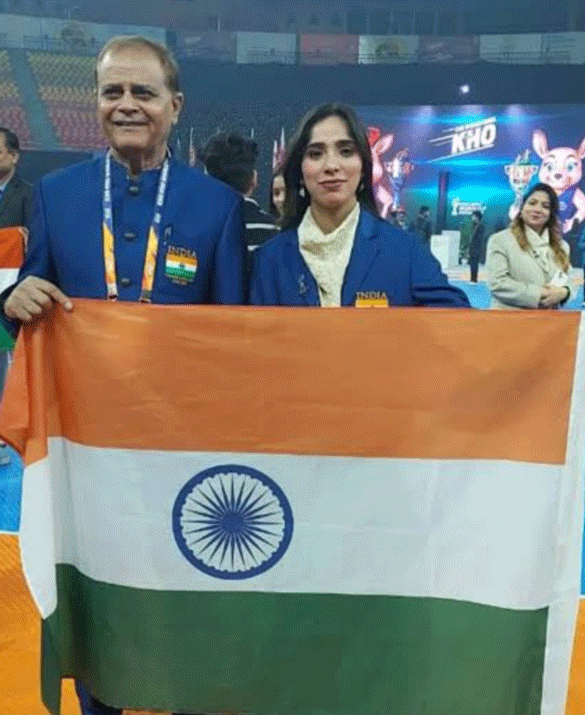
“One person's struggle can open up opportunities for many.”
Nazia Bibi (The first female Kho Kho player from the Bakarwal tribe of Jammu)
The Bakarwal, a nomadic Muslim tribe, inhabit the hilly and rural areas of Jammu and Kashmir. Their main occupation is animal husbandry, which is how they earn their livelihood.
This tribe struggles with difficult circumstances, conservative thinking, illiteracy, and poverty, and has to fight hard even to meet their basic needs. Nazia Bibi is a girl from this Bakarwal tribe who overcame these difficult circumstances and conservative thinking to achieve success.
Nazia Bibi is a 21-year-old Kho Kho player. She was part of the team selected for the Kho Kho World Cup, and that team brought glory to India by winning the gold medal.
Nazia Bibi was born and raised in Nagrota, a small village (rural area) in the Jammu district.
Her father's name is Sabar Ali; he is a shopkeeper and also earns a living through animal husbandry.
Her mother's name is Zulekha Bibi
In the region and community where Nazia Bibi was born, participating in sports is considered challenging for women. Most women in this community are victims of backwardness.
It is extremely challenging for women to wear clothes other than their traditional attire; such women face various taunts and opposition.
Nazia also faced similar opposition. She said in an interview:
“I can understand why my family asked me to stop playing Kho-Kho because people made derogatory remarks about me and mocked me because I didn't wear traditional clothes while practising. I had my uncle, Master Iqbal, who is a teacher, whom I could turn to for help. I would tell him about the problems I was facing in playing Kho-Kho, and he convinced my father.”
Nazia Bibi started playing Kho-Kho in school when she was in the sixth grade. Initially, she was interested in athletics, but later she shifted her focus to Kho-Kho.
In an interview with ETV, Nazia Bibi said:
“I have been an athlete since childhood. I participated in 100-metre, 400-metre, and long-distance races and earned recognition. But when I was in the sixth grade, I started playing Kho-Kho and realised that I could excel in it. In these 12 years, I have participated at the district, state, university, and national levels.”
She is a BA student at 'Padma Shri Padma Sachdev Government Women's College' in Jammu, where she captained her college team and won several championships.
Her outstanding performance caught the attention of the selectors.
Based on her performance, she was invited to the national camp. A total of four players (two men and two women) from Jammu and Kashmir were called for this camp.
The national camp was held at the Jawaharlal Nehru Stadium in New Delhi, with 60 male and 60 female players participating from across the country. During this intensive training and selection process, Nazia Bibi's consistent dedication, hard work, and effective playing skills led to her selection in the 15-member Indian women's team for the first Kho-Kho World Cup to be held in 2025. She was the only female player from Jammu and Kashmir to be selected for the final team.
She was selected as an attacker in this team. In the final match held at the Indira Gandhi Indoor Stadium in New Delhi, India defeated Nepal with a massive score of 78-40 to win the inaugural World Cup title.
When Nazia Bibi and her team won the final match, the same people who had opposed her earlier were now feeling proud of her achievement. Nazia Bibi's father mentioned this in an interview, saying:
“I am illiterate. People used to make fun of my daughter's attire and her participation in sports, which made me feel very bad. Today, the same people are coming to congratulate us, and I am very happy.” Nazia Bibi's struggle is the struggle of a tribal community that lives in extreme poverty and deprivation. They lack the funds to buy equipment for other sports and to spend on other necessities.
Speaking about her challenges, Nazia Bibi said,
“Kho Kho is a game that doesn't require as much money as other sports. This game was suitable for me, and being from a tribal community, I had the energy to achieve a level of fitness that many can only dream of.”
Nazia Bibi's international achievement has opened new doors for many other talented players. Those who were once opposed to the idea of girls playing sports are now encouraging their own children to participate.
The Lieutenant Governor of Jammu and Kashmir, Shri Manoj Sinha, met with Ms. Nazia Bibi, the international Kho Kho player from Jammu and Kashmir, and congratulated her on her achievement.
Talented and courageous girls like Nazia Bibi become an inspiration for other girls. They play a crucial role in changing the prevailing perceptions about girls in society and pave the way for future generations.
…
Afroz Khan is a teacher by profession who writes on women, politics, communal harmony, and Islam. She holds a master’s degree in Education.
URL: https://newageislam.com/islam-women-feminism/nazia-bibi-tribal-girl-stereotype/d/138191
New Age Islam, Islam Online, Islamic Website, African Muslim News, Arab World News, South Asia News, Indian Muslim News, World Muslim News, Women in Islam, Islamic Feminism, Arab Women, Women In Arab, Islamophobia in America, Muslim Women in West, Islam Women and Feminism