
Religious Conservatives Jamaat-e-Islami Object to Women's Cycling Camp in Pakistan
New Age Islam News Bureau
17 December 2022
• At World Cup, Women Shrug Off Worries Over Dress Codes
• Malala Puts Her Faith In Activists To Further Girls’
Education Cause
• Love Knows No Distance: Semanur Kutanis Turkish
Woman Finds Soulmate In S. Korea
• Best Friends, Daughters Of Lebanese Immigrants
Empower Other Arab Women With Higher Education Goals
• Infiltration Of Brotherhood In New Female Faces!
• Abuse Rampant As 860 Violence Cases Against Women In
Kuwait Recorded This Year
Compiled by New Age Islam News Bureau
--------
Religious Conservatives Jamaat-e-Islami Object to
Women's Cycling Camp in Pakistan
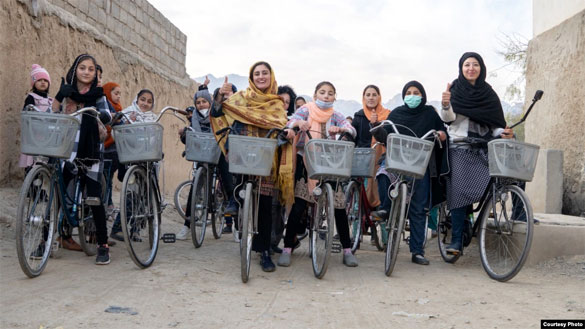
A cycling camp for women in
Pakistan has raised the ire of a religious political party that sees it as a
cultural threat. (Samar Khan)
-----
December 16, 2022
Munaza Shaheed
WASHINGTON —
A women's bicycling camp in northwest Pakistan drew
national attention this week when one of the country’s leading religious
political parties, Jamaat-e-Islami (JI), objected to the event, calling it
vulgar and a threat to religion and local culture.
The camp, organized by Samar Khan, a well-known
Pakistani cyclist and international adventurer, provided girls and women with
bicycles and training to encourage more people to take up the sport.
“The objective of this rally was to make aware and
educate girls on the benefits of cycling, sports careers and eco-friendly
transport. Also, how they can be a part of development if they are not given
opportunities?” Khan told VOA’s Deewa Service.
The local chapter of Jamaat-e-Islami, a conservative
religious party with influence in Pakistan, Bangladesh, India and Afghanistan,
rallied against the camp, held in Landi Kotal, Khyber Pakhtunkhwa, and accused
it of promoting a foreign agenda.
“We will not let such indecent activities take place
in our area which would threaten our religion and culture. This was a Western
agenda applied in Landi Kotal,” Muqtader Shah, a local JI leader, told VOA.
Why un-Islamic?
Another camp organizer, Jamaima Afridi, told VOA she
rejected the idea that the camp promoted foreign values.
“Why is it seen as un-Islamic activity? All the girls
were dressed culturally and wearing hijabs,” she said.
Religious conservatives have not detailed their
objections to the bicycling camp, but organizers suggest it likely has to do
with outdated ideas about protecting symbols of female virginity.
“When most developed countries are enjoying the
benefits of cycling and sports, creating healthy spaces and infrastructure for their
communities, we are debating whether it breaks the hymen of a woman?” Khan told
VOA.
Another local organizer of the camp, Jamaima Afridi,
said learning sports is equally important for girls and boys in the development
of strong bodies, and the girls at the camp clearly appreciated being there.
“The moment when the girls received their first bikes
and experienced the joy, freedom and fun associated with it was beautiful.
Their faces could tell the story,” said Jamaima.
Khan said cycling can help solve practical issues
important to people in the valley, such as promoting better health, reducing
people’s daily commute and curbing pollution. But local attitudes could remain
a challenge.
Much like in neighbouring Afghanistan, many people
living in Landi Kotal hold conservative views on gender norms. However, the
region for many years has had a steady stream of foreign visitors, in part
because of the nearby historic Khyber Pass, one of the main land routes into
Afghanistan.
Over the decades, Queen Elizabeth II; Diana, Princess
of Wales; and even former U.S. first lady Jacqueline Kennedy all visited the
Khyber Pass.
But the waves of extremism from successive wars in
Afghanistan have left an impact. And local activists say the Taliban’s recent
takeover in Afghanistan has made things even more difficult for local women.
Protest against ban
Earlier this month in the region’s main city,
Peshawar, human rights activists protested the Taliban’s ban on women’s
education.
Wagma Feroz, a civil rights activist who was among the
protesters, told VOA about why people turned out to protest.
“Taliban have outlawed women and banned girls from
education. We are calling on the international community to act against the
Taliban’s ban on women,” Feroz said.
Extremism researchers say there is more evidence the
Taliban’s takeover in Afghanistan is worsening the rights situation in
Pakistan.
The Islamabad-based Pakistan Institute for Peace
Studies, an independent research and advocacy think tank, said in a recent
report that Pashtun regions close to Afghanistan have seen a 51% increase in
violence since the Taliban’s takeover in Afghanistan.
Source: VOA News
--------
At World Cup, Women Shrug Off Worries Over Dress Codes
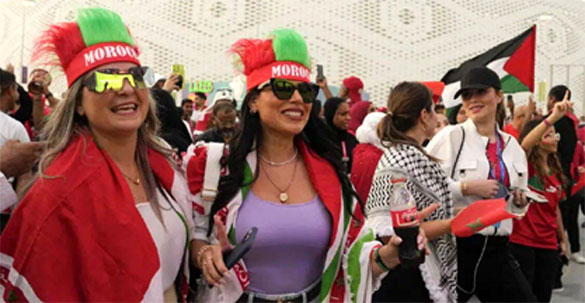
Female Morocco fans arrive
at the stadium before the World Cup quarterfinal soccer match between Morocco
and Portugal, at Al Thumama Stadium in Doha, Qatar, Saturday, Dec. 10, 2022.
(AP Photo/Ebrahim Noroozi, File)
------
By HELENA ALVES And LUJAIN JO
December 16, 2022
DOHA, Qatar (AP) — Coming from Brazil for the World
Cup in Qatar, Daniela Crawford had been worried about conservative dress codes.
But like many women attending the tournament, she said she found no problems.
“In Brazil people are used to it, but we came here and
decided to show how we are,” said Crawford — wearing shorts — as she took
pictures with a Brazilian flag with her husband and two sons outside Doha’s
Education City Stadium before the Brazil-Croatia quarterfinal match last week.
This is the first World Cup held in an Arab and Muslim
nation. In the lead-up, the Qatari government, world soccer body FIFA and
national governments advised people attending from around the world to respect
local customs, on everything from women’s dress to drinking.
Many women fans speaking to The Associated Press said
that despite worries, they’ve encountered no troubles and only had to make
minor adjustments in how they dress. Some welcomed Qatar’s tight restrictions
on alcohol, saying it made them feel safer. Qatar, meanwhile, is presenting the
tournament as an opportunity to overcome stereotypes about women’s role here.
Qatar is a conservative nation, and most Qatari women
in public wear the headscarf and loose-fitting robes. But it’s also home to an
international population of more than 2 million foreign workers, far
outnumbering the around 300,000 citizens – so it’s hardly unused to foreign
women.
Bemie Ragay, a Filipina woman who has worked in Qatar
for eight years, said she has always felt safe, “safer than my country.” Attire
is not an issue as long as you know the boundaries, she said, pointing out that
she was wearing a crop top.
“You can’t just walk here in the street in a backless
(outfit). You have to respect their culture,” she said.
Isabeli Monteiro, a 32-year-old Brazil supporter, said
she was wearing longer skirts instead of shorts and has had no difficulty.
“Nobody looks at us in any way, especially because we are within a World Cup
with different cultures from all over the word.”
Women played an integral role in organizing the World
Cup, including several in high positions in the Supreme Committee, the body in
charge of the tournament, said Fatma Al Nuaimi, the SC spokesperson.
She said she hoped one legacy of the tournament would
be to change attitudes about women in the region.
“A lot of people actually have a misperception,
especially when it comes to the role of women in Qatar or in the region,” she
said. Fans coming to Qatar see that “women do have rights and women are
actually being empowered,” she said.
Qatar has said improving the situation of women in the
tiny Gulf nation is one of its priorities. Women hold a number of prominent
government and academic positions, including three ministers in the Cabinet.
The mother of its ruling emir, Sheikha Moza bint Nasser al-Missned, is one of
the most famous women in the Arab world, known for advocating for social
causes.
Qatar also has one of the strongest rates of women’s
education in the Arab world. The number of Qatari women in university is twice
the number of Qatari men, and nearly all Qatari children — boys and girls —
attend primary school.
Still, the country has for years sat near the bottom
of the World Economic Forum’s Global Gender Gap Report, which tracks gaps
between women and men in employment, education, health and politics.
Rights groups have pointed in particular to laws that
require a male guardian’s permission for a woman to travel or marry, and they
say women often need the same permission to work or for some forms of
reproductive health care, including pap smears.
Around 37% of Qatari women work, high for the region,
but it has remained level in recent years, according to government statistics.
By comparison, Saudi Arabia has seen a more aggressive growth, with the
percentage of Saudi women with jobs rising from 14% in 2019, one of the lowest
in the region, to nearly 27% this year.
Mead El-Amadi, director of the FIFA Fan Festival in
Doha, said women involved in organizing the tournament will be role models for
other women who want to go into the business of soccer or sports in general.
“Globally football is a male-dominated sport,” she
said. But she said women organizers had support of their male colleagues “to
make this happen and to make the world look at us today, delivering this huge
event.”
Source: AP News
https://apnews.com/article/world-cup-qatar-women-dress-code-1540eabaacedbe9835546473f1c13b9f
--------
Malala Puts Her Faith In Activists To Further Girls’
Education Cause
Yusra Askari
December 17, 2022
LAHORE: Once dubbed ‘the bravest girl in the world’,
Malala Yousafzai has grown into a poised young lady of unwavering vision.
I first had the pleasure of meeting 16-year-old Malala
in London, barely a year after she was attacked. I am Malala had just been
released and she and her family were slowly adjusting to life in the UK.
A little over 12 months later, I found myself in the
lobby of the Grand Hotel in Oslo, shaking the hand of the youngest-ever Nobel
Peace laureate, moments before she was to be conferred with the honor.
On both those occasions, Malala had looked me in the
eye to say, “I will return home”.
I had my doubts, but she had none.
The campaigner for girls’ education is now on her
second visit to Pakistan this year, and I caught up with her on a cool winter
evening in Lahore to discuss her work, new partnerships and her plans for the
future.
The Malala Fund has so far invested $9.6 million in
projects aimed at improving girls’ access to quality education in various parts
of Pakistan, while $700,000 has been allocated by the fund towards flood relief
activities, Nobel laureate Malala Yousafzai said.
In a wide-ranging interview with Dawn during her visit
to Pakistan, Ms Yousafzai revealed that the fund is currently working with the
federal and provincial governments to ensure that around 13,000 government
girls’ high schools have science, technology, engineering, arts, and
mathematics (STEAM) teachers and a state-of-the-art environment.
In her view, investment in education will prove to be
the key to addressing two Pakistan’s biggest problems, i.e. economic challenges
and climate-related disasters.
“If you look at all the research on climate change it
tells you that you have invest in gender equality, you have to invest in girls
education — you have to address these problems, it helps us create more climate
resilient economies, so I hope that going forward we will ensure that we are
preparing ourselves against such calamities,” she said.
The Malala Fund, which commenced its operations in
Pakistan in 2017, invests in education advocates and activists who are
“challenging the policies and practices that prevent girls from going to school
in their communities”.
“These are the activists I support through the Malala
Fund… on a local, federal and provincial level… because I believe their
activism can actually make a change. We are always open to ensuring an exchange
of knowledge and expertise,” Ms Yousafzai said.
She believes that in order to see a change in the
country; in policies, social norms and perspectives; all stakeholders need to
be taken on board.
“You have to be able to talk to civil society, you
have to talk to the experts, to the educators, to people who are doing research
work but also you have to open to be able to work with the government as well,”
she said, acknowledging that Pakistan was currently facing many challenges.
“[Pakistan] is vulnerable to climate change disasters…
resources are limited and there are additional external challenges as well… but
people here are passionate about seeing positive change.”
Flood relief
In October 2022, following the devastating deluge that
inundated more than a third of the country, Malala’s visit to meet with
flood-impacted communities across Sindh made international headlines. In an
effort to rebuild lives, the Malala Fund initiated rehabilitation efforts in
Dadu and its surrounding areas.
Recounting her whirlwind trip to the flood-affected
areas earlier this year, Ms Yousafzai said: “We saw how many villages were
completely covered in water. I had the opportunity to go Dadu where I visited a
camp, met with families and some amazing girls there who were at the secondary
level of their education. A lot of them were not in their schools because their
schools were either under flood waters, or they had been displaced.”
When asked whether she plans to make a follow-up
visit, Ms Yousafzai said she makes sure to stay in touch with the communities
she visited and would continue to provide support for girls’ education.
Oxford Pakistan Programme
During her time at university, the Oxonian said she
felt that there was not much content on Pakistan — a lack of scholars from
Pakistan and of opportunities for Pakistani students. According to her, some of
her friends came up with the idea of starting the Oxford Pakistan Programme,
which provides scholarships for students from her home country.
“Alongside the financial support system for students
faced with challenges to… [continuing] their studies… we also initiated the Allama
Iqbal Lecture Series. We want to bring attention to the Pakistani and South
Asian perspective; to our culture, our history and the diversity of thought and
philosophy that comes from our region.”
Ms Yousafzai said she would personally be supporting the
scholarship of one Pakistani female student who comes from a difficult
background.
In addition, she said, the Malala Visiting Fellowship
“is very definitely the first of many fellowships to come. I hope more and more
people will support this fellowship programme, the scholarships and all the
academic initiatives we are doing”.
Foray into showbiz
While she continues to don many hats as an activist,
Ms Yousafzai’s recent foray into the world of television and cinema has been an
unusual detour, even for someone whose interests are as diverse as her’s.
With her newly-minted venture Extracurricular
Productions, Malala has joined hands with Apple TV+ and claims currently to
have six or seven projects in the works, with several more concepts awaiting
approval in the pipeline.
“Two of our upcoming shows are based on books: one
being an adaptation of Fifty Words for Rain by Asha Lemmie — a heartrending
coming-of-age novel about a young woman’s quest for acceptance in post-World
War II Japan. The other is Disorientation, the witty tale of campus chaos by
Elaine Hsieh Chou for which we are working with Adam McKay. Another is based on
a matriarchal society of fisherwomen who live on Jeju Island in South Korea,”
she divulged, before stopping herself from revealing any more spoilers.
“Often we think of activism, from the lens of the NGO
sector, but we have to ensure we explore other means as well. That is why I am
focused on writing as well as producing television content. I know it is a lot
of work, but I enjoy it because I believe it can have an impact,” she said.
Earlier this year, Ms Yousafzai turned executive
producer with the critically acclaimed Joyland, that faced much opposition at
home, despite being slated to be Pakistan’s nomination for the Oscars.
When asked what prompted her to become part of the
project, she explained: “Joyland deserves all the praise and positive attention
it is getting. For me, the movie was deeply moving and I have personally learnt
so much from it.”
Source: Dawn
--------
Love Knows No Distance: Semanur Kutanis Turkish Woman
Finds Soulmate In S. Korea
DEC 14, 2022
Semanur Kutanis (21), a physically disabled Turkish
woman from the northern region of Black Sea province Rize, decided to tie not
with South Korean Koo Dongwan (25), whom she met via a social media platform
five years ago.
Dongwan, covering a distance of 7,300 kilometres
(4,536 miles) from South Korea to the Ardeşen district of Rize, was warmly
welcomed by the Turkish family and organized an engagement ceremony for the
duo.
"Dongwan has visited Türkiye twice before, but
this time, he came to formally ask for my hand. We are also planning to have
our wedding in the next two years, and then he will stay in Türkiye
forever," she expressed.
"I first told my mother about it. My mother was
my supporter. Then I told my aunts. They didn't find it strange because I am
someone who loves different cultures anyway. But it was really hard to reveal
this to my father face to face. Hence, I decided to write a letter to him about
the situation, First, he didn't agree, but later my mother, aunts and I
convinced him. They said, 'If you live here after your marriage, we have no
problem, we don't want you to leave," she explained.
On the other hand, Dongwan said: "We met through
my sister. When I learned that she was disabled, it didn't change my feelings
for her. Thanks to her, I came to know Türkiye and now I love Turks, they are
very hospitable and helpful. The decision to settle in Türkiye was not
difficult for me at all. I love the music of the Black Sea region, and I have
learned to play the horn (for folk music). I learned that distance is not an
obstacle for love," he expressed.
At their engagement, Dongwan reverted to Islam, and
this program was attended by the district mufti, Mehmet Genç, and was given an
Islamic name, Muhammet Ali.
Source: Daily Sabah
--------
Best friends, daughters of Lebanese immigrants empower
other Arab women with higher education goals
December 16, 2022
DEARBORN, Mich (FOX 2) - Two Dearborn natives and
children of immigrant parents, are hoping to help other Arab women. The goal is
give them the tools they need to succeed in higher education.
FOX 2: "What message would both of you send to
anybody who might find themselves wanting to carve out their own path?"
"This is going to sound so cliché but if you can
dream it you can do it," said Hannah Mackie.
Hannah and Lana Charara have been friends for over a
decade, and like many best friends, they share a lot in common - from their
upbringings to their aspirations.
"My parents didn’t go to college so when I wanted
to go, I had to figure out the whole thing myself," Hannah said.
"Picking a major, doing internships."
Hannah and Lana are proud Arab women. Their parents
were born in Lebanon and immigrated to the states. The girls however, were born
in Dearborn.
They both say, as they matured, growing up as modern
women in a traditional household had its challenges. From a young age, they
wanted more, they wanted to be independent, and self-sufficient with degrees
and careers - but they felt pressure.
"It is a very patriarchal culture and there is a
lot of the stress on motherhood and family life," said Lana. "And
sometimes education isn’t as emphasized for girls in these cultures and
communities."
So, these best friends leaned on each other, together.
They decided to go to the University of Michigan and last year they graduated –
both with degrees in political science and plans to go to law school.
But Hannah says carving out a path without an
immediate example to follow, was overwhelming.
"When you’re first generation or you’re new to
this country, you don’t have that," she said. "So we figure that we
could find this organization and be that resource for people."
"While other people in their lives may not be
emphasizing education or these other opportunities, we wanted to try and be
that support for them," said Lana.
In 2019 the two created "Empowering Arab
Women."
It is an organization that provides other young women
and girls in their community with the resources, knowledge and tools all needed
as they navigate college and higher education.
"We want to show them that there is a pathway for
these things," Lana said.
What started informally is now gaining traction on
social media, with Arab women around the country scheduling Zoom meetings and
exchanging emails.
"In recent years you see a lot more women in this
community seeking entrepreneurship, more going to school, and it sounds silly,
but even girls getting married at later
ages," Lana said. "It’s no longer the
priority."
"Believe in yourself and if you can dream it, you
can do it," Hannah said.
Source: Fox2detroit
--------
Infiltration of Brotherhood in new female faces!
December 16, 2022
Jameel Altheyabi
Around 12 years have passed since the so-called “Arab
Spring” that broke out in some Arab countries in 2011. Even after passing all
these years, the Arab people started realizing the existence of this malicious
phenomenon still and that is in terms of the Muslim Brotherhood’s infiltration
from its hideouts to take the lead in the scene, and give the alarming signals
to orchestrate their evil plans.
A number of Arab leftist ideologies have also
infiltrated through the window of the “Arab Spring,” which does not want to
accept the historical fact with regard to the failure of its intellectual and
political project.
Likewise, we saw the Baathists die in Iraq and Syria,
only to emerge in Sudan and Mauritania, without garnering any real support from
the Arab street. Ironically, the “ascension” of Communism ended in its Soviet
and Eastern European cradle. But the Arab Communists claim that its roots are
still kindling.
The “Arab Spring” allowed the Communists to ride the
horse of the Arab revolutions in order to restore the “sideburns” of
classification, and to underestimate others’ right even to exist. How horrible
is this paradox? The far right and the far left are allied to devour the cake
and slaughter the people.
They abandon the development and integrity of the
state to devote themselves to a bloody liquidation because of their well-known
historical differences. Consequently, people have to pay a heavy price in the
form of violence and dirty competition for power and wealth.
Astonishingly, both the left and the right do not have
national authority for their reference. Rather, their reference is foreign.
British journalist Mark Curtis revealed, in his famous book on the Muslim
Brotherhood titled “Secret Affairs: Britain's Collusion With Radical Islam,”
how the British intelligence created the Muslim Brotherhood, chose Hassan
Al-Banna to lead it in Egypt, and funded it to launch its campaign to destroy
Egypt and the Arab and Islamic peoples.
This sinister group is the offspring of British spies
in the Middle East. However, it succeeded in “clouding” the social awareness of
this fatal fact. Its way to do so was to trade in religion and “religionize”
politics. Even though the people refused to yield to the Muslim Brotherhood,
especially in Egypt, Sudan, and Tunisia, the embers of the Brotherhood are
still alive under the ashes and move from one conspiracy to another, waiting
for an opportunity to return to destroy people and countries, seize their
wealth, and change their behavior through the money of countries that are still
financing them.
There is no doubt that the Arab people learned the
lesson that the "spring" was nothing but a frightening autumn that
ended with the rise of the Islamists and the left, in addition to the emergence
of more chaos, violence, and instability. The turmoil caused by the “Arab
Spring” was not through the Brotherhood and the Communists alone, but was also
through all the fragmentations of the right and left such as Sahvi, Sururi,
ISIS, Al-Qaeda, and Takfiri with the aim of occupying power and stealing
people’s wealth. The left extremist outfits also emerged, and these included
Arab nationalists, Iraqi and Syrian Baathists, and Nasserists, along with the
Communists.
All of them are undoubtedly the consequences of what
happened in 2011. The Arab countries, affected by the impact of the so-called
“Arab Spring” have not managed to escape so far, except for Egypt, whose army
succeeded in it. Saudi Arabia stood beside its sister in foiling the
Brotherhood’s scheme, which fled as usual from confrontation, and then engaged
with terrorists, takfiri, and violent extremist ideologies to destabilize this
Arab country, which is important to Arab security and prosperity.
What is certain is that despite the failure of the
Brotherhood in achieving their criminal goals, their groups began trying to
infiltrate again through new platforms, media outlets, and means of new media
with “modernized” faces. And this time they brought in female elements to
reinforce the strategy of “leading the herd” to the guillotine of the hateful
Brotherhood thought.
These are infiltration attempts that include all
ideologies of religious merchants, from Brotherhood, Sahvi, and remnants of
Sururi and Al-Qaeda.
So we must be careful... the embers are still there
under the ashes.
Source: Saudi Gazette
https://saudigazette.com.sa/article/628040
--------
Abuse rampant as 860 violence cases against women in
Kuwait recorded this year
December 16, 2022
KUWAIT CITY, Nov 30: While the scope of violence
against women expanded in the country this year; there has also been a
significant increase in the number of women resorting to human rights and
security authorities to obtain their rights — an indication of the high level
of awareness among women, reports Al-Qabas daily. A number of lawyers and
activists in the field of human rights protection confirmed that the laws
enforced in the country provide the necessary legal protection for women; so
women are keen on protecting themselves.
Improvement of the reporting mechanism for the Public
Prosecution to receive domestic violence cases has contributed to expanding
legal protection for battered women. The daily obtained a copy of the special
human rights report, stating that 138 battered women resorted to human rights
and security authorities in 2021; while a study carried out by Kuwait Human
Rights Society showed that 860 violent cases have been filed in 2022 so far –
double the number of cases filed in previous years.
According to the study, the cases of abused women this
year are categorized into economic, psychological, emotional, physical and
human trafficking – a total of 345 complaints; while the number of those who
were subjected to cyber violence reached 412. Human rights activist Athraa
Al-Rifai believes that women have become more aware and they no longer tolerate
domestic violence, considering the implementation of laws aimed at protecting
them.
She stressed the importance of enforcing the
Protection Law properly and for the National Committee on Family Protection to
lay down a general policy, in addition to the establishment of shelters for
victims. She affirmed more women now have the courage to seek protection for
themselves, owing to the issuance of laws in this regard. She also cited the
big improvement in the mechanism for reporting domestic violence cases to the
Public Prosecution, asserting this has greatly contributed to the expansion of
legal protection for battered women. She disclosed some women are exposed to
extortion, which easily transforms from domestic violence to cyber violence;
prompting the Ministry of Interior to intensify efforts in protecting victims
of cyber violence or bullying through the allocation of a hotline number of
this purpose.
Chairwoman of the Board of Directors of the Kuwaiti
Society for National Fraternity Dr Bibi Ashour called on the government to
provide shelters for victims and activate the role of the National Committee on
Domestic Violence to deal with the rising cases of violence against women in
the country. She told the daily that civil society movements coordinated with
the government and Parliament in guaranteeing the rights of women and protecting
abused women in the past; but they need to intensify their efforts in
protecting women and providing shelters for battered women. Journalist and
political activist Iqbal Al- Ahmad pointed out that the spread of the ‘culture
of shame’ in Arab societies, including the Kuwaiti society, hinders ongoing
efforts to stop the inhumane acts against women – physical and psychological
assault.
She stressed that a high percentage of women condone
such violence due to societal pressure. In her interview with the daily,
Al-Ahmad urged battered women to file a complaint immediately. She said this
will lead to a remarkable decrease in the number of assault cases. She added
most women do not report being subjected to violence. They do not scream
loudly, so the competent legal and psychological authorities could hear them;
thereby, making it difficult to do research on violence against women, she
revealed. She cited statistics from the Ministry of Social Affairs, which is
based on a study on domestic violence in Kuwaiti society, showing that a high
percentage of women tolerate emotional and verbal violence; while the
registered number of abused women is not accurate due to the social obstacles
they are facing.
Attorney Osama Al-Sanad confirmed that the spread of
social media led to an increase in the number of women complaining about
electronic blackmail, especially the threat to publish private photos or
information that could be disgraceful if the conditions of the blackmailers are
not met. He said the statistics issued in 2021 indicate that 80 percent of
domestic violence victims withdraw lawsuits against the accused, then the issue
ends and no one follows up the cases after that.
He pointed out that such behavior tempts the accused
to commit the crime again, stressing the need to pass legislation on
establishing specialized agencies to follow up domestic violence cases even
after an amicable settlement in order to ensure the safety of the victims. He
explained the Domestic Violence Law obliges anyone who witnesses domestic
violence to report it to the authorities and whoever fails to do so will be
penalized as per the Penal Code — imprisonment for a period not exceeding one
year. Chairman of the society’s Complaints Committee Mishari Al-Sanad confirmed
the strong coordination between government agencies in dealing with violence
cases; indicating that 89 percent of recorded violence cases include cyber
bullying, threatening to publish personal information and sending unwanted
messages.
On the recorded human trafficking cases, Al-Sanad said
these cases are considered one of the types of violence committed against women
and girls or the exploitation of people by means of force, fraud, coercion or
deception; disclosing 103 such cases have been recorded so far.
Source: Arab Times Online
--------
New Age Islam, Islam Online, Islamic Website, African Muslim News, Arab World News, South Asia News, Indian Muslim News, World Muslim News, Women in Islam, Islamic Feminism, Arab Women, Women In Arab, Islamophobia in America, Muslim Women in West, Islam Women and Feminism