
Triple Talaq: India Muslim Women in Limbo after Instant Divorce Ruling
New
Age Islam News Bureau
14
September 2022
• First
Lady Diplomacy Complements Jokowi’s Effort as G20 President
• Indonesian
Girls Are Under Pressure to Wear the Hijab
• Doctor
Sparks Fury with Claim That 92% of Saudi Women Watch Porn
• Meet
Cairo’s First Female Metro Train Drivers
Compiled
by New Age Islam News Bureau
URL: https://newageislam.com/islam-women-feminism/triple-talaq-muslim-divorce/d/127947
--------
Triple
Talaq: India Muslim Women in Limbo after Instant Divorce Ruling
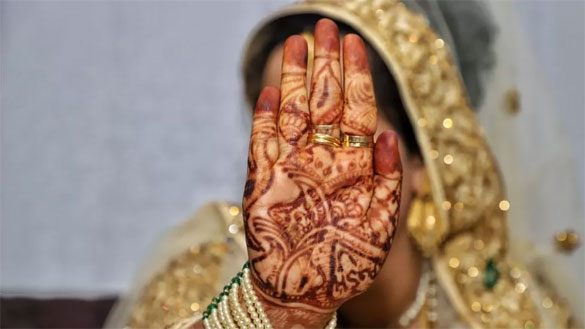
India
outlawed the practice of triple talaq in 2017
-----
By
Neyaz Farooquee
September
14, 2022
In
2017, India's Supreme Court outlawed the Islamic practice of "triple
talaq" which allowed a Muslim man to divorce his wife in minutes just by
saying "talaq" (divorce) three times. While the court's decision was
celebrated by women's rights activists at the time, five years on, many Muslim
women say that the ruling has left them in a limbo.
Afreen
Rehman was elated by the Supreme Court judgement as it made the unilateral,
instantaneous divorce given by her husband a few months earlier legally
invalid.
But
contrary to expectations, things didn't change much for her because her husband
declined to take her back.
Five
years later, Ms Rehman, one of the five women petitioners in the case, is
unsure if she is still married or a divorcee.
This
is also the story of three other women petitioners in the case. They are still
"divorced" as they haven't been taken back by their husbands yet.
Zakia
Soman, co-founder of the Bharatiya Muslim Mahila Andolan, a rights group that
was also one of the petitioners in the case, says that the August 2017
judgment, and the subsequent law in 2019 that criminalised the practice, has
had mixed outcomes for Muslim women.
"Their
husbands are happily remarried and have children, whereas these women continue
[to live] alone," Ms Soman says.
Before
the Supreme Court ruling, India was among a handful of countries that allowed
triple talaq. The campaign by Muslim women and activists for outlawing the
practice was championed by India's Bharatiya Janata Party (BJP) government, led
by Prime Minister Narendra Modi.
Subsequently,
the lead petitioner in the case, Shayara Bano, was made the vice-chairperson of
a women's rights group in the northern state of Uttarakhand, which is governed
by the BJP. Ishrat Jahan, another of the petitioners, has also joined the BJP.
But
some of the other petitioners are struggling - Ms Rehman has not been able to
find a stable job in all these years and Atiya Sabri has won a partial battle
for alimony but is constrained to stay with her parents.
However,
observers say that the top court judgment and the law that criminalised the
practice seem to have brought about a change at the social level.
"This
has brought awareness in the community that instant triple talaq is not the law
of God and our volunteers in different states are reporting that cases are now
fewer in numbers," says Ms Soman.
But
at the same time, cases of men abandoning their wives appear to have gone up. According
to the law, erring husbands are liable to serve up to three years in prison but
a lack of awareness is causing many Muslim men to desert their wives, with
little accountability.
Jameela
Nishat, who runs Shaheen Women's Resource and Welfare Association in the
southern city of Hyderabad, sent her volunteers to study matrimonial cases in
20 slums of the city after the law's introduction.
"They
found that out of 2,106 households surveyed, 683 had women who had been
deserted by their husbands," she says. "We used to get two-three
cases of desertions earlier, but with the introduction of the law, the cases
suddenly went up," Ms Nishat says.
Uzma
Naheed, a former member of the All India Muslim Personal Law Board, the
organisation that opposed the ban on instant triple talaq in court, has
observed a similar trend in Mumbai.
"It's
happening because men want to avoid giving maintenance to women," Ms
Naheed says. "This is very painful. The law has not helped."
Observers
say there has also been a noticeable rise in the number of women seeking
"khula" - a form of divorce initiated by women. Since
"khula" is granted on the woman's request, the man cannot be held
responsible for seeking an instant divorce.
"We
try our best to resolve the matter by organising a dialogue between the parties
and most of the cases are resolved amicably," says Ansar Alam Qasmi, the
head priest at Imarat-e-Sharia, a socio-religious organisation which has its
presence in the eastern states of Bihar, Jharkhand and Orissa. "But, yes,
reports from our centres suggest that instances of women seeking divorce have
indeed gone up."
Though
there is no cross-country consolidated data showing break-ups of instant triple
talaq and khula available, The Hindu newspaper found that many Darul Qazas -
Islamic arbitration centres - have seen a significant increase in the number of
women seeking khula in recent months.
It
signals a better awareness and a determined pushback from Muslim women, but the
practice is also often exploited by men.
Khalida
Begum (name changed to protect her privacy) from Telangana state learnt it the
hard way. She got married in October 2021 but violence at the hands of her
in-laws made her seek divorce. The husband declined, and asked her to seek
khula instead - which meant she had to forego claims of alimony.
She
agreed but put forth a condition: he must admit in writing that the reason for
khula was the violence he and his family had perpetrated on her. Predictably,
he refused. As a way out of the stalemate, Khalida's mother suggested that she
drop the condition, but she refused.
"Why
should I take the blame for what he has done? He comes out clean but, despite
tolerating everything, I seem to be the bad one," Khalida told the BBC.
Her struggle continues for now.
Ms
Rehman is trying to remarry, but has had no luck. "Her case has been
highlighted so much that people are now afraid of Afreen," says Naseem
Akhtar, a Jaipur-based women's rights activist, who helped Ms Rehman take her
case to the Supreme Court.
"The
day the verdict came out, Afreen was on every TV channel. Her non-Muslim boss
fired her when he got to know about the case, saying 'you are such a shrewd
woman that you went all the way to the Supreme Court against your husband. What
if you file a case against us?'" says Ms Akhtar.
Her
family is supportive, but the thought of remarrying now scares her, says Ms
Rehman. "My life has not changed. I am already a villain."
"But
it must change for future generations," she adds.
Source:
BBC
https://www.bbc.com/news/world-asia-india-62805107
--------
First
Lady Diplomacy Complements Jokowi’s Effort As G20 President
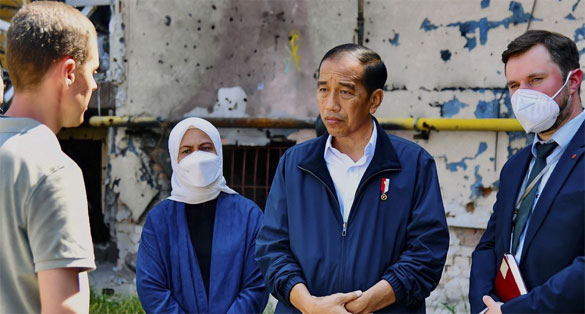
This
handout picture taken and released by Presidential Palace on June 29, 2022,
shows President Joko Widodo (second right) and Indonesia's first lady Iriana
(second left) stand near damaged residential buildings during their visit in
Irpin. (AFP/Presidential Palace). Usage: 0 (AFP/Presidential Palace)
-----
By Athiqah
Nur Alami
14
Sep 2022
JAKARTA
(The Conversation/JP/Asia News Network): President Joko 'Jokowi' Widodo
attracted global attention when he paid a visit to Ukraine and Russia last
month. But fewer observers and public noticed that his wife, First Lady Iriana
Widodo, also accompanied him on the trip – including to Kyiv, the city
currently deemed as the world’s most active war zone.
Iriana
became the second First Lady to visit Ukraine after Jill Biden, United States
President Joe Biden’s wife, in May.
Over
many decades, first ladies from around the world have shown they have important
roles to play in diplomatic missions. They often offer different approaches to
counter the traditional masculine styles of state leadership, and are able to
create a more favourable image of their countries overseas.
The
roles of first ladies in diplomacy First lady diplomacy has a long history and
tradition in international relations in many Western countries. I
n
the US, many past first ladies – from Eleanor Roosevelt, Jacqueline Kennedy,
Laura Bush, Hillary Clinton, to Michelle Obama – have played active roles in
public diplomacy.
The
recent presence of Ukrainian First Lady, Olena Zelenska, at the US Capitol to
call for more weapons to be sent to her homeland has proven the more pronounced
role of first ladies in peace missions.
In
Asia, China’s First Lady Peng Liyuan has taken an active role in diplomacy to
support President Xi Jinping’s foreign policy since 2013.
For
China, the friendly, charismatic presence of Liyuan in Chinese diplomacy has
been significant to create a counter perception against Xi’s assertive
diplomatic style.
The
first ladies have not only accompanied their husbands on overseas trips, but
also made solo trips to a number of countries for diplomatic missions.
One
example is Michelle Obama’s trip to China in 2014, which has been praised for
its success in showing US’ goodwill amid its complex relationship with China.
In
general, there is still limited academic research about first lady diplomacy.
Studies
about women and their roles in international affairs mostly examine female
diplomats and foreign ministers in terms of their diplomatic and negotiating
abilities. Diplomatic efforts and effects by the first ladies, as well as their
merits for their countries’ national interests, have not been widely reported
and recognized.
This
is understandable considering that the first ladies usually do not have
official constitutional duties other than ceremonial roles.
According
to a 2012 paper by US communications studies lecturers Keith V. Erickson and
Stephanie Thomson, there are at least three aspects to the diplomatic roles of
first ladies.
First,
managing the credibility of the president, such as by playing the role of
companion and surrogate. Second, encouraging international relations,
especially through cultural diplomacy. Third, engaging in social activism, such
as promoting humanitarian issues.
The
presence of first ladies in diplomatic activities shows the existence of
feminine norms in the midst of masculine and male-dominated arena of
international politics.
The
more feminine or maternal styles of first ladies can be perceived as helping to
“soften” the hard-line styles of their husbands.
First
ladies also contribute to the construction of national image of a country. Some
studies say that the intellectual ability and charm of the first ladies are
believed to be able to bring their figures closer to the international public.
There
have been some first ladies who have huge impacts on advancing women and human
rights issues in the international stage.
Eleanor
Roosevelt, for example, after finishing as first lady, became the chairperson
of the drafting committee of the Universal Declaration of Human Rights (UDHR).
Michelle
Obama also led a global campaign through “Let Girls Learn” programme to empower
young girls across the world to secure a quality education. Their experiences
have demonstrated how first ladies could play beyond their ceremonial roles and
create a huge impact for society.
Iriana’s
roles: what does it mean for Indonesia’s diplomacy?
The
presence of First Lady Iriana accompanying President Jokowi to a war zone and
providing humanitarian assistance to a hospital in Ukraine has been applauded
by many Indonesian people on social media.
Many
international relations and law experts see her presence as a symbolic message
that Indonesia can bring the hope of friendship, which can be a first step to
open peace talks.
Indonesia
and Ukraine have significant differences, both geographically and culturally.
While Indonesia is an Asian country with a Muslim majority population,
three-fourths of the Ukraine’s population adheres to Orthodox Christianity as
the predominant religion.
Thus,
Iriana’s diplomacy is an effort to introduce Indonesia’s identity to the
Ukrainian people, and to shape the image of Indonesia as a country that is open
and friendly.
This
is important for Indonesia, which holds the G20 presidency this year. In doing
so, Jokowi aimed to project himself as a peace-broker who invited both Ukraine
and Russia to the G20 Summit in Bali this November.
Indonesia
needs to ensure that the G20 summit in Bali in November 2022 runs smoothly. One
indicator for that is the in-person attendance of all G20 members.
Even
if the effect of Jokowi’s trip on overcoming the global food crisis caused by
the Russia-Ukraine war remains uncertain, at least the presence of Iriana on
the trip can bolster Jokowi’s image among Indonesians and help him build a
legacy before he leaves office in 2024.
At
a whole, the first lady diplomacy can complement conventional diplomacy by
heads of states as the authoritative representations of countries.
First
ladies can play significant roles in diplomatic strategies to increase
friendship between countries.
First
ladies should no longer be considered voiceless and only carry out ceremonial
roles. They should and deserve to be active actors in international diplomacy.
In
addition, to make it more meaningful, first ladies must have the power to
amplify the states’ commitment to uphold women empowerment and advancement.
***
The writer is a researcher at the National Research and Innovation Agency
(BRIN) This article is republished in the Jakarta Post from The Conversation
under a Creative Commons licence.
Source:
The Star
--------
Indonesian
Girls Are Under Pressure to Wear the Hijab
By
Ana Salvá
September
14, 2022
Last
July, the debate over the wearing of the hijab again caused a stir in
Indonesia, when a 16-year-old Muslim student was allegedly forced to wear it by
teachers at a public school in the city of Yogyakarta on Java Island.
The
young woman, who is Muslim and does not wear the hijab in her daily life as a
personal choice, felt coerced by the school. She was particularly distressed
when a guidance teacher forced her into wearing a hijab in front of other
students.
This
caused her anxiety and led her to cry in her bathroom, where she was locked up
for almost an hour. The director of the school, and the teachers involved, have
been suspended from their duties while authorities investigate what happened.
Meanwhile the student accepted the option of being transferred to another
school.
In
recent years, several cases of teachers forcing female students to wear the
hijab (the veil used to cover the head, neck, and chest by some Muslim women in
Indonesia) have made headlines.
Indonesia,
a country of 280 million people of whom 88 percent are Muslim, has witnessed a
growing religious conservatism in recent years. The movement has spread to
different facets of society and is having an impact on women’s everyday life.
As
Elaine Pearson, acting Asia director for the NGO Human Rights Watch (HRW),
explained in an email, the shift toward mandatory hijab wearing “was gradual
through the use of local decrees.” But it really stems from the province of
Aceh, a semi-autonomous Indonesian province on the northwest tip of Sumatra
Island, gaining the right to implement Shariah, or Islamic law, in 1999.
Shortly
thereafter, in 2002, the Aceh government passed a local regulation mandating
Islamic dress codes, which for women included the jilbab (a long, loose outer
garment, which is worn by both men and women). Following that move, Pearson
said, “several provinces and regencies in places like West Sumatra and West
Java started to adopt their own by-laws mandating the Jilbab in certain public
buildings, universities, and schools.”
In
2014, the student uniform regulation was released and while it did not make the
hijab obligatory, it was interpreted that way by a number of public schools.
Most of the state schools in Indonesia’s Muslim-majority provinces, at least 24
provinces, chose the hijab, long-sleeve shirt, and long skirt as uniforms for
their female students, according to Pearson.
In
February 2021, the complaint of the father of a high school student rejecting
school regulations that required all girls to wear the hijab at a center in
Padang, the capital of West Sumatra, spread on social media. The young woman is
of Chinese descent and practices Christianity.
Minister
of Education Nadiem Makarim, Minister of Internal Affairs Tito Karnavian, and
Minister of Religious Affairs Yaqut Cholil Qoumas, had to take action: they
signed a decree allowing any student or teacher to choose whether or not to
wear the hijab at school.
However,
this decree was canceled three months later by the Supreme Court, following a
petition by the local group Lembaga Kerapatan Adat Alam Minangkabau, a
quasi-state institution that has lobbied for Shariah to be implemented in West
Sumatra.
Pearson
explained that this group advocates for many Shariah-inspired ordinances in West
Sumatra, including the mandatory hijab as well as laws to prohibit same-sex
relations. “The decree was overturned largely on jurisdictional grounds,
arguing that education is a matter for regional, not central government.
Unfortunately, they won,” she said.
An
inter-ministerial team is now reviewing dozens of mandatory hijab rules and
regulations and their impacts on schoolgirls and female civil servants. They
will report their findings to Vice President Ma’ruf Amin,” explained Pearson.
A
report published in 2021 by Human Rights Watch showed that in recent decades,
the number of national and regional laws that seek to regulate the uniforms of
Muslim girls and women in the educational system has grown.
Women
have not always faced this much pressure over their attire. As Jakarta Islamic
State University professor Saiful Mujani shared on his Facebook page: “Muslim
student clothing like this in Indonesia was a common symptom before the 80s.
Many parties claim that wearing the hijab and even the veil is an obligation
that is ordered in the Qur’an. Was it before the 80s that the verses related to
the hijab and the veil did not enter Indonesia?”
“What
is most likely is that a new interpretation of these verses appeared in the 80s
after the Iranian revolution or later because of the influence of Arab fashion
that is getting stronger in the country. Whatever the reason, whether the veil
is obligatory is a matter of mere human interpretation… and all of them are
open to error,” explained the professor.
“Therefore,
there should be no public institutions such as government offices, public
schools or madrasas, state universities, and even state Islamic universities,
which require the veil,” he added.
The
HRW report documented the widespread harassment of girls and women who do not
wear the hijab and the deep psychological distress that this harassment can
cause. In at least 24 of the country’s 34 provinces, girls who did not comply
were forced to drop out of school or withdrew under pressure, while some civil
servants, including teachers, doctors, school principals, and university
professors, lost their jobs or felt compelled to resign, according to the
research.
In
recent years, pressure has increased on women to wear the hijab, said James
Chin, a professor of Asia Studies at the University of Tasmania in Australia
and an expert on governance issues in Southeast Asia.
The
pressure is less harsh in large cities, such as the capital Jakarta or on Bali
island, home to the majority of the Indonesian Hindu community. “Generally, in
semi-urban and rural areas, the people are getting more conservative. The
country’s leadership plays an important role because people look at the press –
how their leaders are dressing, or if the wife of a minister is wearing a hijab
or not,” said Chin.
In
his opinion, if a poll were done, “most Indonesians would say that wearing or
not wearing the hijab is more of a personal matter than anything else, unless
you are going to ask the religious sphere, where they think differently.”
The
central government has no legal authority to revoke local laws, such as Aceh’s
dress code, but in the other provinces, government regulations authorize the
Ministry of the Interior to override local executive orders that contradict
national laws and the constitution, said HRW, which is asking for urgent
action.
The
problem is not only that the pressures are increasing on women to wear the
jilbab in Indonesia. It is also that this pressure in turn “paves the way for
further restrictions on women,” concluded Pearson.
Source:
The Diplomat
https://thediplomat.com/2022/09/indonesian-girls-are-under-pressure-to-wear-the-hijab/
--------
Doctor
Sparks Fury with Claim That 92% of Saudi Women Watch Porn
13
September, 2022
A
doctor in Saudi Arabia has caused a social media storm by claiming that 92% of
Saudi women watch porn.
Dr.
Nizar Bahberi, the head of the Saudi Infectious Diseases Society in Jeddah,
said in an interview with the Rotana Gulf channel that when he first began
collecting data on the issue in 2014, he found that only 23% of Saudi women had
seen at least one pornographic video in the past year.
“However,
when I repeated the survey in 2019, the percentage reached 92% of respondents.
They numbered 3,000 women,” he said.
“Therefore,
in many pre-marital seminars I tell men that you can’t blame you wife who you
recently married and ask her, ‘how do you know about these things?’ because
access to this content is much easier than before,” the doctor added.
However,
his comments caused outrage in the conservative Saudi kingdom, which has strict
social and religious taboos against extra-marital sexual activity, with social
media users even launching an Arabic-language hashtag against him –
#Nizar_Bahiri_Insults_Saudi_Women.
In
response the doctor tweeted that he had not intended any offence but was merely
publishing results of research, and that access to pornography was much easier
than before.
“More
than 3,000 women answered the question, ‘have you seen a clip at least once in
your life?’ and the answer was 92% yes. This doesn’t mean that it happens in
all of society, this is a sample which follows my [social media] accounts and
this means that [women watching porn] may happen,” Bahiri said.
However
another Saudi doctor, Eidan Alzahrani, attacked Biheri, tweeting “I used to
call for the protection of doctors against those attacking them… but now I call
for protecting society from some doctors and calling them to account for their insults”.
Source:
The New Arab
Https://English.Alaraby.Co.Uk/News/Doctor-Says-92-Saudi-Women-Watch-Porn-Sparking-Fury
--------
Meet
Cairo’s first female metro train drivers
Amr
Adel
September
14, 2022
CAIRO
— The French RATP Group, which manages, operates and maintains the Cairo Metro
Line 3, the main line serving Greater Cairo, has recently conducted training
courses for a number of women to drive trains. This step is a precedent on the
path to empowering women in Egypt and integrating them in various sectors,
through jobs that not long ago were strictly reserved for men.
Although
the Cairo Metro is the oldest metro line in Africa and the Arab world — as it
opened for the first time in the late 1980s — no woman has ever driven a train
there. In Egypt’s patriarchal society, appointing women in this type of job is
tantamount to rebellion against several social restrictions.
The
passengers of Line 3, the newest line of the metro network, are now seeing
women sitting in the driver's cabin and completely controlling the train. This
was unexpected even by the most optimistic about the future of working women in
Egypt and the Middle East.
A
source in RATP told Al-Monitor on condition of anonymity, “The Company
announced its need for female train drivers. This was the first time the
company made such recruitment announcements for women in Egypt. Among the 30
female candidates who passed the exams, two women were appointed — Hind Omar
and Suzan Muhammad.”
He
said, “The Company wants to attract more women to be appointed to several other
jobs at the metro Line 3 stations, including drivers and even station
attendants.”
According
to a statement by RATP, of which Al-Monitor received a copy, the head of the
National Authority for Tunnels, Essam Wali, stressed during the graduation
ceremony for the new batch of metro drivers that training female drivers will
add more efficient skills to the Egyptian cadres in one of the most important
national and vital projects aimed to facilitate the lives of citizens.
Al-Monitor
discussed with Omar the long procedures and tests she went through to become
the first female train driver in Egypt. She said, “I am very proud to take on this
job as the first female train driver. I have to be extremely patient, vigilant
and tactful to deal with any situation that a metro driver may face.”
She
noted, “As soon as I step into the driver’s cab, I start getting different
reactions from the train commuters. Some women would rush to hug me and give me
their blessings while other commuters would accuse me of stealing the few job
opportunities available for men in Egypt. Some even question my ability to
become a good train driver since they believe women are still unable to drive
cars properly.”
She
added, “The strangest incident that happened to me was when an old man leaning
on a crutch refused to board the train when he saw me driving it. However, I
set an example for other girls in Egypt to change the prevailing perception
about women. My skills prove that women can succeed not only at home, but also
in various fields of work. The female would-be drivers took the same driving
and qualification tests [during the RATP training courses] as men and some of
them got higher scores.”
Omar
said, “I never dreamed of driving a train. No woman took this job before to
inspire me to do so. But now I encourage other women to break into this field
and other fields that were difficult for women, to prove that we can do
anything we set our mind to.”
Ahlam
Hanafi, member of the National Council for Women, told Al-Monitor, “When they
receive the adequate education and training, women can take on the same jobs as
men, even jobs that were once seen as far-fetched and outright impossible for
women. We are proud of the new female metro drivers.”
She
said, “President Abdel Fattah al-Sisi has allowed women to make valuable
achievements. Our country must exploit women’s creativity and innovation. In
today’s world, women are excelling in various jobs, and we are behind on
achieving women’s equality. Women in Egypt were supposed to be able to hold
many jobs a long time ago.”
The
move to appoint women as metro trains drivers falls within the framework of the
comprehensive expansion of Metro Cairo, in addition to establishing new lines
to serve Cairo's population of more than 20 million people.
Egypt
seeks to upgrade its public transport train system and network by inaugurating
three new metro lines, along with the first monorail line that connects the far
east of Greater Cairo to its far west.
Source:
Al Monitor
https://www.al-monitor.com/originals/2022/09/meet-cairos-first-female-metro-train-drivers
--------
URL: https://newageislam.com/islam-women-feminism/triple-talaq-muslim-divorce/d/127947
New Age Islam, Islam Online, Islamic Website, African Muslim News, Arab World News, South Asia News, Indian Muslim News, World Muslim News, Women in Islam, Islamic Feminism, Arab Women, Women In Arab, Islamophobia in America, Muslim Women in West, Islam Women and Feminism