
The Contemporary Relevance of Allama Syed Sulaiman Nadvi's Book 'Khutbat-E-Madras'

By Dr Zafar Darik Qasmi, New Age Islam
10 February 2026
Abstract:
Allama Syed Sulaiman Nadvi’s book Khutbat-e-Madras is an important intellectual work that remains highly relevant even after one hundred years. These lectures were delivered in 1925, a time of political, religious, and cultural challenges. Through this book, Allama Nadvi presented the life of Prophet Muhammad (peace be upon him) as a complete, practical, and universal model for humanity. He explained that true human perfection cannot be achieved through material progress or philosophy alone, but through faith, moral values, and righteous actions.
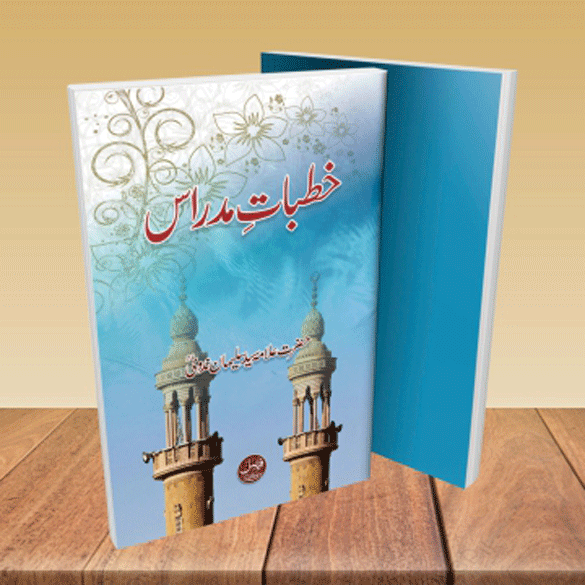
The book highlights that the Prophet’s life is historically authentic, comprehensive, complete, and practical, making it a perfect role model. It also includes a thoughtful comparative study of religions, encouraging dialogue and mutual understanding. In today’s world of hatred, discrimination, and moral confusion, Khutbat-e-Madras reminds us of self-accountability, balance, and positive thinking. Its message is still meaningful for building peaceful individuals and a harmonious society.
Main Points:
· Khutbat-e-Madras presents Prophet Muhammad’s life as a complete, universal, and practical model for humanity.
· Allama Nadvi combined faith, reason, history, and research to present balanced and thoughtful Islamic guidance.
· The book stresses that moral and spiritual guidance is essential alongside scientific and material progress.
· It promotes interfaith understanding through a respectful and comparative study of different religions.
· Even today, the book guides society toward self-reflection, harmony, justice, and positive social responsibility.
—-
It is a historical fact that whenever societies have faced serious problems and challenges, scholars, researchers, religious thinkers, and sensitive institutions have stepped forward to guide people in a balanced and meaningful way. Their historical importance and social usefulness cannot be ignored. However, the nature and method of this guidance have differed according to time and circumstances.
Scholars and intellectuals generally adopted the path of research and teaching to provide social guidance. Other effective and responsible institutions worked for social reform through different appropriate methods. Each of these efforts has its own importance and value, and their achievements still shine on the pages of history.
Among these remarkable contributions, one very important and valuable work is Khutbat-e-Madras by Allama Syed Sulaiman Nadvi, delivered exactly one century ago. Allama Syed Sulaiman Nadvi needs no introduction due to his administrative abilities and outstanding scholarly achievements. The most distinctive features of his intellectual legacy are balance, broad-mindedness, academic honesty, and strong reasoning. He was neither a blind follower of tradition nor an unthinking admirer of modernity. Instead, he presented Islamic thought using sound principles of reason, history, and research.
In his writings, emotional exaggeration is replaced by intellectual balance and seriousness, which not only convinces the reader but also brings inner satisfaction. His style represents a bright chapter of intellectual history whose light continues to grow stronger with time.
Khutbat-e-Madras completed one hundred years in 2025, as these lectures were delivered in October–November 1925. The book consists of eight lectures, titled as follows:
The completion of humanity is possible only through the lives of the Prophets
The only universal and eternal model of action is the life of Prophet Muhammad (peace be upon him).
· The historical aspect of the life of Prophet Muhammad (peace be upon him).
· The perfection of the Prophetic biography.
· The comprehensiveness of Prophetic life.
· The practical and actionable nature of the Prophetic model.
· The message of the Prophet of Islam (peace be upon him).
· The practical application of the Muhammadan message.
A close study of these lectures shows that Allama Syed Sulaiman Nadvi highlighted very important aspects of the Prophet’s life (peace be upon him). Fundamentally, the lectures establish that the life of Prophet Muhammad (peace be upon him) is not only an excellent model (Uswah Hasanah) but also a complete and perfect model (Uswah Kamilah). This directly refutes the view that the Prophet’s example is good but not complete.
Allama Nadvi explains that four essential elements are required for a personality to be a perfect role model: historical authenticity, completeness, comprehensiveness, and practicality. Any personality who possesses these four qualities can be considered both an excellent and a complete model. When we examine the lives of other Prophets or religious figures in this context, we find that these four qualities are found together only in the life of Prophet Muhammad (peace be upon him).
Another important intellectual feature of this book is its comparative study of religions. Allama Nadvi clearly explains why the personality of Prophet Muhammad (peace be upon him) is uniquely important and why his life is an eternal model for all humanity. This aspect of the book is especially relevant today, when interfaith dialogue, mutual understanding, and religious discussions are widely discussed through writings, conferences, seminars, and workshops. For all those interested in inter-religious dialogue, this book is a priceless contribution. The dialogical style of Khutbat-e-Madras reflects Allama Nadvi’s intellectual openness and mature scholarly method.
Another major strength of Khutbat-e-Madras is its detailed discussion on faith (iman) and righteous action (amal-e-salih). Allama Nadvi explains that righteous action is an essential part of faith. Human perfection cannot be achieved through material progress, scientific inventions, or philosophical ideas alone. Moral, spiritual, and practical guidance is necessary, and this guidance can only be obtained from the lives of the Prophets. When people adopt these blessed examples, they can become not only good individuals but also active contributors to a peaceful and righteous society.
The most important aspect of Khutbat-e-Madras is its contemporary relevance. The question arises: what is the importance of these lectures after one hundred years? A careful analysis shows that the ideological, cultural, and civilisational conflicts that existed a century ago, along with organised efforts to distance people from religion, are still visible today in different forms. Hatred, discrimination, and the weakening of democratic values remain serious problems.
Earlier, the struggle was for national freedom; today, the challenge is the protection of the Constitution and the rule of law. When we compare the political, social, religious, and intellectual conditions of that time with the present situation, it would not be an exaggeration to say that many similarities still exist. This similarity greatly enhances the relevance of Khutbat-e-Madras. Therefore, after a century, it is necessary for us to reflect upon ourselves and understand how social harmony and positive thinking are being undermined.
This century of intellectual renewal also reminds us that before Allama Syed Sulaiman Nadvi delivered these lectures in Madras (present-day Chennai), Christian missionaries regularly delivered lectures on the life of Jesus (peace be upon him). At the request of the Islamic Educational Association, Allama Nadvi presented these lectures. One can easily imagine how missionary speeches might have influenced the minds of students. From this perspective as well, Khutbat-e-Madras holds great importance.
After analysing the past century, it becomes clear that although today’s environment may seem difficult, the conditions during British rule were even harsher. To face today’s challenges, we need intellectual strength, strong religious commitment, and solid academic and research preparation. We must nurture individuals who can analyse situations wisely and present positive and balanced ideas to the community—exactly as Allama Syed Sulaiman Nadvi did through the message of the Prophet’s life (peace be upon him).
Today, we largely suffer from a lack of strong faith and self-accountability. Instead of self-reflection, we focus on finding faults in others and mistakenly consider this attitude a sign of wisdom. This is nothing but self-deception. The core message of Khutbat-e-Madras is that we should critically examine ourselves in the light of the life of Prophet Muhammad (peace be upon him). If we carefully observe events, analyse situations wisely, and then move forward, we can certainly contribute positively to our community, our nation, and humanity as a whole.
—-
Dr. Zafar Darik Qasmi is an author and a New Age Islam Regular Columnist.
URL: https://newageislam.com/islamic-ideology/book-syed-sulaiman-nadvi--khutbat-e-madras/d/138789
New Age Islam, Islam Online, Islamic Website, African Muslim News, Arab World News, South Asia News, Indian Muslim News, World Muslim News, Women in Islam, Islamic Feminism, Arab Women, Women In Arab, Islamophobia in America, Muslim Women in West, Islam Women and Feminism