
The Forgotten Theology of Restraint: Why Irja Matters Now

By Dr Hafeezur Rahman, New Age Islam
27 March 2026
A quiet doctrine that once restrained conflict still speaks to a divided present
In the long and often turbulent history of Islam, ideas have spread not only through power or conquest but also through reflection, restraint and moral hesitation. Among these quieter traditions stands Irja, the deliberate postponement of judgment. Once a stabilizing force in early Muslim society, Irja offered a way to manage disagreement without descending into excommunication or violence. Today, when Muslim societies remain entangled in sectarian tensions, rigid certainties and mutual accusations of disbelief, its near disappearance raises an urgent question. How did a doctrine meant to preserve unity become marginal within the very tradition it once enriched?
_NewAgeIslam.gif)
To understand Irja, one must revisit one of the most formative crises in early Islamic history. The assassination of the third caliph, Uthman ibn Affan, did more than end a political tenure. It fractured the moral and political unity of the Muslim community. His successor, Ali ibn Abi Talib, inherited not just a state but a deeply divided society, where demands for justice, vengeance and legitimacy collided.
What followed were not routine political disagreements but battles of conviction. Muslims stood against Muslims, each convinced of their moral correctness. Theology, in such a moment, could not remain neutral. It was drawn into the arena of conflict.
The most uncompromising response came from the Kharijites. They advanced a stark doctrine that fused belief and morality in absolute terms. For them, committing a grave sin was equivalent to disbelief. A sinner ceased to be a Muslim and could therefore be lawfully killed. This was not merely a theological claim but a political instrument that enabled the excommunication of rulers and communities and justified violence.
The consequences of such thinking were profound. Once faith becomes subject to human judgment of actions, and once that judgment is treated as final, the distance between disagreement and violence collapses. It was precisely in response to this absolutism that Irja emerged.
The proponents of Irja refused to enter the arena of definitive judgment. Their argument was both simple and radical. If fellow Muslims had committed grave sins, their ultimate accountability rested with God alone. Human beings, limited in knowledge and prone to error, did not possess the authority to declare others outside the fold of Islam.
This position was often misunderstood as indecision or passivity. In reality, it was a conscious refusal to weaponize theology. It represented moral restraint rooted in humility, not indifference.
Over time, Irja developed into a more structured theological position. At its core lay a subtle but significant distinction. Faith resided in belief and affirmation, while actions, though morally significant, did not define the essence of belief. A Muslim could commit serious sins and yet remain within Islam.
This did not imply moral relativism. Irja did not deny sin or excuse wrongdoing. Instead, it relocated ultimate judgment from the human to the divine domain. It created space for repentance, complexity and moral ambiguity without collapsing everything into rigid binaries.
Among the scholars who articulated this position most clearly was Imam Abu Hanifa. He maintained that a Muslim does not cease to be a Muslim due to sin. Faith, in his formulation, consisted of belief in the heart and affirmation by the tongue, not the perfection of deeds. This distinction introduced a degree of theological flexibility that later shaped large parts of Sunni Islam, particularly through the Hanafi Maturidi tradition.
Yet Irja did not retain its central place. Its marginalization was gradual and shaped by multiple forces.
One reason lay in perception. Because Irja discouraged declaring rulers as infidels, it was seen by critics as politically accommodating or quietist. This reading is incomplete. Many who held Irja inspired views were not passive. They criticized injustice and, in some cases, resisted authority. Their refusal was not against dissent, but against turning theological judgment into a tool of exclusion.
A more decisive shift came with theological currents that insisted on the inseparability of faith and action. Scholars such as Ibn Taymiyya argued that belief could not be divorced from practice. Failure to implement divine law, in this framework, signaled deficient or even absent faith. While internally coherent, this position narrowed the space for ambiguity and tolerance that Irja had preserved.
Centuries later, this emphasis found renewed expression in the movement of Muhammad ibn Abd al Wahhab. His insistence on doctrinal purity sharpened the boundaries between belief and disbelief. Practices seen as deviations were often labelled as polytheism, and those adhering to them risked exclusion.
In the modern era, the consequences of this trajectory have become stark. Groups such as ISIS took the logic of excommunication to its extreme. Their worldview expanded the category of disbelief to include not only opponents but also large sections of Muslims themselves. Violence was not only justified but sacralized.
In a revealing moment, ISIS explicitly identified Irja as a threat. In a 2015 publication, it described the doctrine as a dangerous innovation. The reason was clear. Irja undermined the ideological foundation of excommunication. By refusing to equate sin with disbelief, it made it harder to declare others infidels and justify violence.
This opposition highlights a broader pattern. The rejection of Irja has often coincided with rigid and exclusionary interpretations of religion. Its presence, by contrast, has historically created space for coexistence, patience and humility.
More concerning, however, is not the critique from extremist groups but the relative silence within traditions that once carried Irja’s spirit. The Hanafi Maturidi framework, dominant across large parts of the Muslim world, absorbed elements of this doctrine. Yet over time, its emphasis on restraint weakened.
In many contemporary contexts, scholars and preachers appear increasingly quick to pass moral verdicts and assign labels. Questions that were once left to divine judgment are now addressed with human certainty. This shift has significant consequences.
When individuals or groups begin to decide who is within or outside Islam, the space for internal diversity narrows. Differences that could have been managed through dialogue harden into divisions, and divisions into hostility.
The absence of Irja’s spirit is also evident in responses to sensitive issues. Debates around blasphemy, sectarian identity or doctrinal disagreement often provoke immediate and intense reactions. The language of judgment becomes sharper, while the space for reflection diminishes. In such an environment, even minor disagreements can escalate into major conflicts.
Revisiting Irja does not mean lowering moral standards or excusing wrongdoing. It does not suggest that actions are irrelevant. Rather, it calls for a rebalancing. It reminds believers that they are not the final arbiters of faith and encourages a distinction between moral evaluation and existential judgment.
In practical terms, this could foster a more measured approach to contemporary challenges. Instead of immediate condemnation, communities could priorities dialogue, education and due process. Instead of rushing to define boundaries, they could allow space for diversity within a shared framework of belief.
At a broader level, such a perspective could reshape both internal relations within Muslim societies and their engagement with the wider world. A community grounded in restraint and humility is less likely to be perceived as rigid or exclusionary. It becomes easier to build bridges across differences.
The tragedy is not merely that Irja has faded, but that its absence is felt precisely where it is needed most. The intellectual resources for a more balanced and humane approach already exist within the tradition. What is lacking is not knowledge, but emphasis.
Part of the answer may lie in a human tendency towards certainty. Judgment offers clarity, even when premature. It creates firm boundaries, even when artificial. Restraint, by contrast, demands patience, humility and a willingness to live with ambiguity.
Irja demands exactly this. It asks believers to recognize the limits of their knowledge and resist the urge to deliver final verdicts reserved for God alone.
In an age of loud certainties and deep divisions, such restraint may seem difficult. Yet it may also be necessary. Revisiting Irja is not about nostalgia. It is about reclaiming a principle that speaks directly to the present. It prioritizes unity over division, humility over arrogance and restraint over excess.
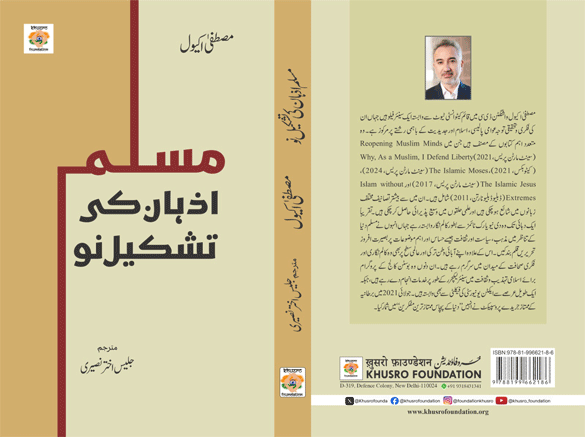
For a deeper exploration of these themes, readers may turn to Khusro Foundation’s latest publication Muslim Azhaan ki Tashkeel e Nau, the Urdu edition of Mustafa Akyol’s Reopening Muslim Minds, which engages with the intellectual and moral challenges facing contemporary Muslim thought.
…
Dr Hafeezur Rahman is an author and Islamic scholar, and serves as the convener of the Khusro Foundation, New Delhi.
URL: https://newageislam.com/islamic-ideology/forgotten-theology-restraint-why-irja-matters-now/d/139426
New Age Islam, Islam Online, Islamic Website, African Muslim News, Arab World News, South Asia News, Indian Muslim News, World Muslim News, Women in Islam, Islamic Feminism, Arab Women, Women In Arab, Islamophobia in America, Muslim Women in West, Islam Women and Feminism