
Abdul Ahad Nadim, Voice of Devotion and Social Reform in Kashmir

By Altamash Ali, New Age Islam
07 May 2026
Abdul Ahad Nadim was a leading Kashmiri poet whose Naats combined deep devotion to Prophet Muhammad with strong social critique. Rooted in Sufi thought, his work promoted justice, equality, and true faith, leaving a lasting impact on Kashmiri literature and spiritual tradition.
Main Points:
· Renowned Kashmiri Naat poet devoted to Prophet Muhammad and Islamic spirituality.
· Emphasised Tawheed, Risalat, justice, and human equality in his poetry.
· Criticised religious hypocrisy and social injustice through works like Shahar-e-Ashob.
· Blended Sufi philosophy with practical social reform and awareness.
· A central figure in Kashmiri Naat tradition; his poetry remains popular today.
Yarub Madni Jani Jahanus
Sooz preth Aanus teeth salwaat
Yeet che chie imkaan qudrech paanus
Sooz preth Aanus teeth Salwaat Or
Arabee shaaha madanee maahaa
Asi gotsh gati manz gaashaa chon
Maahaa tareef chonuy taa haa
Asi gotsh gati manz gaashaa chon
Abdul Ahad Nadim was one of the great poets of Kashmiri literature who made Islamic devotion, Sufi colours, and social awareness the foundation of his poetry. His Naats are so deep and powerful that they are still sung and recited in Kashmir even today. His thought process was mainly based on Tawheed (Oneness of God), Risalat (the greatness of Hazrat Prophet Muhammad), and human equality.
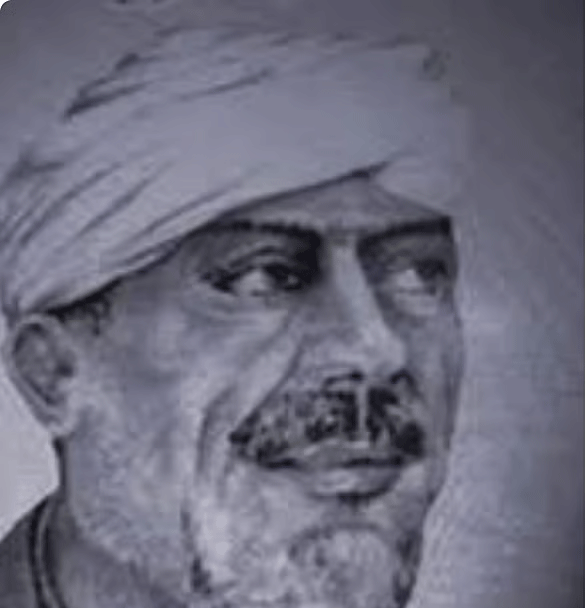
He believed that true devotion should only be for Allah and His Messenger Hazrat Prophet Muhammad, and not for worldly customs or hypocritical Mullahs. In his poetry, Hazrat Prophet Muhammad is repeatedly presented as Rahmatul-lil-Alameen (Mercy for all worlds). In one Naat, he says that the glory of the Hazrat Prophet Muhammad is such that the entire universe lies at his feet.
Nadim Sahab’s philosophy was Sufi in nature, but it was also practical and reformist. He was strongly against the hypocrisy spread in society, the greed of religious leaders, and the exploitation of common people. His famous work Shahar-e-Ashob is proof of this. In it, he sharply satirises the character of religious leaders:
“A courtesan, troubled by lack of customers, starts a prayer congregation in the market,
Corrupt Mullahs come running and join it.
This is something that even infidels used to feel ashamed of earlier.”
This line shows his strong social consciousness. He used to say that true Islam lies in helping the poor, in justice, and in truthfulness, not in show-off. Love, compassion, justice, and spiritual awakening are the main elements in his poetry. He described the Hazrat Prophet Muhammad as the shadow of mercy and said that the door of intercession (Shafa’at) for his Ummah is always open.
In another place he writes:
“O Prophet, your light has illuminated both worlds; without you we are in darkness.”
There was a beautiful blend of devotion and criticism in Nadim’s thought. He was a successor of the Sufi tradition but did not close his eyes to modern social evils. His Naats are emotional, while compositions like Shahar-e-Ashob are satirical and revolutionary. He believed that a poet’s job is not just entertainment, but also to show a mirror to society.
Abdul Ahad Nadim was born around 1840 or 1842 in Bandipora (Kashmir). His full name was Abdul Ahad Nadim. He received traditional education, which included Arabic, Persian, and Kashmiri. The Sufi tradition and folk culture of Kashmir deeply influenced him.
He became famous mainly as a Naat-go (writer of Naats), but his poetry was multi-dimensional. He also wrote Hamd (praise of Allah), Naats, and on social issues. He wrote during the late 19th and early 20th century in Kashmir, under British rule and the local feudal system.
According to a popular story, once Nadim Sahab was present in a religious gathering where some hypocritical Maulvis were collecting donations from common people while living luxurious lives themselves. Nadim Sahab stood up and recited some lines from Shahar-e-Ashob, in which he condemned such Mullahs. This created a stir in the gathering, but common people praised his courage. This incident reflects his bold and truth-loving ideology. He never stayed silent in the face of injustice.
The major works of Nadim Sahab include Kulliyat Abdul Ahad Nadim (collection), which contains his Naats, Hamds, and other poems. Shahar-e-Ashob is an excellent example of social satire. His works are included in various Naat collections, and his Naats from books like Gulale Kashmiri are taught in schools.
His compositions are mainly in the Kashmiri language, but they also show Persian and Urdu influence. The book Abdul Ahad Nadim written by Mir Ghulam Rasool Nazki (1961, Jammu & Kashmir Cultural Academy) is a treasure of his biography, analysis of his poetry, and important quotations. This book is essential to understand the philosophical depth of his work.
In modern studies, he is regarded as a pillar of the Kashmiri Naat tradition. Scholars like Prof. Hamid Nasim Rafiabadi have discussed his Naats by connecting them with the Persian tradition. His poetry also shows Wahdat-ul-Wujud (Unity of Being) tendencies, where the Hazrat Prophet Muhammad is presented as a symbol of Allah’s mercy.
Nadim Sahab raised Kashmiri poetry to new heights. His Naats are still sung in Ramadan gatherings, Milad Sharif, and Sufi programmes. Nadim Day is celebrated in his honour. He was not only a devotee but also a social reformer. His poetry contains both the tears of devotion and the spark of justice.
He used to say that a true Muslim is one who follows the way of Hazrat Prophet Muhammad, simplicity, kindness, and truth. His philosophy is still relevant today, especially when hypocrisy and inequality are increasing in society.
O Mustafa, your shadow of mercy is upon us,
In the dark nights of the world, you are the only lamp.
Without you we are lost, with you we are successful,
Intercede for the Ummah, O Rasool Allah!
Another Famous Naat (with meaning)
You are the shadow of the Prophet’s mercy,
You are the ocean of intercession for both worlds.
Ahad Nadim weeps at your door,
O Rasoolallah, take care of your Ummah.
(Every sinner has hope because of your mercy; you are our last refuge.)
Abdul Ahad Nadim departed from this temporary world in 1911 AD. He was around 69–71 years old at the time.
…
Altamash Ali is a sufi writer and a student at IFTM University....
New Age Islam, Islam Online, Islamic Website, African Muslim News, Arab World News, South Asia News, Indian Muslim News, World Muslim News, Women in Islam, Islamic Feminism, Arab Women, Women In Arab, Islamophobia in America, Muslim Women in West, Islam Women and Feminism