
Abid Hassan Safrani, A Close Associate Of Netaji Subhash Chandra Bose - Coined the Slogan ‘Jai Hind’
By Malik Ashghar
Hashmi
20-01-2021
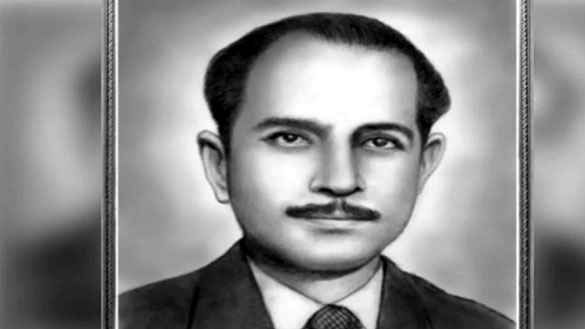
Major
Abid Hassan Safrani
----
Do you know
who coined the slogan ‘Jai Hind?’ This ubiquitous slogan was given by Abid
Hassan Safrani, a close associate of Netaji Subhash Chandra Bose who is being
honoured posthumously by the Kolkatta-based Netaji Research Bureau.
Safrani was
as enigmatic a person as Bose. In his five-year association with Netaji, he
served as his personal assistant when the latter was the Commander-in-chief of
the Indian National Army. He was a Major is the INA.
Author
Narendra Luthur has disclosed how this slogan was coined. It seems once Bose
asked Safrani to give him a salutation for addressing the public from the
platform of the INA. He first replied with usual Hello. Bose dismissed it and
thereafter Safrani came up with ‘Jai Hind.’
This fact
is corroborated by Choudhary Acharya in his book on freedom fighters. He said
Safrani used ‘Jai Hind’ for the first time in 1941 during the first meeting of
the free Indian centre in Berlin. Bose instantly liked it started using it. He
would start and end all his speeches with 'Jai Hind.'
The slogan
became so popular that all the frontline leaders of the Indian freedom struggle
including Mahatma Gandhi, Jawaharlal Nehru etc incorporated it in their
speeches.
In no time,
'Jai Hind' became a symbol of Indianness and decided later too continues to
pump adrenal in the veins of all Indians. It’s also the official salutation for
all the armed forces.
How Bose became Netaji?
Historian
Sayeed Naseer Ahmed writes in his book ‘The immortal’ Safrani was the first to
call Bose as Netaji. Soon everyone started addressing him as Netaji, a
sobriquet has stuck with him even after his death.
Saifrani
traveled with Netaji during his journeys through Germany. Bose’s nephew Sisir
Kumar Bose has given a detailed account of their association in his book “INA
in IndiaToday.”
Abid Hassan
was born into a family of freedom fighters in Hyderabad in 1912. After getting
a degree in engineering, he left for Germany for higher studies and ended up
joining the INA. He was handpicked by Bose for organisational responsibilities
in view of his leadership skills. He held the rank of Major and was in charge
of the Gandhi regiment of the INA
Safrani was
a polyglot; had good command over English, German, French, Arabic, Telgu and
Punjabi.
After the
INA’s surrender to the British Indian Army in April 1945 in Imphal, Safrani was
imprisoned in a dark and dingy cell. In a latter to his mother Amir Begum “Ammi
Jaan,’ Safrani had described the hellish conditions of the cell. He was awarded a six-year prison term and
also put on trial for treason in the famous Red Fort army trials. Fearing that her son may get
death sentence, a worried Begum Amir approached senior Congress leaders. Later,
on the intervention of J L Nehru and Governor General Lord Mountbatten, he was
released.
A Family Of Patriots
His father
Zaffar Hassan was the dean of Osmania University; mother Begum Amir was a
Gandhian. They raised Abid and his brother Badrul Hassan as staunch patriots
and nationalists. The family was close to Mahatma Gandhi. Badrul Hassan, in his
book, writes that whenever the Hassan family would come to meet Gandhiji at
Sabarmati Ashram, his Personal assistant Pyare Lal came to receive them at the
railway station. Badrul Hassan has edited Gandhi Ji’s book ‘Young India”.
Begum Amir
Hassan followed Gandhi till her death (1870-1970). Always wearing khadi, Amir
lived frugally and remained confined to a small room, just the way Gandhiji
lived in Sabarmati Ashram. He gave away her inherited property to the cause of
freedom movement. She was also a close friend of Sarojini Naidu.
Most of the
Congress leaders fondly addressed her ‘Ammijan.’
Abid
Manzil, the family’s ancestral house still stands tall in Hyderabad. It’s also
the place from where the of burning the English goods started on the appeal of
Gandhiji in 1920.
Sisir Bose
has given details of his uncle’s travels across Germany, on a submarine and in
the jungles of Imphal during the second world war.
Once Nehru
visited a jail in Singapore where the INA prisoners were kept. During his
interaction with the Indians he spotted a man sitting in the corner and asked
who he was. In response, the man barely said ‘Jai Hind.’ As Nehru asked wether
he was from Hyderabad, he just said ‘yes.’
After his
release from prison, Safrani’s health continued to deteriorate and
personalities like Batak Chandra, Elizabeth, C S Vasu attended to him at his
Banjara Hills home.
As a Civil Servant
After he
had recovered, he unsuccessfully dabbled into business. Thereafter, he sat for
the Civil Services and cleared it in the first attempt. It’s said that he was
interviewed by Prime Minister Nehru and inducted into foreign service.
As a
diplomat he served in Egypt, Iraq, Turkey, Senegal Gambia, Ivory Coast etc. He
also had to face criticism when he was found absent from Baghdad at a time when
the Jordanian Kind Shah Hashma-e-faizal was murdered in a military coup.
Safrani was
a gardening enthusiast. After retiring, he set up a horticulture farm in
Golkunda. Quite often he would carry the farm produce to Kolkatta for the
family of Netaji. It was his way of commemorating the memory of Netaji.
Safrani
passed away in 1984. His niece Suraiya Hassan has opened a School in her
uncle’s name in Golcunda.
There is an
interesting story about his assumed surname, Safrani. When the INA was to
select the colour of its flag, a dispute arose; the Hindus preferred saffron
and the Muslims chose green. Later, the Hindus withdrew their proposal and yet
the Muslims continued to insist on green. It’s said that the adamant attitude
of Muslims hurt Safrani. At this stage he assumed Safrani (after Saffron) as a
gesture towards the open mindedness of the Hindus. His real name, however, was
Zainul Abdeen.
Original Headline: Who coined ‘Jai Hind’?
Source: Awaz, the Voice
URL: https://newageislam.com/islamic-personalities/abid-hassan-safrani,-close-associate/d/124134