
The Courageous Story of Rajathi Samsudeen (Salma) Of Tamil Nadu

By Afroz Khan, New Age Islam
18 March 2026
Salma, born Rajathi Samsudeen in Tamil Nadu, spent nine years confined at home after her education was stopped at age thirteen. Writing secretly, she later became an internationally recognised writer, politician, and activist, raising powerful voices against patriarchy, child marriage, and gender injustice.
Key Points:
· 1.Salma was confined inside her home for nine years during her teenage years.
· 2.She secretly wrote poems on scraps of paper at night.
· 3.Her mother helped send her writings to publishers.
· 4.She later became Panchayat President and a recognised political figure.
· 5.Her writings highlight women’s freedom, desires, and social oppression.
“My poems are that part of me which was never imprisoned. The body can be kept within four walls, but thought cannot be confined.”
— Rajathi Samsudeen, also known as Salma
In 1968, in Thuvankurichi village of Tiruchirappalli district in Tamil Nadu, Rajathi Samsudeen was born into a very conservative family. In that environment, there were many social restrictions on girls’ education. When Rajathi turned 13 and entered adolescence, her education was stopped and she was confined inside her own home.
She remained imprisoned in her own house for almost nine years. She was not allowed to go outside or take part in any kind of social activity. Even the windows of her house were covered with curtains so that she would be completely cut off from the outside world.
But talent is like a river. No matter how much you try to hide or suppress it, both talent and rivers eventually find their own path and create their own flow.
Rajathi Samsudeen too found a way to allow her writing talent to flow. She secretly continued to pursue her desire for education at night and began expressing her loneliness and emotions through poetry.
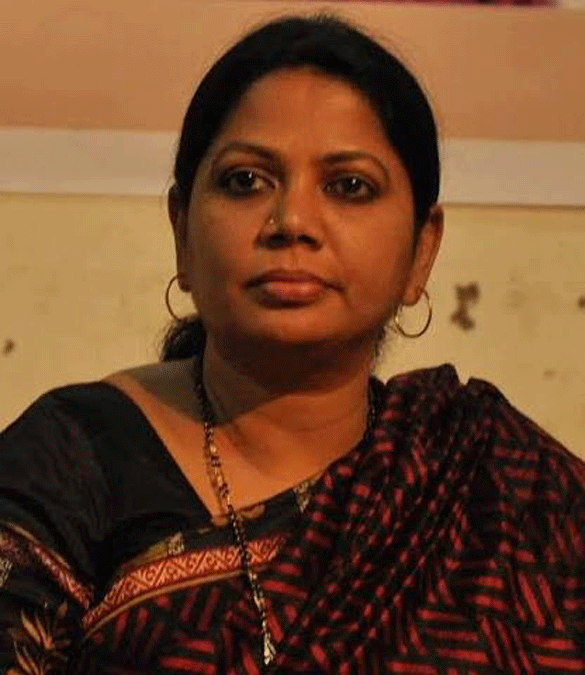
She used to write poems on medicine prescriptions, on the corners of newspapers, or on any small piece of paper she could find. Her mother sensed the talent growing within her daughter and recognised her deep passion for writing. She decided to fully support Salma.
Her mother and younger sister secretly carried those papers out of the house and delivered them to publishers. To hide her identity from the family, she started using the pen name Salma.
Salma originally wrote her poems in the Tamil language and expressed her pain and fear on paper in a powerful way. An excerpt from one of her poems reads:
Intac ciṟiya iruḷ niṟainta iṭattil,
jaṉṉalkaḷ kūṭa kaṇkaḷai mūṭum iṭattil,
eṉ conta mūcciṉ etiroliyai nāṉ kēṭkiṟēṉ.
Cuvarkaḷ eṉṉuṭaṉ pēcukiṉṟaṉa,
mēṟparappu metuvāka acaikiṟatu,
eṉṉai viḻuṅkuvatu pōl.
Cūriya oḷi maṟṟum kāṟṟu niṟainta oru muḻu ulakamum veḷiyē uḷḷatu,
itō nāṉ—
kākitattiliruntu kiḻikkak kāttirukkum oru vārttai.
(“In this small patch of darkness,
where even the windows close their eyes,
I hear the echo of my own breathing.
The walls speak to me,
and the ceiling slowly bends down,
as if it wants to swallow me.
Outside there is a whole world
filled with sunlight and air,
and here I am—
a word waiting to be torn from the paper.”)
When Salma turned 19, she was married into a conservative political family. There too, her struggle to continue writing went on. Like her own family, her husband also did not support her writing. He often threw away her books and writing materials. But Salma was not someone who would give up easily. She continued writing, and as before, her mother continued to support her.
The year 2001 became a turning point in her life. When the government introduced reservation for women in local panchayats, her husband forced her to contest the election so that political power could remain within the family. However, entering politics gave Salma the opportunity to see the outside world, which gave her greater courage to write. After entering politics, major changes took place in her life.
In 2001, Salma was elected as the President of the Ponnampatti Town Panchayat. She began sitting in government offices, listening to the problems of people and leading development work. This greatly increased her confidence. Recognising her ability, senior leaders of the DMK party noticed her work and later appointed her as the Chairperson of the Tamil Nadu Social Welfare Board.
After entering politics, she shared her struggles openly with society and narrated her life story. Her life was so inspiring and dramatic that it felt almost like a powerful narrative. Because of this, the BBC and other international media organisations made documentaries about her life.
Speaking about her struggle-filled life, Salma says:
“True freedom is not the one that is given to you, but the one you achieve by breaking your silence.”
The Hour Past Midnight (Irandam Jamankalin Kathai) is a novel based on the lives of women in a conservative Muslim community. It tells the story of girls who are confined inside their homes as soon as they reach adolescence. In many ways, the novel reflects her own life. It also raises a strong voice for those women who, like her, could not become free and are still confined within the four walls of their homes.
The novel boldly portrays male dominance, the suppressed desires of women, their bodies, and their struggle for freedom. It was shortlisted for the Man Asian Literary Prize, and Salma suddenly became internationally recognised.
An excerpt from another of her poems perfectly reflects her life:
Nī katavukaḷai mūṭiviṭṭāy,
jaṉṉalkaḷil tiraiccīlaikaḷai varaintāy,
āṉāl vārttaikaḷ viricalkaḷ vaḻiyāka naḻuvic cellum eṉpatai nī karuttil koḷḷavillai.
(“You closed the doors,
you drew curtains over the windows,
but you never thought
that words can slip through the cracks.”)
Another of her novels, Women Dreaming (Manaamiyangal) portrays the lives of rural women and the conflict between their dreams and reality. It shows how, in the name of religion and tradition, the small joys and dreams of women are often crushed.
Salma writes about subjects that are often considered taboo in society, such as women’s sexual desires and domestic violence. Nothing in her novels is artificial; they reflect her own life and the real experiences of the women around her.
In 2010, Salma founded an NGO named “Your Hope is Remaining.” This organisation works especially for the rights of Muslim women and the transgender community. It provides legal assistance and shelter to women who are victims of domestic violence.
Salma has also been a strong voice against child marriage in the rural areas of Tamil Nadu. She has actively helped stop several child marriages and has played an important role in reconnecting girls with education.
Salma’s life is nothing less than a powerful story. A girl who was imprisoned at the age of 13 fought a long struggle, secretly pursued her dreams, and when destiny finally gave her the opportunity to step out of that confinement, she made full use of it. She moved forward in her own life and also inspired society, showing that one should never give up in difficult circumstances and must continue striving to fulfil one’s dreams.
…
Afroz Khan is a teacher by profession who writes on women, politics, communal harmony, and Islam. She holds a master’s degree in Education.
New Age Islam, Islam Online, Islamic Website, African Muslim News, Arab World News, South Asia News, Indian Muslim News, World Muslim News, Women in Islam, Islamic Feminism, Arab Women, Women In Arab, Islamophobia in America, Muslim Women in West, Islam Women and Feminism