
The Cultural and Literary Contribution of Rahmunnisa Begum

By Afroz Khan, New Age Islam
5 March 2026
Rahmunnisa Begum was an 18th-century Bengali Muslim poet and translator known for adapting Laila–Majnu into Bengali using the Payar metre. Writing in Dobhashi style, she also composed Padmabatir Punthi. Her works reflect linguistic mastery, cultural synthesis, and a sensitive female literary voice.
Points:
· 18th-century Bengali Muslim woman poet.
· Translated Laila–Majnu into Bengali in Payar metre.
· Wrote in Dobhashi (Bengali–Persian–Arabic mix) style.
· Authored Padmabatir Punthi based on Alaol’s epic.
· Recognised as an early feminist and cultural voice in medieval Bengal.
…
“Rahmunnisa stands among the rare female voices of medieval Bengal who not only created literature but also built a cultural bridge through translation (Laila–Majnu) during her time.”
Dr. Anisuzzaman (renowned scholar and writer)
The history of Bengali literature is quite ancient. It is regarded as one of the richest and oldest literary traditions in the world. Many poets, both men and women, have contributed over time to enrich this tradition.
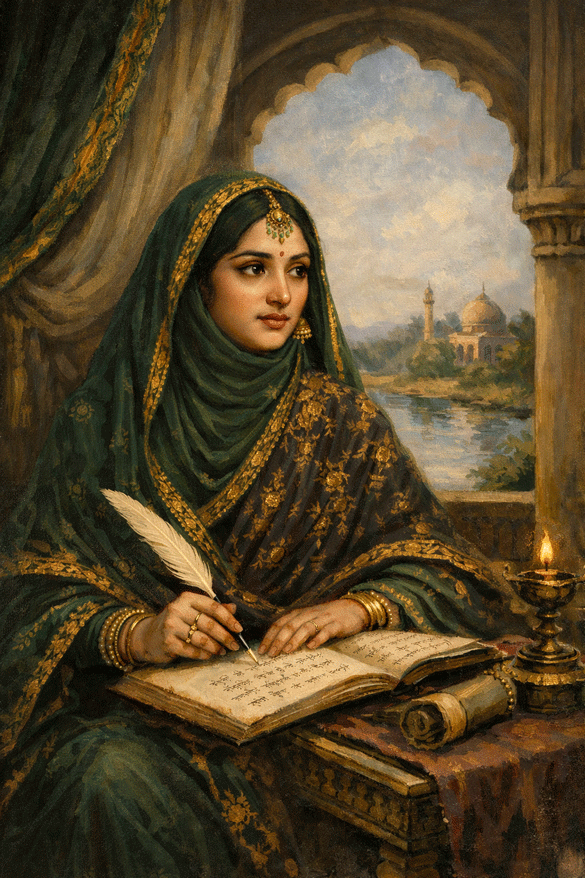
In this contribution, the role of Muslim women has also been extremely significant. Rahmunnisa Begum of the 18th century is considered the first known Muslim woman and is regarded as the first Bengali Muslim woman poet.
It is believed that Rahmunnisa Begum’s family was related to the Quraysh tribe of Mecca.
According to historical traditions, her ancestors stood with Imam Hussain in the Battle of Karbala, after which they migrated to Baghdad and later came to India (Bihar).
Her grandfather, Jali Shah, was originally a resident of Munger in Bihar. He revolted against the British in Bihar, after which he left the region and settled in the village of Suluqbahar in Chittagong (present-day Bangladesh).
Rahmunnisa’s father’s name was Abdul Qadir Shah. He passed away when she was very young. She was brought up by her mother, Alimunnessa, who, despite social orthodoxy and restrictions, paid special attention to her education. In her poems, Rahmunnisa regarded her mother as her principal guide and teacher.
One of her poetic lines is quite famous, in which she expressed gratitude toward her mother Alimunnessa, because it was her mother who educated her during that period:
“Shuno shuno sarbojan amar bachan,
Alimunnessa namete janani amar.
Tahar charane ami kori namaskar,
Jahar prasadey ami dekhilam sansar.”
(“Listen, listen all people to my words,
My mother’s name is Alimunnessa.
At her feet I bow in reverence,
By whose grace I have seen this world
and received education.”)
During that era, formal education for women was extremely limited; therefore, she received her education at home from her mother and her youngest brother, Abdul Gaffar, (who himself was a scholar) She gained proficiency in Arabic, Persian, and Bengali languages, along with Islamic theology.
Rahmunnisa Begum turned toward literature at a very young age. However, greater literary maturity became visible in her writing after her marriage.
Her most famous literary work was the Bengali translation of the well-known Persian romance Laila–Majnu. Yet, this was not an ordinary translation. Rahmunnisa Begum composed it in the ‘Payar Chhanda’ (Payar meter), a traditional Bengali poetic form consisting of fourteen syllables.
She adapted the Persian story into the Bengali cultural and linguistic context in such a way that it felt native to the local people.
It was written in the ‘Dobhashi’ style, a mixture of Bengali with Persian and Arabic vocabulary.
Her manuscript was later discovered and preserved by the eminent historian and manuscript collector Abdul Karim Sahitya Bisharad. Through his efforts, the world came to know of her remarkable contribution.
According to Abdul Karim:
“Rahmunnisa’s poems reflect the social and emotional depth of her time. The flow in her composition in Payar Chhanda is evidence of her command over language.”
Rahmunnisa wrote several ‘Puthis’, which were medieval Bengali narrative poems.
In these works, religious themes, morality, and human emotions are often interwoven. Her puthis were written in the Dobhashi style, in which the Bengali script was used, but the vocabulary was a blend of Arabic, Persian, and Bengali.
The literary maturity of Rahmunnisa Begum is evident from the fact that she possessed a strong command over Arabic, Persian, and Bengali, and skillfully utilised these languages to create refined literature.
Rahmunnisa’s ‘Padmabatir Punthi’ is an extremely rare and historically significant work of medieval Bengali literature. It is based on the famous epic ‘Padmavati’ composed by the renowned poet Alaol. Rahmunnisa re-presented it in her own manner and linguistic style.
She wrote it in the colloquial Bengali of that time so that common people could understand it easily.
The work reflects glimpses of 18th-century Chittagong’s folk culture and rural environment. As a woman poet, she portrayed the character of Padmavati and her emotions with greater sensitivity.
Some excerpts from her composition:
Padmābatī ēkajana dhārmika mahilā
āmi ālā'ōlakē sam'māna kari
tini tāra bicakṣaṇatāra jan'ya sam'mānita
tini ē'i smaraṇīẏa khaṇḍaṭi likhēchēna surēlā ślōkaguli khuba śaktiśālī
āmi kībhābē bujhatē pāri,
bēcārā mahilā
[āmāra] sbāmīra anurōdha āmi grahaṇa kari
āmi ē'i lā'inaguli lēkhāra sāhasa karēchi.
(Padmavati is a pious lady.
I honour Alaol.
He is honoured for his wisdom.
He wrote this memorable volume; the melodious verses are very powerful.
How could I fathom it,
a poor woman?
I accepted my husband’s request.
I have dared to compose these lines.)
Rahmunnisa described herself as “Akinchan,” meaning humble or insignificant, which reflects her modesty. She passed away in the early decades of the 18th century. At that time, she was approximately 36–37 years old.
Within this brief span of life, she translated Laila–Majnu and composed significant works like Padmabatir Punthi, establishing her as a major feminist and cultural voice in medieval Bengali literature.
Afroz Khan is a teacher by profession who writes on women, politics, communal harmony, and Islam. She holds a master’s degree in Education.
New Age Islam, Islam Online, Islamic Website, African Muslim News, Arab World News, South Asia News, Indian Muslim News, World Muslim News, Women in Islam, Islamic Feminism, Arab Women, Women In Arab, Islamophobia in America, Muslim Women in West, Islam Women and Feminism