
Divine Brotherhood: The Mystical Journey of Yousufain Sharifain

By Adnan Faizi, New Age Islam
16 January 2026
Hazrat Syed Shah Sharifuddin and Hazrat Syed Shah Yousufuddin, famed as Yusufain Sharifain, journeyed from Mughal commanders to radiant Sufi saints, spiritually transforming the Deccan. Their sacred Dargah in Hyderabad continues to breathe mercy, devotion, and divine presence.
Main Points:
· Hazrat Syed Shah Sharifuddin journeyed from Mughal military life to divine Sufi illumination.
· Alongside Hazrat Syed Shah Yousufuddin, he spiritually transformed Deccan’s destiny.
· Their Golconda victory unfolded through spiritual power, faith, and divine assistance.
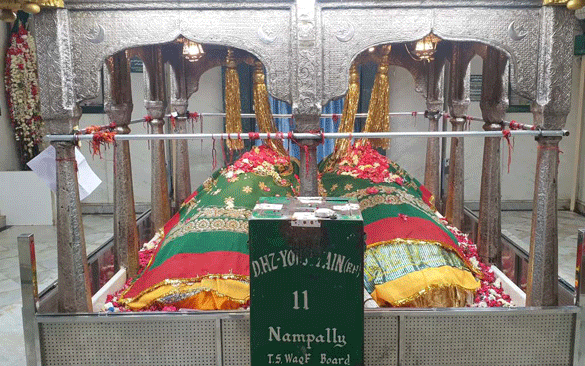
· After renouncing worldly authority, they established Dargah Yusufain as Hyderabad’s eternal spiritual centre.
· The annual Urs draws multitudes, sustaining their legacy of mercy, devotion, and spiritual guidance.
The Journey of Yousufain Sharifain: From Lineage to Legacy
In the radiant tradition of Indian Sufism, Hazrat Syed Shah Sharifuddin and Hazrat Syed Shah Yousufuddin, collectively honoured as Yousufain Sharifain, hold a unique place of reverence. Hazrat Sharifuddin was born in Kanaan (ancient Palestine), and Hazrat Yousufuddin in Egypt. Though separated by geography and culture, both belonged to the noble Syed lineage, tracing 43 generations to Hazrat Imam Hussain and thereby carrying forward the spiritual inheritance of Prophet Muhammad. They were not biological brothers. Their souls first connected during the Hajj pilgrimage in Mecca, where a chance meeting blossomed into a profound friendship. So deep was their bond that they lived, served, and ultimately departed this world together, earning the title of spiritual “brothers” in the hearts of devotees across Hyderabad, India, and beyond. During this pilgrimage, they encountered the eminent Chishti-Nizami Sufi master Hazrat Shaykh Kaleemullah Jahanabadi of Delhi, who was also present in Mecca. Seeking a land for the propagation of Islam and spiritual service, they became his disciples, took bay‘ah, and were granted the saintly khirqa. Recognising their devotion and spiritual potential, Hazrat Kaleemullah conferred upon them khilafat in both the Chishti and Nizami silsilas.
Their genealogical line further connects them to a succession of revered Sufi luminaries, firmly placing them within the authentic Chishti spiritual continuum:
Hazrat Khwaja Moinuddin Chishti, Hazrat Qutubuddin Bakhtiyar Kaki, Hazrat Fariduddin Ganj Shakar, Hazrat Nizamuddin Auliya, Hazrat Nasiruddin Chiragh Dehlavi, Hazrat Kamaluddin Qudsara, Hazrat Sirajuddin Oudsara, Hazrat Alimuddin Oudara, Hazrat Shaykh Mahmood alias Shaykh Juman Oudsara, Hazrat Jamaluddin alias Shaykh Juman, Hazrat Shaykh Hasan Mohammed, Hazrat Shaykh Mohammed Hazrat Shaykh Yahiya al-Madani, Hazrat Kalimullah Shah Jahanabadi, Hazrat Syed Shah Yousufuddin & Hazrat Syed Shah Sharifuddin
Following their Murshid’s guidance, they left Egypt and Syria, embracing worship, mystical discipline, and complete tawakkul upon Allah, journeying to India during the reign of Emperor Aurangzeb Alamgir. Upon arrival in Delhi, they entered Mughal military service, as a means of livelihood and service, while quietly fulfilling their spiritual mission. Their commitment to faith, obedience to their Murshid, and mutual companionship prepared them for the Deccan, where they would transform from soldiers into saints, playing a pivotal role in the conquest of Golconda Fort (1687 CE) and ultimately establishing Dargah Yousufain in Nampally. Their lives exemplify the core Sufi truth: the Murshid guides the seeker, spiritual friendship strengthens the path, and devotion, love, and service can transform even the turbulence of war into a sanctuary of mercy, unity, and remembrance. United by lineage, by Murshid, and by divine purpose, Yousufain Sharifain’s journey remains a timeless testament to Sufism’s enduring legacy in the Deccan.
Golconda Conquest and Spiritual Authority of Yousufain Sharifain
In 1687 CE, Hazrat Syed Shah Sharifuddin and Hazrat Syed Shah Yousufuddin accompanied Emperor Aurangzeb Alamgir’s army during the campaign to capture Golconda Fort. Beyond their military role, the brothers maintained constant devotion praying, reciting the Quran, and engaging in muraqaba even amid floods, storms, and battlefield chaos. Historical accounts credit their spiritual presence and karamat with the fort’s surrender. The mystical cobbler Qutub, guardian of Golconda, recognised their saintly rank and vacated the fortress voluntarily, leaving its security to Allah. This act allowed the Mughal army to enter with minimal resistance, highlighting the decisive role of the brothers’ spiritual authority alongside military strategy. Despite recognition and temporary command, the brothers renounced worldly power, disturbed by the bloodshed around them. They settled in Nampally, establishing a khanqah and langar, sustaining it through Quran transcription a practice mirroring Aurangzeb’s personal piety and creating a center of devotion, service, and guidance.
Hazrat Sharifuddin led majalis, sama‘, and teachings on tawhid and akhlaq, while Hazrat Yousufuddin oversaw practical irfan through wazaif, muraqaba, and discipleship. Without biological heirs, their spiritual legacy continued through countless mureeds and khalifas, ensuring that their silsila endured across generations. This episode exemplifies the unique Sufi synthesis embodied by Yousufain Sharifain: worldly action harmonized with spiritual authority, where discipline, devotion, and ethical guidance shaped tangible outcomes even in times of war.
Death, Urs, and the Eternal Legacy
Hazrat Syed Shah Yousufuddin and Hazrat Syed Shah Sharifuddin completed their divine mission and Passed away on 6th Zil-Hajj 1121 Hijri at Nampally, Hyderabad. Historical records note no formally documented disciples or khalifas, yet their barakah and spiritual influence endured. Hazrat Yousufuddin passed away first after a brief illness. Hazrat Sharifuddin was absent at the time; on learning of his brother demise, he said " Brothers who lived together must depart together", wrapped himself in a chadar, lay beside him, and passed away shortly thereafter. Both were buried the same day at their residence: Hazrat Yousufuddin on the western side, Hazrat Sharifuddin on the eastern side. As recorded in Anwar-e-Alamgiri, Sad-Ullah Bahadur, Diwan of Arcot, later constructed the tomb and a small water reservoir. The dome and residential structures were developed subsequently, while the mosque on the western side was built in 1132 Hijri by the first Sajjada, Hazrat Abdul Salam. The Asif Jahi rulers also showed continued devotion to the shrine. Nearby graves include Amir Minai and Dagh Dehlvi with his wife. The present custodian is Hazrat Faisal Ali Shah.
The Urs is observed every year on the 5th and 6th of Zil-Hajj. The sacred sandal ceremony takes place on the 5th, while the 6th is marked by the illumination of the mausoleum and recitation of the Qur’an. On these days, hundreds of thousands of devotees cutting across caste, creed, and faith arrive with folded hands and hopeful hearts, seeking blessings and the fulfilment of their vows. In this way, Dargah Yousufain continues to breathe as a living sanctuary of mercy, unity, and devotion, reminding all that the saints’ legacy endures not through formal successors, but through a presence that is still felt, lived, and lovingly remembered.
___
Adnan Faizi is a Peace and Harmony activist based in Delhi. He is an alumnus of CCS University, Meerut.
New Age Islam, Islam Online, Islamic Website, African Muslim News, Arab World News, South Asia News, Indian Muslim News, World Muslim News, Women in Islam, Islamic Feminism, Arab Women, Women In Arab, Islamophobia in America, Muslim Women in West, Islam Women and Feminism