
Five Centuries On, a Baghdad Saint Still Draws India Together in Warangal

By Syed Amjad Hussain, New Age Islam
21 January 2026
Hazrat Mashooq-e-Rabbani, a Baghdad-born Sufi saint, journeyed to Warangal, transforming the Deccan through faith, simplicity and compassion, leaving a five-century legacy of harmony.
Main Points:
· His birth in Baghdad and descent from Shaikh Abdul Qadir Jilani
· Early spiritual training and miraculous childhood
· Journey to Makkah, Madinah and the Deccan
· Years of meditation, service and miracles in Warangal
· A lasting legacy of simplicity and communal harmony
Introduction
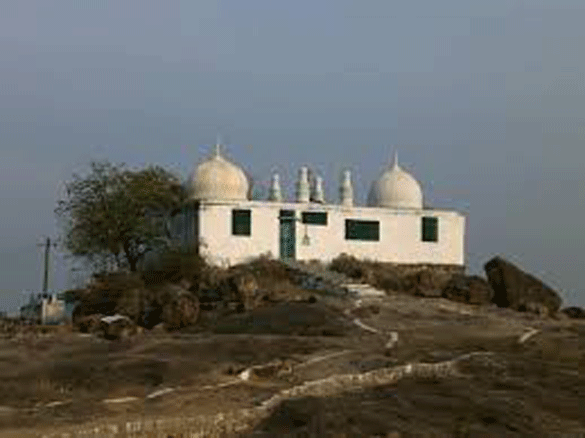
Just five kilometres from Warangal railway station, in a modest village now known as Urs Jagir, stands a shrine that has quietly shaped the spiritual life of South India for more than five centuries. The Dargah of Hazrat Mashooq-e-Rabbani Rahmatullahi Ta'ala Alaih is not only a place of Muslim devotion. It is also one of the region’s oldest living symbols of communal harmony, simplicity, and spiritual discipline.
Every year, between the 21st and 23rd of Rajab al-Murajjab, thousands of people gather here for his Urs. Many of them are Hindus. There is no loud qawwali, no grand spectacle. The atmosphere remains calm and restrained, almost deliberately quiet, as if the place itself insists on reflection rather than performance.
That mood reflects the life of the saint who lies buried here.
A Child Born into a Line of Saints
Hazrat Mashooq-e-Rabbani was born on 7th Rajab 896 Hijri (24 May 1491), in Baghdad. His birth name was Syed Hammad. Later, he came to be known by the honorifics Jalal-ud-Din and Jamaal-ul-Bahaar. The name by which history remembers him, however, is Mashooq-e-Rabbani, “the Beloved of Allah”.
He was the 11th direct descendant of Ghous-ul-Aazam Hazrat Shaykh Abdul Qadir Jilani, the founder of the Qadriyya Sufi order. In those days, Baghdad was still regarded as the “Bride of Cities”, a centre of learning, scholarship, and spirituality. His family home itself was known locally as a house of knowledge.
From an early age, Hazrat Syed Hammad showed an unusual sharpness of mind and seriousness of temperament. He memorised the Qur’an under the supervision of his mother, who was herself a woman of deep learning and spiritual awareness. His father, Hazrat Syed Hasan Abdul Qadir Saani, personally trained him in both outward (zahiri) and inward (batini) knowledge.
By the age of twelve, he had completed his formal education and spiritual training. His father then granted him the khirqa, the saintly robe, and formally appointed him as his khalifa (spiritual successor).
The Strange Fate of His Brothers and Sisters
Family tradition speaks of a strange and unsettling pattern. Whenever one of the children showed a miraculous sign, their parents would say, “Baby, take rest,” and the child would die soon after. Several of his brothers and sisters died in this way.
Until the age of twelve, no miracle appeared from Hazrat Syed Hammad. In hindsight, his family believed this was why he alone survived. He was being kept for a greater purpose.
The Journey That Changed His Life
One day, while standing in his house, he lightly moved his leg as ducks and geese ran towards him. One duck fell dead on the spot. When the housemaid reported this to his mother, she became deeply disturbed. She feared that his growing spiritual power would put him in danger if he remained at home.
With his father’s permission, she prepared him for separation. He left Baghdad with a small group of disciples and followers and was instructed to travel directly to Makkah Shareef and Madina Shareef.
He reached Madina Shareef at the age of sixteen and stayed there for two years. He spent his days in prayer, meditation, meetings with Sufi elders, and study circles. During this period, several miracles were attributed to him: reviving a dead camel, producing water in the desert, restoring sight to a blind boy, and even bringing a dead child back to life.
Mashooq-e-Rabbani
One night in Madina Shareef, he reportedly stood before the locked door of the Prophet Hazrat Muhammad Mustafa Sallallahu Ta'aala Alayhi Wasallam’s mausoleum and called out, “Ya Jaddi” — O my grandfather. The doors opened, and a voice replied, “Ya Waladi” — O my son.
After spending the night in spiritual retreat, he emerged with a new divine title: Mashooq-e-Rabbani, the Beloved of Allah. He informed his disciples that he had been instructed to travel to the Deccan in South India for the propagation of Islam.
A Saint Arrives in Warangal
Around 916–917 Hijri (1510–1511 AD), Hazrat Mashooq-e-Rabbani reached Warangal during the reign of Sultan Quli Qutb Shah of Golconda. Historical accounts say that seventy to eighty elephants accompanied his caravan, carrying the belongings of his followers and dervishes.
Along the way, landlords and local rulers offered him gifts after witnessing what they believed were his miracles. People joined his caravan in large numbers.
Twelve Years Standing in Prayer
His first long stay was in Somaram village, about sixteen miles south of Warangal. There, he spent nearly twelve years in standing meditation, absorbed in remembrance of Allah.
During this period, a blind weaver came to him for prayers and regained his sight. Thousands of local villagers reportedly embraced Islam after such incidents.
Later, he moved to the hills near Hanmakonda, where a a person attempted to harm him using magical stones and a giant python. According to tradition, both attempts failed. The stone bearing the imprint of the saint’s finger and the marked rock are still shown to visitors today.
The person eventually accepted the truth and remained in the saint’s service for the rest of his life.
Urs Jagir and His Final Resting Place
He finally settled in Qazipura village after seeking spiritual permission from the soul of Qazi Ziauddin, a martyr of the Tughlaq period. He marked his burial spot with his staff, about 150 yards from the Qazi’s tomb.
Over time, Qazipura came to be known as Urs Jagir because of the annual Urs of Hazrat Mashooq-e-Rabbani.
Family Life and Los
He married around 925–926 Hijri and had three sons and one daughter. Three of his children died young after displaying miraculous signs. Only one son, Hazrat Ghouse Moinuddin, survived and continued the lineage.
Their graves lie to the left of his mausoleum.
The Horse That Came Back to Life
Among many reported miracles, the most famous is the story of the horse. A local ruler gifted him a costly horse. When food ran short, the saint ordered the horse to be slaughtered to feed the hungry dervishes.
Angered, the ruler demanded the horse back. The saint asked for the bones to be collected, prayed over them, and said, “Qum bi-iznillah” — Rise by Allah’s command. The horse stood up alive. The ruler, shaken, gifted him the vast Ranga Samudram water tank.
A Shrine for Everyone
Today, the shrine remains under the care of his descendants. Naveed Baba, the 17th descendant and current custodian, says the Urs rituals begin with sandal paste on the dargah, followed by prayers, Qur’an recitation, fateha, and chiraaghan. There is no qawwali.
“Simplicity was his core virtue,” says Syed Maqdoom, a commentator and translator. “The silence of this Urs is deliberate. It keeps the focus on Allah, not on spectacle.”
A Legacy That Refuses to Fade
Five hundred years after he walked into Warangal, Hazrat Mashooq-e-Rabbani still draws people across religious lines. Hindus, Muslims, and others sit together in quiet prayer at his dargah. No sermons on harmony are delivered here. The place simply practises it.
-----
Syed Amjad Hussain is an author and independent research scholar on Sufism and Islam. He is the author of 'Bihar Aur Sufivad', a bestselling research book based on the history of Sufism in Bihar.
New Age Islam, Islam Online, Islamic Website, African Muslim News, Arab World News, South Asia News, Indian Muslim News, World Muslim News, Women in Islam, Islamic Feminism, Arab Women, Women In Arab, Islamophobia in America, Muslim Women in West, Islam Women and Feminism