
Hazrat Khwaja Niyaz Muhammad Shah Shamsi: Beacon of Faith, Service, and Enduring Barakah in the Deccan

By Adnan Faizi, New Age Islam
24 February 2026
Hazrat Khwaja Niyaz Muhammad Shah Shamsi Chishti al-Qadri, known as Allah Ke Hukumse, transformed Aurangabad through unlettered spiritual wisdom and Sharia-Tariqa unity, modelling tawakkul in turbulent times. His Niyazi khanqah still guides seekers toward Prophet-centred love and service in modern India.
Main Points:
· Hazrat Niyaz Muhammad Shah embodied ummi sainthood through ladunni knowledge, tawakkul, and service.
· His 25 years of khidmat earned Chishti-Qadri khilafat and Qutb-e-Zaman recognition widely.
· Living as labourer, he distributed earnings, and upheld Sharia-Tariqa-Haqiqat unity faithfully.
· Miracles, teachings, and independence from rulers strengthened faith and moral responsibility among devotees.
· His Ali Chaman dargah, Urs, and Niyazi silsila continue guiding seekers today globally.
…
Introduction
Hazrat Khwaja Niyaz Muhammad Shah Shamsi Chishti al-Qadri was among the great Qutbs of the Deccan and an example of an ummi wali unlettered yet endowed with divine knowledge. Born in a poor family in Lad Sangoli, he intuitively corrected Qur’anic recitation through ladunni ilm, as testified by his son Hazrat Khwaja Muhammad Waliur Rahman Shah Niazi (Miya Bhai). Known for saying “Allah ke hukum se,” he embodied complete trust in God during the turbulent final years of Hyderabad State and the 1948 police action. He served his murshid Hazrat Khwaja Shamsuddin Muhammad Mahboob Rabbani Chishti al-Qadri for 25 years, receiving spiritual authority in both Chishti and Qadri lineages tracing back to Hazrat Khwaja Moinuddin Chishti and Hazrat Ghaus-e-Azam Abdul Qadir Jilani. Despite his rank, he lived as a labourer, giving away his earnings and practising lifelong austerity.
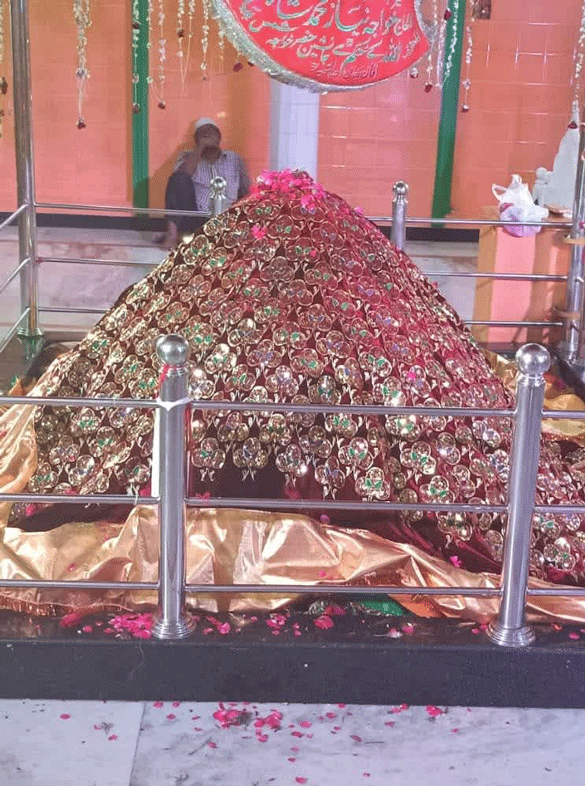
His miracles and independence from rulers led contemporaries like Hazrat Maulana Abdul Qadir Siddiqui to regard him as Qutb-e-Zaman. Today his dargah at Ali Chaman, maintained by his son Hazrat Khwaja Haji Nisar Muhammad Shah Niyazi, hosts monthly Fateha and a large annual Urs drawing lakhs. His Sharia-Tariqa-Haqiqat triad counters modern distraction, urging huquq-ul-Allah and huquq-ul-ibad revival, proving ummi gnosis endures in digital age seekers.
Origins, Bay‘ah and Spiritual Formation
Hazrat Khwaja Niyaz Muhammad Shah Shamsi Chishti al-Qadri was born in the poor family of Lad Sangoli (Aurangabad, Maharashtra), a background that nurtured deep tawakkul rather than worldly privilege. A tazkira by Mohammed Khalil Rahman Shah Niazi records that he later had five sons — Hazrat Khwaja Noor Muhammad Shah, Hazrat Khwaja Aziz Muhammad Shah, Hazrat Khwaja Muhammad Waliur Rahman Shah (Miya Bhai), Hazrat Khwaja Ghafur Rahman Shah, and Hazrat Khwaja Haji Nisar Muhammad Shah — and three daughters whose names were not preserved. Poverty denied him formal education, yet he displayed ladunni (divinely granted) knowledge; his son Miya Bhai testified that he could correct Qur’anic recitation despite never studying. An early miracle is remembered in which a dervish carried him away from his cradle for several days and returned him with the prophecy that he would become a great spiritual figure.
Drawn to the Sufi path, he took bay‘ah with Hazrat Khwaja Shamsuddin Muhammad Chishti, khalifa of Hazrat Khwaja Shams al-Haq Chishti, who kept him in service for 25 years. Through this long khidmat he passed through the stages of suluk and received khilafat symbols the qirqa, tawakkul and kambal along with the title Sawar Shah, Allah Ke Hukumse. He was authorised in both the Chishti and Qadri lineages and instructed to maintain spiritual companionship with Hazrat Azam (Banne Miya Majzub) of Aurangabad. He also shared a deep bond with Hazrat Maulana Abdul Qadir Siddiqui (Piya Siddiqui), who regarded him as a fakir and Qutb-e-Zaman, alongside other leading scholars of Hyderabad. His life rising from poverty through service, discipline and divine grace continues to inspire seekers today, showing that true spiritual rank comes through patience, humility and lifelong devotion rather than status or learning.
Rigorous Devotion, Travels and Public Mission
Hazrat Khwaja Niyaz Muhammad Shah Shamsi Chishti al-Qadri lived a life of extreme ascetic discipline joined with compassionate service. By day he worked as a porter and distributed his entire earnings to the poor, sustaining himself on a few grams, leaves or dry bread, often remaining hungry even in Ramadan while intensifying worship. His routine centred on constant dhikr — “Allah Allah,” “La ilaha illallah,” and salawat — performed at all times, along with Friday purification, miswak, fragrance when available, and early arrival at the Jami ‘Masjid for nawafil and remembrance. He undertook retreats in the forests of Adilabad, where his ecstatic zikr reportedly resounded across long distances, and practised sama ‘as a state of spiritual rapture rather than entertainment, always insisting that Tariqa must remain grounded in Sharia. His generosity and trust in Allah became defining traits, offering a model of service to humanity.
He travelled widely for spiritual benefit and preaching, performing Hajj twice by sea while serving fellow pilgrims and once carrying his mother on his shoulders throughout the journey. In 1965 he visited Baghdad, where he experienced a profound spiritual retreat at the shrine of Hazrat Ghaus-e-Azam and visited major saints’ mausoleums across the region, affirming the living spiritual presence of the awliya. Across the Deccan especially Hyderabad and Aurangabad he spent decades guiding people towards faith and moral reform. His independence from worldly authority was evident when he declined royal offerings from the Nizam’s court, accepting only what aligned with divine will. Through worship, travel, charity and fearless integrity, he left a legacy of spiritual resilience that continues to inspire seekers facing modern anxiety, inequality and moral confusion.
Disciples, khalifa and Spiritual Lineages
Hazrat Khwaja Niyaz Muhammad Shah Shamsi devoted his entire life to serving humanity, making the exact number of his disciples impossible to determine. Every day, morning and evening, large crowds of both ordinary people and prominent figures came to seek guidance and pledge allegiance at his hands. Among the known disciples and devotees were Hazrat Ghous-e-Mohiuddin alias Dastagir Pasha, Hazrat Moulavi Haji Khwaja Hasan Niyazi, Hazrat Muhammad Abdul Gafur Rahman Niyazi, Hazrat Moulavi Syed Latif Quader Niyazi, Hazrat Moulavi Abdul Qayyum (Chief Advisor to the Nizam of Hyderabad), Hazrat Barrister Skinder Ghouri, Hazrat Moulavi Muhammad Akbar Ali Khan (Manager of Sahifa Press, Chaderghat), Hazrat Maulavi Mustafa Hussain, Hazrat Mohammed Ansari( cheif justice), Hazrat Akbar Ali Khan Barrister (former Governor of India), and Hazrat Moulavi Syed Abdul Rahim only a small portion of his vast following. The precise number of his caliphs is also unknown, though prominent khalifas included Hazrat Moulavi Khwaja Moin Allah Shah Niyazi, Hazrat Moulavi Abdul Razaq Niazi Shamsi, Hazrat Moulavi Afzal Hussain Niyazi Shamsi, Hazrat Moulavi Ashraf Ali Khan Niyazi Shamsi, Hazrat Moulavi Burhanuddin Baig Niyazi Shamsi, Hazrat Moulavi Kabir Muhammad Niyazi Shamsi, and Hazrat Moulavi Muhammad Hussain Niyazi Shamsi, through whom his teachings spread widely.
His Chishti spiritual lineage trace back to from the Prophet Muhammad through Hazrat Ali and the early saints of Basra to the great Chishti saints — Hazrat Khwaja Moinuddin Chishti, Hazrat Khwaja Fareeduddin Ganjshakar, Hazrat Khwaja Nizamuddin Auliya, Hazrat Khwaja Nasiruddin Chiragh Dehlavi, later Indian luminaries, Hazrat Khwaja Shams al-Haq, and Hazrat Khwaja Shamsuddin Muhammad Mahboob Rabbani — culminating in Hazrat Khwaja Niyaz Muhammad Shah and continuing through his successors Hazrat Khwaja Aziz Muhammad Shah and Hazrat Khwaja Haji Nisar Mohammed Shah. His Qadri lineage traces from the Prophet Muhammad through Hazrat Ali ibn Abi Talib to Ghaus-e-Azam Hazrat Shaykh Abdul Qadir Jilani, then through successive Qadri masters including Hazrat Syed Muhammad Ghaus Gwaliori, Hazrat Shah Niyamatullah Qadri, and Hazrat Shah Barkatullah Qadri, reaching Hazrat Khwaja Shamsuddin Muhammad and culminating in Hazrat Khwaja Niyaz Muhammad Shah.
Through countless disciples, numerous khalifas, enduring teachings, and these unbroken Chishti and Qadri chains, Hazrat Allah Ke Hukumse’s spiritual light continues to guide seekers, preserving a living legacy of devotion, remembrance, and service to humanity.
Miracles and Teachings
Numerous accounts from disciples present Hazrat Khwaja Niyaz Muhammad Shah Shamsi Chishti al-Qadri as a wali whose spiritual insight touched everyday life. Hazrat Ghous-e-Mohiuddin Dastagir Pasha recalled that when Hazrat pressed his leg, he felt the presence of his deceased mother, whose vision he was granted. On another journey, companions unknowingly passed a saint’s resting place until Hazrat identified it as Hazrat Baba Sharafuddin. A printer who secretly tested him by pricking himself found Hazrat simultaneously feeling the pain in his chest. When asked for a remedy for an eye ailment, he conveyed guidance attributed to Hazrat Ali despite being formally unlettered. At the dargah of Hazrat Jehangir Peeran, a night of hunger reportedly ended when the grave opened and fresh food appeared, which he described as the saint’s gift. Admirers such as Hazrat Maulana Abdul Qadir Siddiqui regarded him as a Qutb-e-Zaman entrusted with reviving faith and moral responsibility, and devotees continue to associate blessings and healing with his Urs.
His teachings centred on a simple but comprehensive path: strict adherence to Sharia, inner purification through Tariqa, and realisation of Haqiqat. He taught that love of the Prophet Muhammad should shape every aspect of life, that sincerity and ethical conduct fulfil both the rights of Allah and of humanity, and that spiritual guidance through bay‘ah helps seekers remain balanced. Drawing inspiration from the example of the Companions, he emphasised humility, service and trust in Allah as the foundation of spiritual growth. Today his message speaks strongly to modern seekers, offering a grounded alternative to superficial spirituality and encouraging disciplined faith, compassion and moral responsibility in an age of confusion.
Wafat, Dargah, and Enduring Niyazi Silsila
After a hip fracture in his final illness, Hazrat Khwaja Niyaz Muhammad Shah continued worship and declined prolonged treatment, foretelling that a “guest” would arrive within three days. He passed away on Sunday night, 24 May 1969 CE, at Ali Chaman, Languji Guda Street, Saroornagar (Hyderabad-Secunderabad). His funeral prayer on 8 Rabi al-Awwal was led by Hazrat Ahmed Khairuddin Qadri, and he was buried within his residence, which later became a mosque-dargah complex. Custodianship first passed briefly to his elder son Hazrat Khwaja Aziz Mohammed Shah Niazi, and is now held by his youngest son Hazrat Khwaja Haji Nisar Muhammad Shah Niazi Shamsi Chishti al-Qadri.
His shrine remains active with a monthly 7th-day Fateha featuring recitation, sama‘ and langar, while the annual Urs on 7–8 Rabi al-Awwal draws lakhs of devotees for sandal, chadar, qawwali and communal meals. Through his sons, khalifas and the wider Niyazi Chishti-Qadri network, his spiritual influence continues across the Deccan. In a materialistic age, his example of unlettered wisdom, poverty with trust in Allah, love, obedience and service inspires social welfare, interfaith harmony and resistance to extremism. Digital manqabats and Urs livestreams now carry his message globally, preserving the legacy of the saint remembered for speaking and acting only “by Allah’s command.”
____
Adnan Faizi is a Peace and Harmony activist based in Delhi. He is an alumnus of CCS University, Meerut.
New Age Islam, Islam Online, Islamic Website, African Muslim News, Arab World News, South Asia News, Indian Muslim News, World Muslim News, Women in Islam, Islamic Feminism, Arab Women, Women In Arab, Islamophobia in America, Muslim Women in West, Islam Women and Feminism