
Hazrat Maulavi Muhammad Abdul Qadir Siddiqui Qadri: Hyderabad's Bahr-ul-Uloom and Beacon of Ahle-Sunnat Revival

By Adnan Faizi, New Age Islam
3 March 2026
Hazrat Maulavi Muhammad Abdul Qadeer Siddiqui Qadri, known as Bahr-ul-Uloom Hasrat, united deep scholarship with Sufi spirituality across multiple silsila. From his birth in Qazipura to leadership at Osmania, his lifelong work especially Tafseer-e-Siddiqui continues guiding youth toward balanced, thoughtful faith today.
Main Points:
· Hazrat was born 1288H in Hyderabad, of Siddiqui-Husaini lineage, honoured by Nizam’s stipend.
· He won Punjab Fazil gold medals and led Osmania Theology Department for twenty-two years.
· Hazrat received khilafat in four silsila, guiding over five lakh disciples and deputies.
· His works ,Tafseer-e-Siddiqui, Ad-Deen and Kulliyyat-e-Hasrat enriched Islamic scholarship across generations.
· He passed away 1381H; Shawwal Urs sustains the living legacy at Siddiqui Gulshan.
Introduction
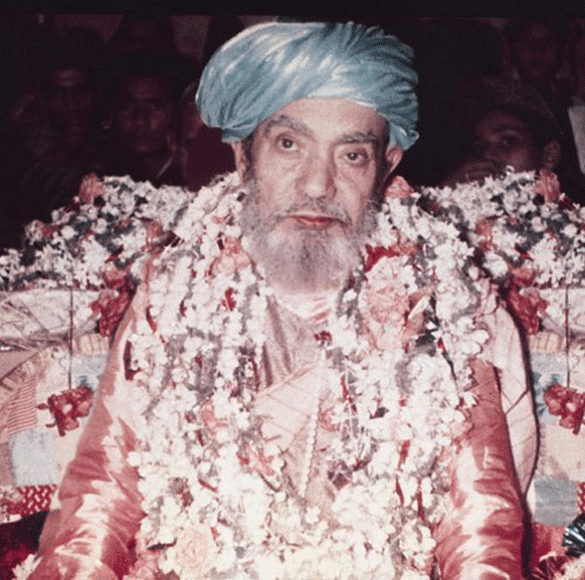
Hazrat Maulavi Muhammad Abdul Qadir Siddiqui Qadri, revered with titles such as Bahr-ul-Uloom, Shams-ul-Mufassireen, Shaykh-ul-Muhaddiseen and Ustaad-ul-Ulama, and known by the poetic name Hasrat, was one of the greatest scholar-saints of the Deccan. He was born on 27 Rajab 1288 Hijri (12 October 1871 CE) at Qazipura, Hyderabad, in the home of his maternal grandfather Hazrat Mir Parwarish Ali Baadshah Husaini Qadri, and at his birth the Nizam, Asif Jah VI Mir Mahboob Ali Khan, granted him a lifelong monthly stipend of Rs 100. His lineage combined two noble lines 28 generations to Hazrat Abu Bakr Siddiqui on the paternal side and 32 generations to Hazrat Imam Husain on the maternal side hence he was known as Siddiqui al-Hussaini. while his wider spiritual legacy continued through family and disciples. An outstanding scholar, he won gold medals in the Maulvi-Munshi Fazil examinations of Punjab University and later served at Madrasa Mahboobia, Dar-ul-Uloom, and as Head of Theology at Osmania University for twenty-two years until 1932. His major works include Siddiqui, Ad-Deen (four volumes), and Kulliyyat-e-Hasrat.
Hazrat Maulavi Muhammad Abdul Qadir Siddiqui Qadri had four wives and a large family of ten sons and twelve daughters. From Paasha Begum bint Mohammad Ghulam Husain Siddiqui were born five sons Hazrat Abdur Raheem, Hazrat Shujauddin Husain, Hazrat Muhammad, Hazat Abu Turaab Ali and Abdul Azeez. From Aa’isha Sultaan Jahaan was born Hazrat Abdul Qadir Moeenuddin; from Farrukh Begum, Hazrat Ahmad Abdul Shakoor Siddiqui; and from Bibi Rabia Madani bint Syed Akbar Husaini were born Hazat Ghaus Mohiuddin, Dr Hazrat Moosa Abdur Rahman, and Fatima Begum. Through this extensive family, his spiritual and scholarly legacy continued across generations.
Ancestry, Early Trials, and Scholarly Rise
Hazrat Maulavi Muhammad Abdul Qadir Siddiqui Qadri was born into a distinguished scholarly-Sufi family whose roots stretched from Ahmedabad to the Deccan under the Nizams. His great-grandfather Hazrat Abdul Gafoor Siddiqui sent his son Hazrat Abdul Qadir Siddiqui to the Deccan, where he became Mohiuddin Daula Nawab Quader Khan and moved with the court from Aurangabad to Hyderabad. The family produced eminent jurists and saints: his grandfather Hazrat Mohammad Fazlullah Siddiqui, a hafiz with Naqshbandi bay‘ah, served as Qazi-ul-Quzzat, and his father Hazrat Abdul Qadir Siddiqui also held that office after receiving bay‘ah from Hazrat Shah Sa‘dullah and khilafat from Hazrat Shah Abdul Gani Naqshbandi Mujaddidi. His mother Hazrat Anwar Begum was the daughter of Hazrat Mir Parwarish Ali Badshah Husaini Qadri, while his maternal uncle and spiritual guide was Hazrat Khwaja Syed Muhammad Siddiqui Husaini Mehboobullah Qadri. This legacy of scholarship, justice and spirituality continues to inspire links between legal and Sufi traditions in Telangana. He performed Hajj at the age of eight in 1879 with his parents and uncle-pir, gaining early exposure to the Haram. The death of his mother in 1304H/1887 CE, when he was sixteen, coincided with his receiving khilafat, shaping a resilient spiritual character, while the Nizam’s stipend recognised his exceptional status from birth.
His education combined traditional and modern disciplines. He studied at Madrasa Mahboobia under Hazrat Maulana Mohammad Zama and at Dar-ul-Uloom Hyderabad, mastering Dars-e-Nizami, Hadith, qira’at, poetry, Tibb and science under leading teachers including Hazrat Shaykh Abdus Samad, Hazrat Maulana Syed Umar, Hazrat Syed Tonsi, Hazrat Khwaja Muhammad Siddiqui Husaini, Hazrat Dr Mansoor Ali Khan and Hazrat Babu Amrit Lal. He earned gold medals in the Punjab University Maulvi Fazil and Munshi Fazil examinations. Appointed teacher at Dar-ul-Uloom in 1314H/1896, he later became Head of Theology at Osmania College in 1328H/1910 and Professor-Head of Islamic Studies at Osmania University in 1337H/1919, serving until 1932 and completing a remarkable 66-year career devoted to knowledge and guidance, leaving a legacy that continues to inspire the integration of religious and modern education.
Spiritual Authority and Guiding Mission
Hazrat Maulavi Muhammad Abdul Qadir Siddiqui Qadri received bay‘ah from his maternal uncle and Hajj companion Hazrat Khwaja Syed Muhammad Siddiqui Husaini Mehboobullah Qadri, and by the age of sixteen was granted complete khilafat across multiple Sufi paths Qadri, Chishti, Naqshbandi and Rifai while also inheriting the Naqshbandi-Mujaddidi line through his father Hazrat Abdul Qadir Siddiqui (linked to Hazrat Shah Abdul Gani). Additional authorisations came through the Chishti-Kamali path from Hazrat Shah Ihsaan-ul-Haq Qadri and the Qadri tradition connected to Baghdad through Hazrat Syed Muhammad Husaamuddin Mahmood Qadri. With the Qadri path as his spiritual centre, he guided more than 500,000 disciples, presenting a unifying model that brought different Sufi traditions together and emphasised bay‘ah as a means of moral and spiritual refinement. His disciples included leading figures from religious, academic and legal circles, such as Hazrat Syed Muhammad Badshah Husaini Qadri Chaman (khateeb of Makkah Masjid), the renowned scholar Hazrat Dr Muhammad Hamidullah of Paris, Prof Hazrat Abdul Hafiz Qateel, Prof Hazrat Ilyas Burney, Dr Hazrat Syed Abdul Lateef, and Sessions Judge Hazrat Abul Fazl Syed Mahmood Qadri. At his centre in Siddiqui Gulshan, daily and weekly gatherings — Fajr lessons, Sunday Qur’an assemblies, monthly sama‘ on the 11th, Burda recitations on the 17th, and celebrations on 27 Rajab — nurtured a vibrant spiritual and intellectual community. Ninety-two recognised khulafa, including figures such as Hazrat Shujauddin, Hazrat Ghaus Mohiyuddin, Hazrat Ahmad Abdul Shakoor, Hazrat Hafiz Abdul Razzaq, Hazrat Abbas Siddiqui, Hazrat Qazi Ahmad Basheer-uddin, Dr Hazrat Iqbal Ali Khan and Abdur Rasheed Siddiqui Qadiri, helped carry his teachings across society, influencing educational and social reform while continuing to guide communities today through both traditional gatherings and digital platforms.
Scholarly Legacy and Teachings
His written legacy is equally vast. Major works include the complete Urdu Qur’anic commentary Tafseer-e-Siddiqui, commentaries on Surah Fatiha and Juz’ Amma, the four-volume Ad-Deen covering knowledge, faith, excellence and practice, and numerous theological and philosophical texts such as Fusoos-ul-Hikam commentary, Al-Tawhid, Hikmat-e-Islamiya, Usool-e-Islam, Al-Irfaan, Mayaar-ul-Kalaam, Tafhimat-e-Siddiqui, Haqeeqat-e-Bay‘ah, Haqeeqat-e-Me‘raj and Sood ka Mas’ala, along with his poetic collection Kulliyyat-e-Hasrat. Through these works he explained Islam as a balanced path of knowledge, spirituality and ethical living, seeking to protect ordinary believers from confusion and extremism while encouraging deep love for faith and humanity. In his famous commentary on Surah Fatiha, he highlighted both the outward meaning and inner spiritual depth of Tawheed, teaching that true monotheism must unite belief, knowledge, love and humility before Allah rather than remain a dry intellectual concept. Through his writings and teachings, he sought to clarify theological misunderstandings with wisdom and compassion, emphasising that sincere faith, adherence to Sharia, inner purification through spirituality, and service to humanity together lead to success in the hereafter. His approach was not confrontational but reformative — strengthening orthodox understanding while promoting unity, balance and mercy. Today his message continues to guide seekers toward a thoughtful, spiritually rich Islam grounded in knowledge, remembrance of God and love for creation.
Wafat and Enduring Legacy
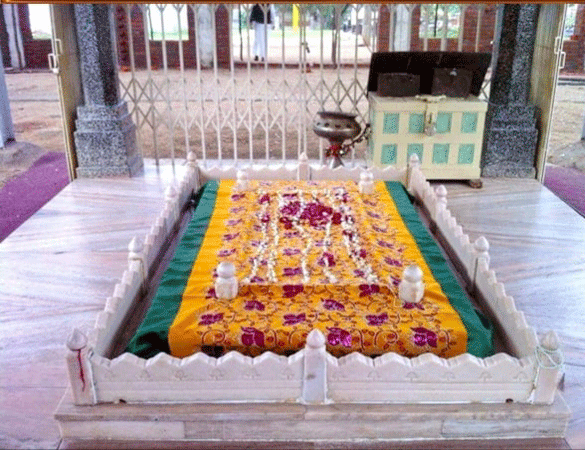
About fifteen days before his passing, despite severe illness, Hazrat Maulavi Muhammad Abdul Qadir Siddiqui Qadri calmly designated his burial place at Siddiqui Gulshan, reflecting complete trust in Allah. He passed away on 17 Shawwal 1381 Hijri (24 March 1962 CE) at 3:45 PM at the age of 94. His mausoleum at Bahadurpura, which also houses the graves of family members, remains a centre of devotion, and his annual Urs from 16 to 18 Shawwal draws large gatherings for Qur’an recitation, sama‘ and langar, bringing together people across Hyderabad’s Old City.
His legacy continues through scholarship and guidance. The Hasrat Academy preserved and published his works, including the English translation of Tafseer-e-Siddiqui (1995–2002) under family supervision. Over sixty-six years of teaching and more than half a million disciples left a lasting impact on religious scholarship, judiciary, academia and public life, supported by a network of ninety-two khalifas worldwide. His Qadri-centred khilafat united multiple Sufi traditions, while his teachings on the ideal human being (Insan-e-Kamil) continue to inspire spiritual practice. Today, digital publications of his tafsir, academic circles linked to Osmania University, and global bay‘ah networks carry forward his message of balanced faith, knowledge, moral responsibility and harmony beyond sectarian divisions, keeping his influence alive in modern Hyderabad and beyond.
___
Adnan Faizi is a Peace and Harmony activist based in Delhi. He is an alumnus of CCS University, Meerut.
New Age Islam, Islam Online, Islamic Website, African Muslim News, Arab World News, South Asia News, Indian Muslim News, World Muslim News, Women in Islam, Islamic Feminism, Arab Women, Women In Arab, Islamophobia in America, Muslim Women in West, Islam Women and Feminism