
Hazrat Maulavi Shah Rafiyuddin Saheb Qadri: Kandhar's Multi-Silsila Luminary and Silsila-e-Rahmatiya Janasheen

By Adnan Faizi, New Age Islam
28 February 2026
Hazrat Maulavi Shah Rafiyuddin Saheb Qadri of Kandhar was a great scholar-saint who united the Qadiriyya, Naqshbandiyya, Shattariyya and Rifaiyya paths. From Hataipura to Mecca, his journey shaped Deccan spirituality, and his dargah still nurtures Hindu-Muslim harmony today.
Main Points:
· Born in Kandhar 1164H, Qadri by origin with Rifai Sarwar Maqdoom nisbat.
· Educated in Surat, Mecca and Arcot, mastering teachings of four Sufi orders.
· Received khilafat from Hazrat Khwaja Rahmatullah Nayabe Rasool as his Janasheen.
· Nawabs became disciples; his Mecca-written Samaratu Meai taught practical spiritual guidance today.
· 5.He passed away in 1241H; his shrine, Kandhar’s second largest, fosters communal harmony.
Introduction
Hazrat Maulavi Shah Rafiyuddin Saheb Qadri, also known as Hazrat Shah Rafiuddin Khandari, was born on 19 Jamad-us-Sani 1164 Hijri in the Hataipura masjid area of Kandhar to Hazrat Qazi Muhammad Shamsuddin, son of Hazrat Maulana Tajuddin, a Bhokar-Dhanora Qazi devoted to Hazrat Haji Sayyah Sarwar-e-Maqdoom Syed Saeeduddin Rifai Qandhari. Married to Hazrat Anwar Bibi Saheba (daughter of Gayasuddin Saheb Kazi), Hazrat Khadar Bibi Saheba, and Hazrat Pir Maa Saheba, he had five sons and five daughters; his childhood name Ghulam Rifaai reflected a dream foretelling his Rifai connection. Travelling through Surat, Mecca-Madinah, Aurangabad, Arcot and Hyderabad, he attracted patrons such as Nawab Amir Kabir Bahadur and Nawab Rafatullah Mulk Bahadur, authored works including Samaratu Meai, Samratul Makki, Unfaas Aashiqeen, Risala Chishtiya, Sulook Naqshbandiya, Anwar-ul-Khandar and Tazkira Naubahar, and, though rooted in the Qadiriyya, Master the Naqshbandiyya, Shattariyya and Rifaiyya paths; his Rahmatiya Janasheen legacy continues at Kandhar’s second-largest dargah, symbolising interfaith harmony in Nanded today.

Kandhari Roots, Lineage and Family
Hazrat Maulavi Shah Rafiyuddin Saheb Qadri was born into a juristically distinguished family in Kandhar, where his father, Hazrat Qazi Muhammad Shamsuddin ibn Maulana Tajuddin, served the Bhokar-Dhanora courts and lived near the Hataipura masjid. A devoted follower of Hazrat Haji Sayyah Sarwar-e-Maqdoom Syed Saeedoddin Rifai Qandhari, the Qazi prayed for a child at the Badi Dargah; a dream vision then inspired the name Ghulam Rifaai, foretelling his future Rifai connection. Though his Qadiriyya heritage blended with strong Rifai spiritual affiliation, and his scholarship was marked by fluency in Persian, Arabic and Dakhni Urdu, linking jurisprudence with spirituality in Kandhar’s Sufi milieu. His family life further extended this legacy through three marriages: Hazrat Anwar Bibi Saheba (daughter of Gayasuddin Saheb Kazi), who bore four daughters; Hazrat Khadar Bibi Saheba, mother of four sons; and Hazrat Pir Maa Saheba, mother of one son and one daughter — making five sons and five daughters in total. His sons, Hazrat Shah Nazmuddin Saheb Rafai, Hazrat Jain-ul-Abidin Saheb Rafai, Hazrat Khayamulah Maulana Kayam Shah Saheb, and Hazrat Shah Gulaam Naqshbandi Saheb reflected affiliations with different Sufi paths, while his daughters and descendants helped sustain the Rahmatiya spiritual tradition in Kandhar. Through this large progeny and scholarly-spiritual inheritance, his household became a continuing centre of devotion and custodianship, preserving the region’s Sufi heritage across generations.
Education, Travels and Literary Legacy
From the age of fourteen, Hazrat Maulavi Shah Rafiyuddin Saheb Qadri received rigorous training under his father, mastering the Qur’an and foundational fiqh, before advancing in Arabic and Persian under Hazrat Kayamuddin Saheb, a prominent Qadri scholar of Kandhar whose shrine stands at Qila Khay. His quest for knowledge then took him beyond India through Surat to the holy cities of Mecca and Madinah, where he deepened his understanding of Qur’an and Hadith during an extended stay. In Aurangabad he benefited from Hazrat Shah Muhammad Azimiuddin Balkhi and entered the Naqshbandi path, while in Arcot he studied with Hazrat Shaykh-ul-Mashaykh Hindu Saheb, gaining authorisation across the Qadri, Naqshbandi, Shattari and Rifai traditions. A later period in Hyderabad drew leading nobles such as Hazrat Nawab Amir Kabir Bahadur and Hazrat Nawab Rafatullah Mulk Bahadur to become his disciples, reflecting his wide influence across regions and social classes.
His years in Mecca also produced a rich body of scholarship, most notably Samaratu Meai, a profound Qur’anic and philosophical work now lost in Kandhar, alongside other writings including Samratul Makki, Unfaas Aashiqeen, Risala Chishtiya, Sulook Naqshbandiya, Anwar-ul-Khandar, and Tazkira Naubahar. A gifted poet and polymath, he combined spirituality with intellectual depth, leaving texts that guided seekers in multiple Sufi paths. Though some works disappeared, surviving materials — especially Anwar-ul-Khandar — continue to preserve Kandhar’s scholarly heritage and support traditional religious learning, demonstrating how his lifelong pursuit of knowledge and writing shaped both spiritual practice and education in the region.
Bay‘ah, Khilafat and Wider Influence
Hazrat Maulavi Shah Rafiyuddin Saheb Qadri’s inner formation began under his father, but his decisive bay‘ah took place in the khanqah of Hazrat Khwaja Rahmatullah Nayabe Rasool, where a year of disciplined spiritual training culminated in the bestowal of the khirqa. He received ijazat in the Qadiriyya, Naqshbandiyya and Rifaiyya paths and was proclaimed a true Janasheen, recognised as a leading khalifa whose authority extended beyond a single silsila. His scholarship was further refined under Hazrat Maulana Syed Qamaruddin Husaini in Hadith, fiqh and tafsir, while earlier training in Arcot had consolidated his familiarity with multiple Sufi traditions, strengthening his Rahmatiya mantle as recorded in the chronicles of Rahmatabad. During his stay in Hyderabad, prominent nobles such as Hazrat Nawab Amir Kabir Bahadur and Hazrat Nawab Rafatullah Mulk Bahadur entered his discipleship, reflecting his influence across social and political circles.
He undertook a second Hajj and spent three years in the Hijaz, where he composed Samaratu Meai within the sacred environment of the Haram. His life thus united scholarship, multi-silsila khilafat, royal discipleship and global pilgrimage, leaving a legacy that shaped Deccan Sufism while modelling inclusive spiritual leadership beyond sectarian boundaries.
Death and Legacy
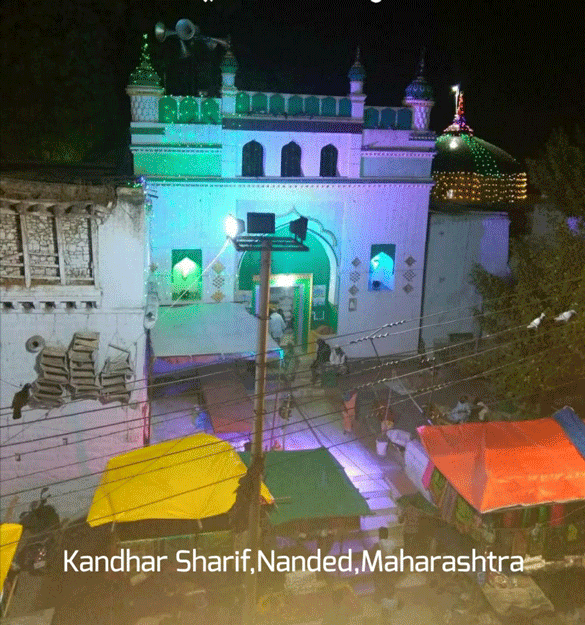
After years of travel and teaching, Hazrat Maulavi Shah Rafiyuddin Saheb Qadri established a major khanqah at Kandhar that became the Rahmatiya centre for spreading multiple Sufi paths — Qadiriyya as the foundation, alongside Naqshbandiyya discipline, Shattariyya spiritual ecstasy, and Rifaiyya fervour — through discourses, literary gatherings and poetry-filled assemblies. Its influence extended to surrounding areas such as Adgaon, Ambulga, Madali Ashtur and Anteshwar, where the khanqah network continued guiding seekers and promoting unity among different silsilas. He passed away at the age of 27th on 16 Rajab 1241 Hijri. His funeral prayer was held at his residence, where he was buried; the site later developed into his dargah, crowned by a grand dome built by Nawab Shamshul Amra and recognised as the second-largest shrine complex in Kandhar near the Badi Dargah. His annual Urs around 16 Rajab draws large gatherings of both Hindus and Muslims who participate in commemorations and langar, reflecting the enduring appeal of his message and the shrine’s role as a centre of spiritual solace and social support.
Conclusion
Hazrat Maulavi Shah Rafiyuddin Saheb Qadri’s legacy continues through his descendants, the Rahmatiya custodianship, and the living khanqah tradition. His writings — including the lost Samaratu Meai from his Meccan retreat and the preserved Anwar-ul-Khandar — still influence scholarship, while his multi-silsila approach unites Sufi centres across Kandhar, including Sangari, Balka and Deulgaon. The shrine’s interfaith Urs fosters communal harmony, his teachings strengthen madrasa learning against extremism, and welfare activities support rural communities. In an era of rapid change, digital preservation and global outreach ensure that the spiritual light of Kandhar’s scholarly saint continues to guide seekers worldwide.
___
Adnan Faizi is a Peace and Harmony activist based in Delhi. He is an alumnus of CCS University, Meerut.
New Age Islam, Islam Online, Islamic Website, African Muslim News, Arab World News, South Asia News, Indian Muslim News, World Muslim News, Women in Islam, Islamic Feminism, Arab Women, Women In Arab, Islamophobia in America, Muslim Women in West, Islam Women and Feminism