
Hazrat Qamar Ali Darvesh: The Young Saint Who Turned Faith into Living Miracle

By Adnan Faizi, New Age Islam
10 February 2026
Hazrat Qamar Ali Darvesh, a young Chishti saint of Khed Shivapur near Pune, showed that true strength lies in faith, humility, and remembrance of Allah. His levitating stone miracle continues to inspire interfaith harmony and spiritual equality beyond material understanding.
Main Points:
· Hazrat Qamar Ali Darvesh showed spiritual maturity beyond age through early Sufi initiation.
· He upheld Chishti renunciation, humility, and constant remembrance of Allah.
· Hazrat Qamar Ali Darvesh's levitating stones unite Hindus, Muslims in shared faith.
· Hazrat Qamar Ali Darvesh proved true power lies in faith, not in age.
· Hazrat Qamar Ali Darvesh's Shivapur dargah attracts millions seeking healing, harmony.
Introduction
In the spiritual history of Maharashtra, Hazrat Qamar Ali Darvesh is remembered as one of the youngest yet most revered Sufi saints. Also known as Hazrat Kamar Ali Darvesh, his name—meaning “Moon of Hazrat Ali”—reflects deep love for the Ahl al-Bayt, while “Darvesh” marks him as a faqir who chose divine nearness over worldly strength. Though he lived only eighteen years, his spiritual legacy endures powerfully at his dargah in Khed Shivapur near Pune. Born into the Chishti Nizami silsila through his father, Hazrat Shaykh Bahauddin, a khalifa of Hazrat Nizamuddin Auliya of Delhi, Hazrat Qamar Ali Darvesh rejected worldly pride and embraced zuhd, dhikr, and total reliance on Allah. His most famous karamat—the lifting of a heavy stone by the fingertips of devotees who call his name—continues to draw people of all faiths. At his shrine, Hindus, Muslims, Christians and others gather together, finding in his life a timeless message: real strength lies not in the body, but in faith, humility and unity.
Early Life and Family Background
Hazrat Qamar Ali Darvesh was born in the late 12th or early 13th century CE. His exact birthplace is not clearly recorded, though his early life is linked to the Chishti spiritual environment connected with Delhi. His father, Hazrat Shaykh Bahauddin, was a respected Chishti khalifa associated with the silsila of Hazrat Nizamuddin Auliya, and he personally supervised his son’s early Islamic and spiritual upbringing. After the death of Hazrat Shaykh Bahauddin, his mother, Hazrat Nazira Begum, played a decisive role by granting her young son permission to dedicate his life fully to the path of Allah. This maternal support allowed his spiritual journey to unfold without worldly restraints. From childhood, Hazrat Qamar Ali Darvesh stood apart from others of his age. While his brothers were known for physical strength and boldness, he was gentle, inward-looking, and deeply inclined toward remembrance of Allah. In a society that admired outward power, he quietly embodied inner strength — a quality that later became the foundation of his spiritual legacy. His life eventually became permanently associated with Khed Shivapur near Pune, where his blessed memory continues to draw seekers.
Spiritual Training, Journey and Living Message
From early childhood, Hazrat Qamar Ali Darvesh was nurtured in both outward and inward knowledge. His first lessons in Qur’an, Hadith and basic fiqh came at home under the care of his father, Hazrat Shaykh Bahauddin, who also introduced him to the manners and discipline of the Chishti path. Alongside this, he was placed into spiritual training from a very young age. At only six years old, he entered into discipleship with a Sufi pir whose name has not been preserved, but whose early influence shaped his inner life. After his father’s death, and with the permission of his mother, Hazrat Nazira Begum, he chose a life of complete spiritual dedication. He later took formal bay‘ah with Hazrat Shamshad Hussain Madani, known as Gara Pir of Pune and became his mureed. Through these links, he remained firmly connected to the Chishti Nizami silsila, though the Deccan’s wider spiritual environment also exposed him to broader Sufi influences. Withdrawing from ordinary social life, Hazrat Qamar Ali Darvesh moved towards Khed Shivapur, where he devoted himself to riyazat, seclusion and constant dhikr. His path was marked by zuhd a quiet rejection of worldly display and physical competition and a deep focus on remembrance of Allah. Where others valued bodily strength, he cultivated inner strength, patience and humility. His message was lived more than spoken: real power lies in faith, unity and nearness to Allah, not in muscle or pride.
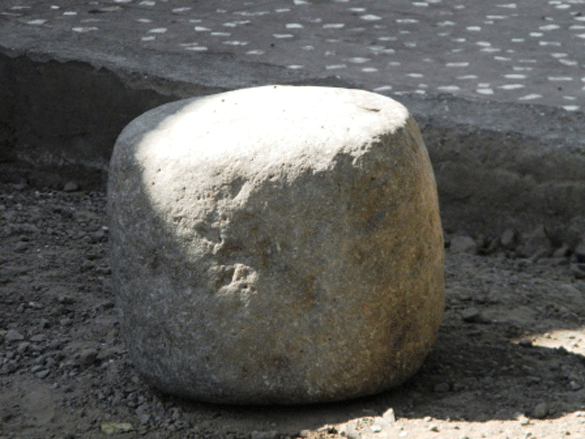
This inner discipline later became visible through well-known karamat. The most famous are the stones at his dargah: a large stone, said to weigh around ninety kilograms, lifted only when eleven people raise it together on their fingertips while calling his name, and a smaller one lifted by nine. Visitors of different faiths participate, and the act is seen as a sign that spiritual force responds to sincerity. Another tradition speaks of a spring that appeared through his dua during a time of water scarcity, whose water devotees still regard as blessed. Through these signs and through the memory of his simple, devoted life, Hazrat Qamar Ali Darvesh continues to teach that humility is greater than pride, faith stronger than force, and that divine grace is open to all who turn with a sincere heart.
The Levitating Stones: Where Faith Touches the Unseen
At the dargah of Hazrat Qamar Ali Darvesh in Khed Shivapur, two simple stones have become a living sign of his spiritual legacy. The larger stone, believed to weigh around ninety kilograms, and a smaller companion stone behave in a way that continues to astonish visitors. When handled casually, they feel heavy and unmoving. At the shrine of Hazrat Qamar Ali Darvesh, devotees gather around a stone weighing about 90 kg, believed to rise only when exactly eleven people lift it with their index fingers while chanting his name together in one continuous breath. Tradition holds that the stone responds to a unified call of faith and focus; outside the shrine or without the shared chant, it is said not to move Many people over the years including students, sceptics, and curious observers have tried to understand this through ordinary explanation. The stones show no visible trick, device or mechanism. Still, they do not respond to force alone; they seem to respond to a shared moment of faith and focus. For devotees, this is a reminder that not everything meaningful can be measured in a laboratory.
What makes this karamat especially moving is its openness. People from different religions, backgrounds and beliefs take part together. Hindus, Muslims, Christians, and even those who come only out of curiosity have lifted the stone when calling his name with respect. In that moment, differences fall away, and a sense of unity fills the air. In today’s world, where strength is often measured by power, technology or physical ability, these stones quietly teach another lesson: true strength comes from humility, sincerity and turning towards the Divine. Hazrat Qamar Ali Darvesh’s miracle continues as a gentle invitation to believe a little deeper, to stand together, and to recognise that there are dimensions of reality the heart understands before the mind does.
Dargah, Urs, and the Living Message
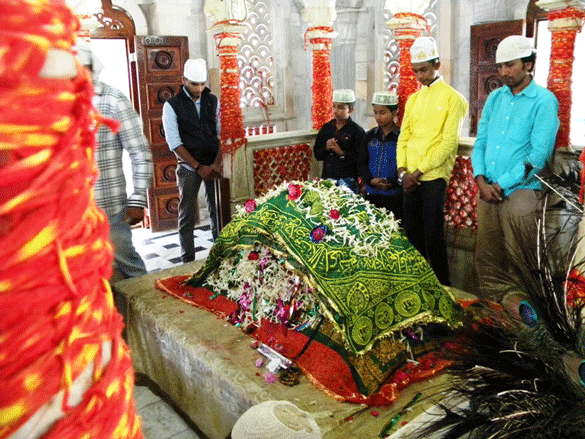
Hazrat Qamar Ali Darvesh left this world at just eighteen years of age in Khed Shivapur, Pune district, about 28 kilometres from Pune Junction. His blessed dargah, modest in structure yet immense in spiritual presence, contains his mazar, the two famous levitating stones, and the spring long believed to carry healing blessings. His annual Urs is observed from 26 April to 2 May, drawing large gatherings of devotees. Qawwali, langar for all visitors, and the remarkable stone-lifting ritual performed by calling his name together remain central features. People of every faith visit, making the shrine a living space of shared devotion and harmony. Though Hazrat Qamar Ali Darvesh left no written books and no formally recorded khalifas due to his short earthly life, his legacy continues through living faith and tradition. His dargah serves as an open khanqah where equality, service, and remembrance of Allah are practiced daily. In a world focused on power and competition, his life delivers a timeless lesson: true strength is born from humility, unity, and trust in Allah. The stone that will not rise for one person alone lifts when many join together—an enduring sign that spiritual power flows through collective faith and sincere hearts.
Living Relevance of Hazrat Qamar Ali Darvesh
Hazrat Qamar Ali Darvesh’s legacy continues to speak powerfully to the modern world. At a time when people rely only on material explanations, the phenomenon of the levitating stones at his dargah reminds visitors that reality is not limited to what science alone can measure. Engineers, students, sceptics, and believers alike witness the same event: a heavy stone that will not move through ordinary effort rises when a group calls his name with sincerity. For many, this becomes less a challenge to science and more a reminder that the human heart and intention hold dimensions still beyond explanation. His shrine in Khed Shivapur has also become a quiet lesson in social harmony. People from different religions, castes, languages, and backgrounds stand together, place their fingers under the same stone, and lift it collectively. Without speeches or slogans, the act itself teaches unity, humility, and shared faith in something higher than individual strength. In a society often divided by identity, this shared experience becomes a living symbol of togetherness.
His life also offers an alternative model of strength for today’s generation. In a world that glorifies physical dominance and competition, Hazrat Qamar Ali Darvesh, a young saint, showed that spiritual focus, remembrance of Allah, and purity of intention carry a deeper power. Though he wrote no books and left no formal line of khalifas, his message survives through living practice at his dargah: humility over pride, unity over division, and faith over fear. Centuries after his brief life, his presence still guides hearts, proving that true influence is measured not by years lived, but by light left behind.
___
Adnan Faizi is a Peace and Harmony activist based in Delhi. He is an alumnus of CCS University, Meerut.
New Age Islam, Islam Online, Islamic Website, African Muslim News, Arab World News, South Asia News, Indian Muslim News, World Muslim News, Women in Islam, Islamic Feminism, Arab Women, Women In Arab, Islamophobia in America, Muslim Women in West, Islam Women and Feminism