
Hazrat Sangde Sultan Mushkil Aasan: Beacon of Rifai Grace in Deccan

By Adnan Faizi New Age Islam
21 February
Hazrat Syed Shah Shaykh Ali Sangde Sultan, revered as Mushkil Aasan, embodied Rifai spiritual prowess, scholarly depth and miraculous grace, illuminating Deccan’s Sufi landscape for centuries.
Main Points:
· Hazrat Syed Hussaini lineage traces to Hazrat Rifai through 13th generation.
· Revived Rifai path in Qandhar Sharif with khanqah and talab worship.
· Authored lost treatises on zahir batin sciences and tasawwuf exegesis.
· Among his devoted khalifas were Hazrat Manjhle Chilledar and Hazrat Ziauddin Biabani.
· Annual Urs draws lakhs, preserving mushkil‑kusha legacy eternally.
…
Introduction
Hazrat Syed Shah Shaykh Ali Sangde Sultan, known as Hazrat Sangde Sultan Mushkil Aasan Al-Qandhari, was a towering saint of the Rifai tradition in the Deccan. Born in the late eighth century Hijri at Qandhar Sharif (Nanded, Maharashtra), he belonged to a Syed Hussaini lineage linked to Hazrat Syed Ahmed Kabir Rifai of Basra. He was a great scholar of both Shariah and Tasawwuf, whose writings were later lost to history. he turned Qandhar into a great khanqah through ascetic struggle, preaching and trust in Allah. Initiated by his father Hazrat Syed Shah Shaykh Ahmad Rifai, he received ijazat in Rifai, Qadri, Chishti and Suhrawardi paths, guiding seekers through zikr, chilla and disciplined suluk. His karamat earned the title Mushkil Aasan, while his legacy continues through hereditary khalifas, the Biabani silsila of Hazrat Ziauddin Biabani, and a massive annual Urs.
Family Heritage and Early Spiritual Formation
Hazrat Syed Shah Shaykh Ali Sangde Sultan belonged to the exalted Saadat Hussaini lineage. Munshi Hazrat Amir Hamza traced hazrat's genealogy to the Prophet Muhammad through 33th generations, while genealogical records identify him as the 13th descendant of Hazrat Syed Ahmed Kabir Rifai Mashooq of Basra, founder of the Rifai silsila. His great-grandfather, Hazrat Syed Shaykh Ibrahim Rifai, titled Sipah Salar, arrived in the Deccan around 725 Hijri with Hazrat Haji Sayyah Sarwar-e-Makhdoom Qandhari in the army of Sultan Muhammad bin Tughlaq after receiving blessings from Hazrat Nizamuddin Auliya in Delhi. They settled in Qandhar Sharif and established the Badi Dargah and Choti Dargah, enduring centres of Rifai spirituality. Hazrat Syed Shaykh Ibrahim Rifai later moved to Kalyani Paragana (present-day Chitguppa, Karnataka), where his mazar still stands. His grandfather, Hazrat Syed Shah Shaykh Muhammad Zakaria Rifai, devoted himself to worship and zikr near the Qandhar talab and received his laqab from Hazrat Haji Sayyah Sarwar-e-Makhdoom Qandhari His father and murshid, Hazrat Syed Shah Shaykh Ahmad Rifai, lived by the same talab, guiding seekers in zahiri and ruhani sciences and granting bay‘ah in multiple silsilas.
Hazrat Sangde Sultan married Hazrat Jamal Bibi Sahiba, mother of his heirs, and Hazrat Tara Bibi Sahiba, who remained without children. From Hazrat Jamal Bibi Sahiba were born three sons: Hazrat Syed Shah Azeemuddin Rifai, Hazrat Syed Shah Ahmad Manjhle Chilledar Rifai, and Hazrat Syed Shah Moinuddin Rifai, Both were laid to rest at Gavalipura, Qandhar. His first and third sons became popularly known as Shah Dhadak and Shah Kadak. Their shrines are located about two kilometres west of his dargah in Qandhar, and their Urs is observed on 10 Safar following his Urs. Hazrat Syed Shah Ahmad Manjhle Chilledar Rifai later became his first khalifa and sajjada nasheen, continuing the hereditary silsila. Born in the late eighth century Hijri, around 770 Hijri, at Qandhar Sharif in present-day Nanded district, Maharashtra, Hazrat Sangde Sultan grew up in a region already shaped by Sufi influence since the Tughlaq era. From childhood he received rigorous training in both outward and inward sciences under his father at the talab-side khanqah, mastering fiqh, tafsir and Hadith alongside the disciplines of Rifai suluk, zikr, jihad-e-nafs and tawakkul. Signs of wilayat appeared early: his discourses impressed elders and his karamatain brought relief to seekers, foreshadowing the title Mushkil Aasan by which he later became universally known.
Spiritual Mission, Khalifas and Living Teachings
Hazrat Sangde Sultan received bay‘ah from his father and murshid, who granted him ijazat in multiple silsilas — Rifai as primary, along with Qadri, Chishti and Suhrawardi paths. This comprehensive spiritual authorisation shaped his intense suluk: prolonged chillas beside the Qandhar talab, gatherings of zikr combining loud (jahri) and silent (khafi) remembrance, deep muraqaba and spiritual unveilings. He embodied classic Rifai traits such as discipline in sama‘, control over the nafs, and rigorous ascetic training, while also reflecting Qadri firmness and Chishti love-centred spirituality. After bay‘ah, he travelled widely across the Deccan and even to Punjab and Sindh, preaching Islam with wisdom and compassion. A journey to Khorasan around 832 Hijri deepened his spiritual insight, while a stay in Daulatabad — where he overcame a sorcerer named Sangad through spiritual retreat — earned him the title “Sangde Sultan.” Returning to Qandhar, he established a khanqah by the lakeside that became a centre for guiding seekers. Among his foremost khalifas was Hazrat Syed Shah Ahmad Manjhle Chilledar Rifai, who inherited the spiritual authority and continued the family lineage through his renowned chillas. Hazrat Syed Ziauddin Biabani of Ambad, Jalna. His nephew, son-in-law and khalifa, who was married to his daughter Hazrat Fatteh Shaha Ma, preserved his teachings in the Persian work Matlub-ut-Talibeen and founded the Biabani silsila. Hazrat Ibrahim Tajeer strengthened the institutional base by constructing the khanqah.
His disciples included scholars, warriors and ordinary people, all trained in core principles recorded in Tareekh Anwar-ul-Qandhar by Hazrat Maulana Shah Rafiuddin Qandhari: struggle against the ego, absolute trust in Allah, disciplined spiritual gatherings, and active preaching. His sayings and letters emphasised helping people overcome difficulties through sincere reliance on Allah. His symbolic dual spears represented mastery of both outward struggle and inner purification, while his time in Sindh and martial reputation reinforced his titles. Today, his life speaks directly to modern seekers overwhelmed by distraction and anxiety. His emphasis on self-discipline over ego, love over division, and service over status offers a practical path in an age of noise and materialism. The khanqah model he built — combining worship, learning, charity and community — remains a blueprint for spiritual renewal even now. Hazrat Sangde Sultan’s message endures: true strength comes from conquering the self, trusting Allah in hardship, and using knowledge and compassion to guide society.
Scholarly Contributions, Miracles and Lasting Impact
A master of both outward and inward knowledge (alim-e-zahir-batin), Hazrat Sangde Sultan authored several important works on religious and spiritual sciences including fiqh commentaries and tasawwuf exegeses though most were later lost during periods of turmoil, a loss deeply lamented by later scholars. Hazrat Maulana Shah Rafiuddin Qandhari praised him as a mufassir of tasawwuf, and traces of his teachings survive in Matlub-ut-Talibeen. His writing style was concise and practical — manuals of suluk that united shari‘ah with spiritual realisation, making them especially suited for Deccan seekers. His titles reflect powerful events in his life. “Sangde” is linked to his Sindh sojourn at Sangad where devotees bowed before his spiritual authority, while another tradition connects it to his defeat of a sorcerer at Daulatabad and to his mastery of the dual spears he carried. Known as Mushkil Aasan for resolving hardships through karamat, stories include saving storm-struck ships through prayer. In the turbulent post-Tughlaq Deccan, his preaching influenced diverse communities — from warriors to common people — while his refusal to align with political power strengthened his independent spiritual authority and lasting social impact.
Dargah, Urs and Living Legacy
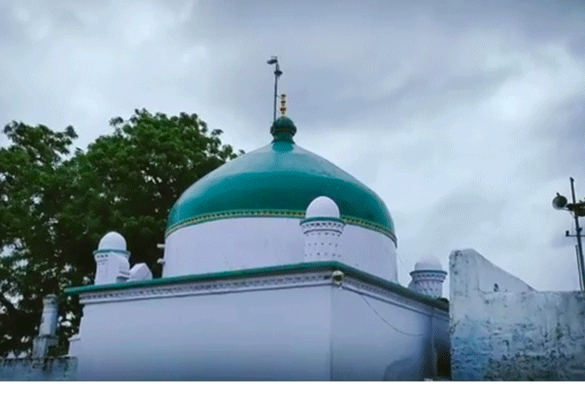
Hazrat Sangde Sultan was died on 8 Safar 856 Hijri (1452 CE) at about 86 years of age. He rests at Rouza-e-Khurd in Qandhar Sharif, where his square-domed mazar forms a sacred complex including a mosque, khanqah and Ashurkhana, and where his two spears (sang) are still preserved as revered relics. His annual Urs on 8 Safar — the 591st observed in 2025 — draws lakhs of devotees from all faiths for ghusl-e-mazar, sandal, zikr, qawwali, langar and mehfil-e-sama‘, with processions arriving from the Badi and Choti Dargahs before the concluding dua. The shrine today is overseen by the sajjada nasheen, Hazrat Syed Shah Moulana Anwarullah Hussaini Rifai Al Qadri, who continues the Rifai-Qadri tradition. His spiritual legacy endures through the family line of Hazrat Manjhle Chilledar and the Biabani branch spreading to Jalna and Ambad, forming a wider Marathwada Sufi network linked with Khuldabad and Daulatabad. The dargah remains a living centre where the mosque resounds with zikr, the khanqah guides seekers, and the Urs unites people beyond caste and creed. Scholarly research, digital manqabats and recordings continue to carry his Mushkil Aasan legacy across Maharashtra, Karnataka, Telangana and the diaspora, preserving his place as Qandhar’s enduring spiritual beacon.
____
Adnan Faizi is a Peace and Harmony activist based in Delhi. He is an alumnus of CCS University, Meerut.
New Age Islam, Islam Online, Islamic Website, African Muslim News, Arab World News, South Asia News, Indian Muslim News, World Muslim News, Women in Islam, Islamic Feminism, Arab Women, Women In Arab, Islamophobia in America, Muslim Women in West, Islam Women and Feminism