
Khwaja Hasan Sani Nizami: Sufi Saint of Delhi

By Sahil Razvi, New Age Islam
04 April 2026
Khwaja Hasan Sani Nizami was a Sufi saint, scholar, and peace-builder who served at Nizamuddin Dargah. He promoted qawwali poetry, authored spiritual books, and worked tirelessly for Hindu-Muslim unity.
Main points:
· Patron of qawwali and Sufi poetry.
· Wrote and edited over a dozen books on Sufism and history.
· Champion of Hindu-Muslim unity and Ganga-Jamuni culture.
· Awarded Delhi Gaurav for interfaith work
“We declare that such Taliban and others of their ilk anywhere in the world [are] kharij-ul-Islam (out of Islam).”
~Khwaja Hasan Sani Nizami
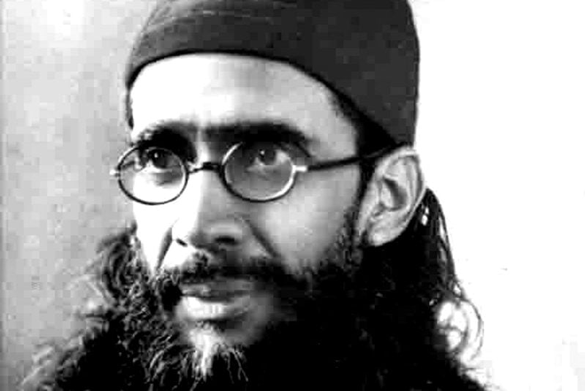
Khwaja Hasan Sani Nizami, born Khwaja Hasan Abu Talib Nizami, was a towering Sufi personality of the Nizami branch of the Chishti Order and the Sajjada Nashin (spiritual successor and head caretaker) of the revered Dargah of Hazrat Khwaja Nizamuddin Auliya in Delhi. Son of the legendary Sufi scholar and litterateur Khwaja Hasan Nizami, he carried forward a rich family legacy spanning centuries, tracing its spiritual lineage to Hazrat Ali (RA) in the 34th generation. He was a prolific scholar, editor, radio personality, and interfaith bridge-builder. A true embodiment of India’s composite Ganga-Jamuni culture, he remained a steadfast champion of Hindu-Muslim unity throughout his life, even as he guided lakhs of mureeds (disciples) from diverse faiths across the globe. Unmarried and childless, he devoted his entire life to the service of the dargah,
Born and raised in the sacred precincts of Basti Hazrat Nizamuddin, Khwaja Hasan Sani Nizami imbibed Sufi values from infancy amid the daily rhythms of dhikr, sama, and langar at the dargah. He received his early religious education at home under the loving guidance of his illustrious father. Later, he graduated from Jamia Millia Islamia, blending traditional Islamic learning with modern education. In 1955, following his father’s demise, he succeeded as Sajjada Nashin, assuming the hereditary responsibility that his family had shouldered for generations. As the spiritual head of the Nizami Chishti silsila, he oversaw the dargah’s rituals, maintained its physical and spiritual sanctity, and welcomed pilgrims of every faith with open arms, reinforcing the Chishti ethos of love, tolerance, and service to humanity.
Some of his sayings.
“There is no end to quotes to prove that religion is indeed against intolerance and Violence. But it is also a fact that in spite of our claim there was and there is Violence everywhere”
~Khwaja Hasan Sani Nizami
His encyclopaedic knowledge earned him membership in premier institutions such as the Delhi Urdu Academy, Ghalib Academy (of which he later became Chairman), Ghalib Institute, and the National Amir Khusrau Society. He also served as founder-member of the All India Sufi Conference, Hyderabad, and Secretary of the Khwaja Hasan Nizami Memorial Society. A member of the United Nations Religious Initiative in San Francisco, he represented India at the UN-sponsored All Religions Conference and the Millennium World Peace Summit, delivering lectures at universities in India and abroad on Sufism, peace, and interfaith dialogue.
While Khwaja Hasan Sani Nizami is primarily remembered as a scholar and prose writer rather than a prolific poet like his father, he inherited and passionately nurtured the poetic and musical traditions of Chishti Sufism. He was deeply fond of Qawwali, the soul-stirring devotional music introduced by Hazrat Amir Khusrau, and regularly organised mehfil-e-sama sessions at the dargah, drawing thousands of devotees. These gatherings kept alive the classical ghazals, manqabats, and mystical poetry of the Chishti silsila, making the dargah a living centre of Sufi lyricism even in the modern era.
In his book Tasawwuf Rasm Aur Haqiqat, Hazrat Khwaja Hasan Sani Nizami writes:
“The status of the Book (Qur’an) and the Sunnah is that of a touchstone as well as of light. It serves as a key to understanding the direction of the Sufis’ lives and the orientation of their struggles and conduct. The Sufis had made the Book and the Sunnah the centre and pivot of their lives, and it was within these alone that they spent their days and nights.”
Tagged under the pen name “Nizami” in literary circles, he carried the family’s poetic sensibility forward through patronage and occasional compositions in the classical style. His promotion of Qawwali was not merely cultural but spiritual, a medium to experience divine love, fana (self-annihilation), and wahdat (unity). Through these efforts, he ensured that the poetic heritage of Nizamuddin Auliya and Amir Khusrau continued to resonate, blending seamlessly with the syncretic ethos of Indian Sufism.
Khwaja Hasan Sani Nizami was a tireless litterateur who authored and edited numerous works while ensuring the preservation of his father’s vast literary treasure. He continued editing the monthly magazine Munaadi (started by his father) from 1955 onwards, using it as a platform for essays on history, Sufism, culture, and contemporary issues. He penned innumerable articles and delivered hundreds of radio talks on a wide range of subjects, from Islamic sciences to Delhi’s civic history.
His own writings, including titles such as Power of the Noble Qur’an as the Spoken Word and Sufism: Myth and Reality, reflected his deep engagement with tasawwuf and humanism. He also republished twelve rare volumes by his father on the 1857 War of Independence, making them accessible to new generations. His literary output, though often collaborative and editorial, was marked by clarity, depth, and a commitment to preserving Delhi’s Indo-Islamic heritage.
In an era of occasional communal tensions, Khwaja Hasan Sani Nizami stood as a shining symbol of Hindu-Muslim unity and India’s composite culture. A true representative of Ganga-Jamuni tehzeeb, he actively promoted communal harmony and interfaith dialogue as essential for national integration. His dargah remained a sacred space open to devotees of all faiths, where Hindus, Muslims, Sikhs, and others offered prayers side by side, reflecting the Chishti ideal that love for God encompasses love for all humanity.
He represented India at international interfaith forums, including the UN-sponsored All Religions Conference, emphasising religion’s role in fostering peace and countering intolerance. His spotless secular credentials and tireless efforts to build bridges between communities earned him the prestigious Delhi Gaurav (Pride of Delhi) Award from the Government of India during Atal Bihari Vajpayee’s tenure as Prime Minister. Even in 2006, he publicly condemned the Taliban as “out of Islam,” reaffirming his moderate, inclusive Sufi worldview. By organising Qawwali programmes, delivering lectures on shared spiritual values, and upholding the dargah’s tradition of universal brotherhood, he carried forward his father’s legacy of mutual respect, exemplified in works like Krishna Beeti, while adapting it to contemporary challenges. For him, true Sufism meant transcending religious labels and working for the unity of India’s diverse populace.
Khwaja Hasan Sani Nizami passed away on 15 March 2015 after a prolonged illness. As per his will, his funeral prayers were offered twice, once by his disciple Syed Rashid Nizami and again by the dargah’s Imam Maulana Syed Minhaj Nizami. He was laid to rest in Khwaja Hall beside his father. His nephew, Khwaja Syed Mohammad Nizami, succeeded him as Sajjada Nashin.
In 2017, two beautifully designed volumes on his life and achievements were released by Vice President M. Hamid Ansari. Condolence meetings across madrasas, literary bodies, and milli organisations paid rich tributes to this “Mystical Sufi, Humanist, and Encyclopedia of Delhi.” Today, his mureeds worldwide and the thriving dargah stand as living testimonies to his message of love, tolerance, and unity.
In an age still seeking harmony, Khwaja Hasan Sani Nizami’s life reminds us that the path of Sufism is the path of humanity, where poetry, scholarship, and service.
…
A regular contributor to New Age Islam, Sahil Razvi is a research scholar specialising in Sufism and Islamic History. He is an alumnus of Jamia Millia Islamia.
URL: https://newageislam.com/islamic-personalities/khawaja-hasan-sani-nizami-sufi-saint-delhi/d/139539
New Age Islam, Islam Online, Islamic Website, African Muslim News, Arab World News, South Asia News, Indian Muslim News, World Muslim News, Women in Islam, Islamic Feminism, Arab Women, Women In Arab, Islamophobia in America, Muslim Women in West, Islam Women and Feminism