
Mahjoor: The Voice of Kashmir's Soul and Conscience

By Altamash Ali, New Age Islam
17 January 2026
Mahjoor was not only a poet of nature and love but also a voice of resistance and reform. Writing in Kashmiri, he awakened social and national consciousness, earning his place as the harbinger of modern Kashmiri poetry and the enduring “Shair-e-Kashmir.”
Main points:
Mahjoor transformed Kashmiri poetry into a medium of social awareness and national consciousness.
Deeply inspired by Kashmir’s nature, he linked beauty with justice and freedom.
Tagore called him the “Wordsworth of Kashmir,” though his poetry went beyond romanticism.
He chose Kashmiri over Urdu to speak directly to the masses.
His verses played a vital role in awakening people during the Dogra rule.
“The spring has arrived in the gardens,
I keep singing ghazals, expressing the pain of my heart.
Every lake, every garden, every valley of Kashmir,
Lives within my poetry.”
Mehjoor’s poems were not just words; they were the echo of Kashmir’s soul, its pain, and its beauty. His writings reflect folk life, the grandeur of nature, and social awareness. Even today, his verses are sung in fields, during festivals, and at local celebrations, filling people’s hearts with patriotism, love, and humanity.
Mehjoor was born on August 11, 1887, in Mitrigam, Pulwama, Kashmir, India. His father was Peer Abdullah Shah, and his mother was Sayeeda Begum. Mehjoor was only two years old when his mother passed away, and his father took responsibility for his early education. From a young age, Mehjoor was curious and eager to learn, with an exceptional memory and intellect.
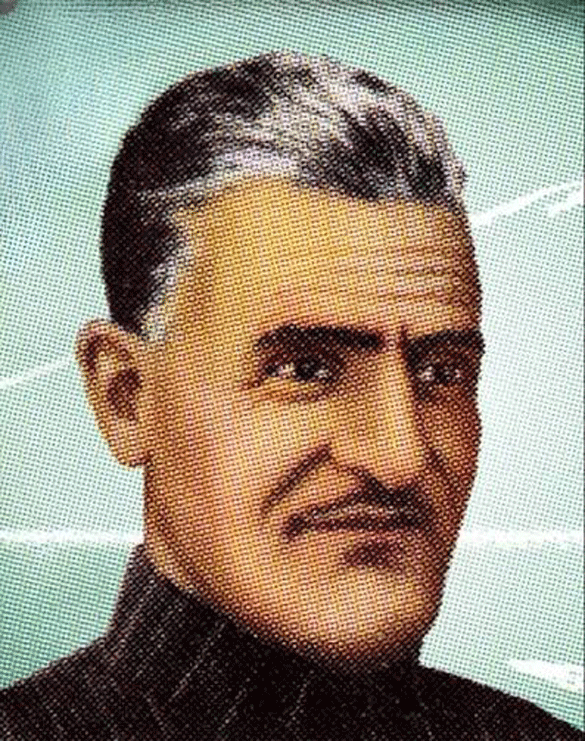
He received his primary education in Tral, where his teacher Abdul Ghani Aashaq guided him in both poetry and scholarship. In 1901, Mehjoor was sent to the Nusrat-ul-IslamMadrasa in Srinagar. His father hoped he would follow a religious path, but Mehjoor’s dreams were in literature and poetry.
In 1905, Mehjoor went to Amritsar, where he learned calligraphy, which later helped him secure a job at a local newspaper. During this time, he met many famous Urdu poets, including Maulana Bismil Amritsari, Mohammad Din Fouq, and Maulana Shibli Nomani, who inspired and refined his poetry. It was during this period that he adopted the pen name “Mehjoor.”
In 1908, he returned home, and the next year he was appointed as a Patwari (revenue officer). His first posting was in Ladakh, and later he worked in various parts of Kashmir. These travels allowed him to observe Kashmir’s culture, traditions, and folk poetry, which deeply influenced his work.
One notable incident from Mehjoor’s life shows his sensitivity and sense of responsibility. Once, his village was struck by hunger and extreme poverty. People lived in small huts, their clothes were torn, and the children’s faces reflected deep suffering. Mehjoor felt that merely observing this was not enough.
He called a small gathering of children and young people in his home and said:
“Poetry is not just words. It is our voice. It is a way to expose injustice and to spread hope.”
That night, inspired by what he had seen, Mehjoor wrote a poem highlighting the suffering of the poor and farmers, the injustice in society, and the importance of humanity. This incident became a turning point in his life, teaching him that poetry is not just art but also a tool to awaken and change society.
Rabindranath Tagore described Mahjoor as the “Wordsworth of Kashmir,” a reference to the romantic strain in his poetry. However, Mahjoor’s work went far beyond mere romanticism of the landscape or the sentimentality of everyday life, reflecting deeper social, cultural, and national concerns.
One of his famous poetry:
O bulbul, let the freedom urge possess your soul!
Bid good bye to your cage, step out,
Gather your flowers and enjoy their bloom!
Speak out bold and clear. Your voice
Need not falter with fear
As when you sang within your cage.
In bondage, they served you ample food.
Now gather in the fields what grain you can,
And see how sweet is food in freedom!
Though unfreedom made you stammer,
Your call enchanted the birds of the air,
For it was born of love.
You can't remain with folded wings!
Plume them, fly and see the world.
See flowers now with eyes of freedom.
You don't know the latest about the garden!
Forget about the past; sing new songs now
Mahjoor, throw away this belt of bondage!
From now, you are free as a bird.
Your heart commands, your voice obeys!
Mehjoor first tried writing Urdu and Kashmiri poetry around 1911–12, but soon realized that his true expression belonged to the Kashmiri language. A poetry competition in Urdu did not bring him success, which encouraged him to embrace his mother tongue. In 1915, he completely shifted to Kashmiri.
In his poetry, Mahjoor celebrates his homeland, Kashmir, using rich metaphors drawn from nature.
bulbul wanan chu poshan
gulshan watan chu souni.
mahjoora des sonuy
baagah chhu nundabonuy
ath lol gatghi baronuy
gulshan vatan chhu sonuy
The bulbul sings to the flowers:
‘A garden is our land!’
Mahjoor, our motherland
Is the loveliest on earth!
Shall we not love her best?
A garden is our land
(Translation by Triloknath Raina)
His first Kashmiri poem, “Vanta Hay Vesy”, was published in 1918. This work marked a turning point, bringing him widespread recognition and earning him the title “Shair-e-Kashmir” (Poet of Kashmir). His poems celebrate Kashmir’s natural beauty while conveying messages of justice and humanity.
In 1972, a bilingual film titled Shayar-e-Kashmir Mahjoor was released, with the Hindi version featuring Balraj Sahni in the lead role. A public square in Srinagar has been named in his honour. He was laid to rest near the grave of the renowned poet Habba Khatoon at a site close to Athwajan on the Jammu–Srinagar National Highway.
One of Mahjoor’s poems, “Ha Gulo,” was featured in Coke Studio Explorer and was performed by the Kashmiri regional band Qasamir.
In 2013, Prime Minister Manmohan Singh and UPA Chairperson Sonia Gandhi released a postal stamp in honour of Shair-e-Kashmir Peerzada Ghulam Ahmad Mahjoor.
Peerzada Ghulam Ahmad, known as Mahjoor, died on April 9, 1952, in Mitrigam, Kashmir, India.
…
Altamash Ali is a Sufi writter and a student at IFTM University.
URL:https://newageislam.com/islamic-personalities/mahjoor-voice-of-kashmir-soul-/d/138477
New Age Islam, Islam Online, Islamic Website, African Muslim News, Arab World News, South Asia News, Indian Muslim News, World Muslim News, Women in Islam, Islamic Feminism, Arab Women, Women In Arab, Islamophobia in America, Muslim Women in West, Islam Women and Feminism