
Maulana Abul Kalam Azad Was A Liberated Soul
By Faizaan Bhat
November
11, 2020
On 11
November, 1888 South Asia’s prominent Islamic scholar, politician, author,
journalist Maulana Abul Kalam Azad was born. He has a strong presence in the
religious, social and political consciousness of Muslims in South Asia. Azad
has been discussed a lot in present era because of recent political
developments in whole South Asia especially about the rights of minorities. E.H
Carr in his seminal work What is History writes that “History is an unending
dialogue between past and present”, It connects our past with present. Due
to some political developments in
present times we have to connect it with our past, what our leaders did that
time. In this way Azad, one of the prominent leaders is one of the most
discussed person.
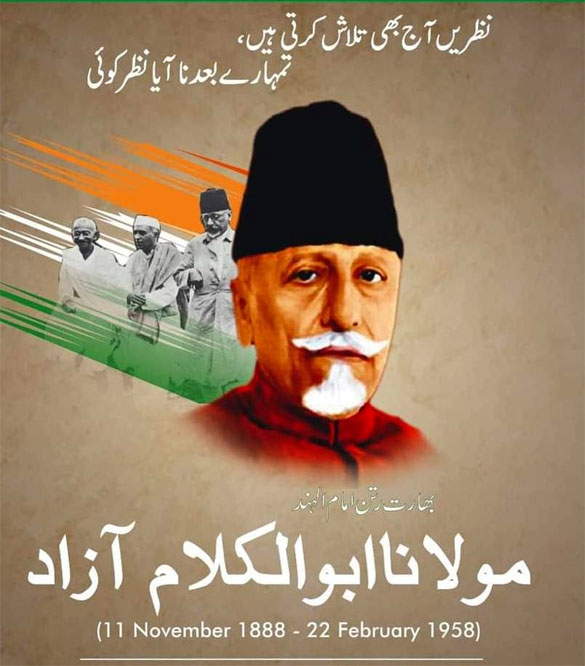
Photo
Courtesy: Dr. Nargis Kausar
@kausar_nargis
------
Azad was
not only a politician but a scholar. Ian Douglas in the introduction of his
critical book on him Abul Kalam Azad, an
intellectual and religious biography
beautifully sums up him “ Maulana Abul Kalam Azad is by any reckoning a
major figure in twentieth century in Indian history. He was a scholar
thoroughly trained in Islamic sciences, with great intellectual abilities and
eloquence of pen and speech. He had in addition a remarkable openness to
Western knowledge even as he opposed Western rule over India. He made a lasting
contribution to Urdu literature with translations and interpretations of the
Quran, his many other religious writings and his introspective autobiographical
and epistolary works. He was a skilful journalist, and an ideologue who played
a leading role in the Indian independence movement, and then in the government
of Indian republic, remaining a symbol of Muslims co existing with people of
other religions in Modern India.”
He started
writing at a very young age of 12 in 1899 for Nauragi-Alam, then Misbah. He
became editor of a paper at a very young age. It was when he and his brother
wrote for Khandage Nazar with his brother when the editor said we will publish
your articles only if Azad edits the paper. He got writing inspiration from his
father who has written more than 10 books. Azad had a great influence of his
father on him who was a sufi and whose ancestors had fought against Akbar and
his supporters on “Din-i-Elahi”. In
his own words in Azad Ki Kahani Khud Azad
Ki Zubaani, he started losing faith, became atheist between 12-22 of his
age, and gained his faith back after reading. He then came under the influence
of Sir Syed Ahmad Khan on religious and intellectual life which he later
criticized on their loyalism to British empire. He then started criticizing Taqlid and some Sufi doctrines which his
father used to follow. He rebelled against his father and got a pen name Azad
(liberated). At this time Azad was under the influence of Mutazzalites and
started to translate Ghazalli’s Tahafati
Filasafa and Rushd’s Tahafat Ul
Tuhafat. He had also started writing book on Sir Syed’s theology. He lost
interest in all these books and didn’t complete them. It was at this time
Shibli Nomani wrote to Azad. Thus started their correspondence and later Shibli
made Azad officer of Anjuman i Taraqqi Urdu for the promotion of Urdu.
After this
Azad came in contact with Shyam Sundar Chakravarti who was a disciple of
Auribundo Ghose and a member of Bengal revolutionary movement. He joined them
and told them Muslims should also join this movement. Azad had started his own
paper Al Hilal then Al Balaagh. It was during this period that prominent scholars
like Mahmud ul Hassan Deobandi and Syed Sulaiman Nadwi praised him for writing
about the forgotten aspects of Islam. It was at this time Azad was greatly
inspired by the work of Ibn Tayyimiah, especially on Ijtihaad. Later Azad in
his life was the pioneer of controversial philosophy “Wahdat I Din” that All religions have same message and lead to same
path, Muslims can’t disbelief other religions.
Azad, as a
personality, was complex and at times contradictory He underwent a transition;
from being a Pan Islamist to being a pioneer of composite nationalism. During the Khlifat Movement he had written a
book on Khilafat too, and worked closely with Gandhi on it. He was the youngest
to preside the Congress at the age of 35. Aga Sourish Kashmiri in his book Abul
Kalam Azad writes that he had interviewed him in 1946 during Simla Conference
and talked to him in detail about problem of Muslims, and on Pakistan. In his
own words, “It is one of the greatest frauds on the people to suggest that
religious affinity can unite areas which are geographically, economically,
linguistically and culturally different. It is true that Islam sought to
establish a society which transcends racial, linguistic, economic and political
frontiers. History has, however, proved that after the first few decades or at
the most after the first century, Islam was not able to unite all Muslim
countries into one state on the basis of Islam alone”, creation of Bangladesh
proved him right.
When he was
jailed fifth time during second world war his wife passed away. He didn’t seek
permission of British government to visit her funeral citing moral reasons.
When he was released from prison he was the Congress President and Indian
independence and creation of Pakistan was being discussed. Unfortunately he was
side-lined by his own people. Prominent South Asian historian Ayesha Jalal, in
her article Azad, Jinnah and Partition (Economic and Political Weekly, 27 May
1980) cites “Transfer of Power, volume 6” when he tried to give solution for
Pakistan problem, he as Congress President wasn’t allowed to talk to Muslim
leadership, instead Congress sub committee was told to talk. How he got
lukewarm response from Gandhi, which Azad in his autobiography India wins
Freedom writes should have been talked to him as a president. This is where
historians, political scientists can intervene and connect our past with
present.
Azad, being
a prolific writer, journalist, and author, after independence, was made the first
education minister. As education minister he re organized University Grants
Commission, All India Council of Technical Education. Indian Council of
Cultural Relations. He was an institution builder, laid foundation to prominent
institutes in India and before independence was among the founders of Jamia
Milia Islamia. It was first started in the tents in Aligarh then shifted to the
present campus. One may have disagreements, or fundamental disagreements, but
one can’t ignore his personality.
Original Headline: Azad: Freedom Personified
Source: The Greater Kashmir
URL: https://newageislam.com/islamic-personalities/maulana-abul-kalam-azad-liberated/d/123439
New
Age Islam, Islam Online, Islamic Website, African Muslim News, Arab World News, South Asia News, Indian Muslim News, World Muslim News, Women in Islam, Islamic Feminism, Arab Women, Women In Arab, Islamophobia in America, Muslim Women in West, Islam Women and Feminism