
Maulana Abul Kalam Azad: Precious Heritage Of Dance, Drama And Music Is One Which We Must Cherish And Develop
By
Saquib Salim, New Age Islam
18 October
2023
“You
(Sardar Patel) perhaps do not know that I (Maulana Azad) have always taken a
keen interest in Indian music and at one time practiced it myself.” Maulana
Abul Kalam Azad wrote to Sardar Vallabhbhai Patel in a letter dated 10 February
1947. He was dissatisfied with the “standard of music of All India Radio
broadcast” and asked Patel to look into the matter so “that All India Radio
should set the standard in Indian music and lead to its continual improvement.”
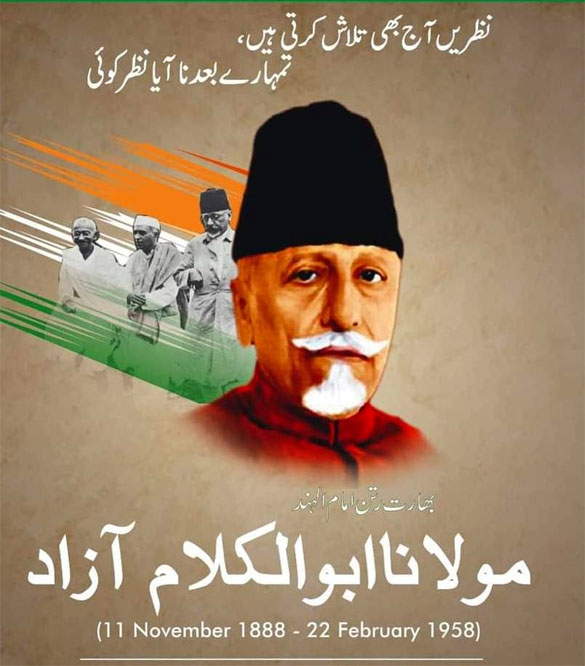
Maulana Abul Kalam Azad, India's first education minister
------
It is a
lesser-known fact that Maulana Abul Kalam Azad, an Islamic scholar and a
freedom fighter, was a trained musician.
Maulana
Azad in an unposted letter, dated 16 September 1943, to Maulana Habibur Rahman
Sherwani, wrote, “Let me tell you one thing! I have contemplated this many
times. I can be happy without everything in life, but I can't live without
music. For me, the sound of music is the support of life, the cure of mental
efforts, and the cure of all diseases of the body....If you want to deprive me
of the comforts of life, just deprive me of this thing and your purpose will be
fulfilled.”
Maulana
Azad developed an interest in music in 1905 after he bought Raag Darpan, a
Persian translation of an ancient Sanskrit text on Indian Music by Faqirullah
Saif Khan (a musician contemporary of Aurangzeb). When he was at the bookshop
Denis Ross, Principal of Aliah College, Kolkata, challenged a 17-year-old
Maulana to explain the content of this book. He did not know music and couldn’t
explain. After this, he took it as a challenge to learn music.
Maulana
asked Masita Khan, a disciple of his Sufi father and an accomplished musician
trained in Jaipur and Delhi traditions, to teach him. Maulana’s father was against
music and thus Masita trained him at a friend’s home. It didn’t take long for
him to learn sitar. He kept training sitar daily for almost five years until he
became an accomplished sitar player.
Maulana
Azad wrote, “There is an incident of the same period that the trip to Agra was
agreed upon. It was the month of April and there were moonlit nights. When the
last watch of the night was about to begin, the moon curtain would be removed
and one by one would peek. I had made special efforts to arrange for the Taj to
take a sitar at night and sit on its roof facing the Yamuna. Then, as soon as
the moonlight began to spread, he would play a song on the sitar and get lost
in it. What shall I say and how shall I say how the flashes of illusion have
passed before these very eyes.”
Maulana
Azad in this 26 pages long letter wrote a concise history of Indian music and
its development through the middle ages. In his view, music runs through the
veins of India. When Aurangzeb banned music that couldn’t stop Indians from
learning and playing music. The order could only affect court musicians but
several musicians kept the tradition alive outside the royal courts.
When after
independence Maulana Azad took charge as the Education Minister of India he
took a special interest in the promotion of Indian music. One of the first
tasks undertaken by his ministry was to establish a trust for training in
music, drama, and dancing in Indian culture.
In a speech
delivered on 29 August 1949, Maulana Azad said, “There should for the purpose
be three Academies, namely, an Academy of Letters to deal with Indian
languages, literature, philosophy and history, an Academy of Arts (including
graphic, plastic and applied art) and Architecture, and an Academy of Dance,
Drama, and Music. The object of these Academies would be to develop, promote,
and foster studies in the subjects with which they deal.”
He also
declared, “The Government of India have, as a first step towards the
encouragement of Indian Music, promoted the establishment of two academies —
one of Hindustani Music at Lucknow and the other of Karnataka Music at Madras.
The object of these academies will be to promote advanced studies and research
in these branches of Indian Music.”
On 28
January 1953 while inaugurating the Indian Academy of Dance, Drama and Music
(Sangeet Natak Akademi) Maulana Azad said, “it is my conviction that in the
field of music, the achievement of India is greater than that of even Greece.
The breadth and depth of Indian music is perhaps unrivalled as is its
integration of vocal and instrumental music. The essence of Indian civilization
and culture has always been a spirit of assimilation and synthesis. Nowhere is
this more clearly shown than in the field of music.”
Maulana
Azad further said “This precious heritage of dance, drama and music is one
which we must cherish and develop. We must do so not only for our own sake but
also as our contribution to the cultural heritage of mankind. Nowhere is it
truer than in the field of art, that to sustain means to create. Traditions
cannot be preserved but can only be created afresh. It will be the aim of these
academies to preserve our traditions by offering them an institutional form.”
Financial
aid to students and institutions were also earmarked for the promotion of
Indian music by Maulana Azad during his tenure as Education Minister.
URL: https://newageislam.com/islamic-personalities/maulana-azad-dance-drama-music/d/130922