
Mohammad Amin Kamil: The Soul of Modern Kashmiri Literature

By Altamash Ali, New Age Islam
29 December 2025
Mohammad Amin Kamil was a pioneering Kashmiri poet, short story writer, and cultural activist who gave Kashmiri ghazals an independent voice, shaped modern Kashmiri literature, and devoted his life to language, humanity, and progressive thought.
Main points
· Pioneer of modern Kashmiri ghazals and short stories
· Champion of Kashmiri language and identity
· Sahitya Akademi Award (1967), Padma Shri (2005)
· Founder-member of J&K Cultural Academy
· Works remain a lasting inspiration in Kashmiri literature
…
Tikta lagith ta band lifafa-n manz
Be-patah khat chhi daak-khana-ikesi
(Meaning: With a stamp affixed and sealed in an envelope,
We are address less letters in a post office)
~Amin Kamil
Mohammad Amin Kamil, was one of the greatest poets, short story writers, critics, editors, translators, and researchers in the Kashmiri language. He is regarded as a main pillar of modern Kashmiri literature. His works freed Kashmiri ghazals from Urdu-Persian influences and gave them an independent and fresh form.
His ghazals have a mix of simple language, deep emotions, satire, and the truth of life.
"Nindar chhi tosi katan vazne paemich kar taam
Yindar chhu toti nachan intizaar pagahuk kar"
(Sleep awakens so many hopes in you from somewhere,
Inside you, the wait for tomorrow is dancing.)
This shows the depth of love and hope.
"Naerov, manzil chhi vaarah door paek
Yemi chhi saayri kochi baay gul nor paek"
(Come, the destination is still very far,
All these lanes are empty of flowers, come.)
This talks about the long journey and struggle of life.
"Yeti chhu soruyi fiza karamaech hund
Yeti chhi prath mehkamus chalavaan laash"
(Here everywhere miracles are common,
Here everywhere corpses rule over the living.)
This is social satire, where old traditions and dead ideas control the living.
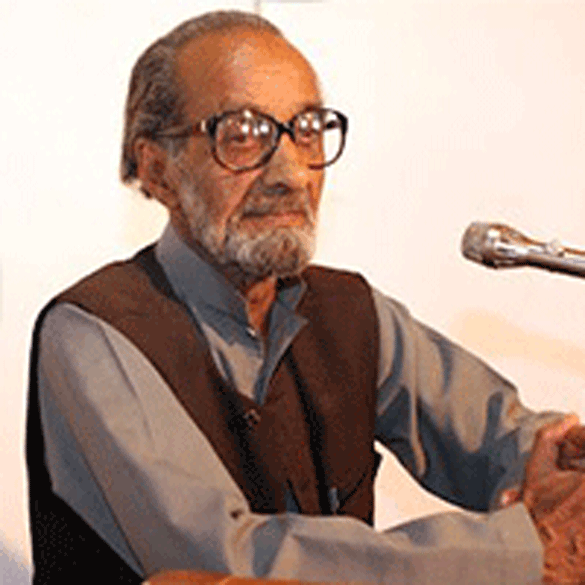
He was born on 3 August 1924 in Kapran (or Kaprin) village in Kulgam district of South Kashmir. This small rural area, with its lush green valleys,
His full name was Mohammad Amin Nengroo. Amin Kamil's literary journey was deeply connected with the Progressive Writers' Movement. Under its influence, he left Urdu and started writing in Kashmiri. He believed that the Kashmiri language is the true identity of Kashmiris. He used to say, "We are Kashmiris because of the Kashmiri language." This movement turned him towards social justice, the pain of common people, and progressive ideas. His first poetry collection Mas Malaar (1955) was influenced by this ideology.
Narrating an anecdote in Kashmir Life, Bilal Handoo writes that at the time, one day Kamil caught Abdullah off guard before he could run away from class, and asked him: “Why do you often run from class?” The young Abdullah replied: “I run to have my lunch coming from the home.” This angered Kamil, who retorted Abdullah: “Do you think you are a privileged one; or, somebody special than your classmates. Listen up, don’t you dare to run away from my class, again.” the noted academician Prof. J. L. Koul was the Principal of S.P. College. A few days later, Kamil noticed an anxious Prof. Koul pacing the college lawn. On seeing Kamil, Koul called out to him and said, half-disturbed, “Kamil Sahib, do you want to render me jobless?”
The remark left Kamil baffled. “I don’t understand you, sir,” he replied.
“Do you know,” Koul continued, visibly perturbed, “Begum Sahib, Farooq Abdullah’s mother, just rang me up and expressed her anger over your treatment of her son.”
Kamil said nothing and quietly walked into the staff room. After a while, the college peon entered with a message: “Principal Sahib has called you to his office.” Without reading too much into the summons, Kamil made his way to the principal’s office. On entering, he encountered an unexpected sight, Sheikh Mohammad Abdullah, the Prime Minister of Jammu and Kashmir, was waiting for him there.
“I have come to apologise to you on behalf of my son’s irate behaviour,” Kamil heard the ‘leader of the masses’ say. Turning to his son, Sheikh Abdullah reprimanded him and ordered, “Touch your Masterji’s feet and apologise.”
However, Kamil did not allow Farooq Abdullah to bow before his father. “Kamil Sahib, I promise you,” Sheikh Abdullah then assured him, “that from tomorrow, no lunch will be sent for my son.”
An interesting incident happened in his life here. In the 1950s, there was a student in his class who would often mark attendance and then skip the lecture. That student was none other than the young Farooq Abdullah, who later became the Chief Minister of Jammu and Kashmir. This incident is an example of Amin Kamil's simplicity and his relationship with students. He never got angry; instead, he would just smile and watch. This small thing gives a glimpse of his nature, he was always calm, profound, and humane.
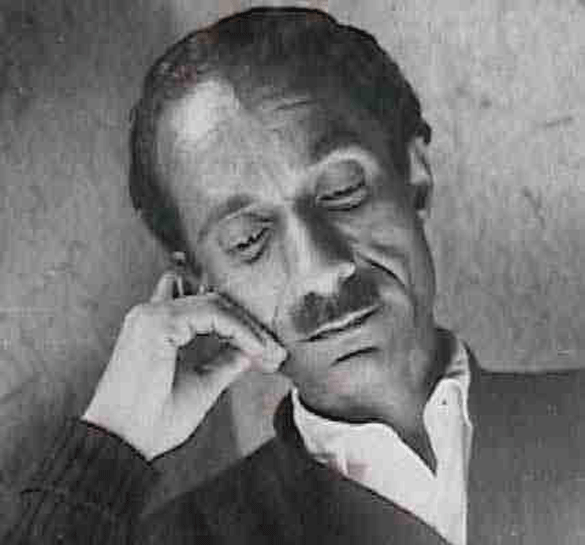
In Kashmir Pen, Sanjay Pandita writes that in many of his poems, the words seem to breathe—their meaning inseparable from their sound. Lines such as “Yi chu myon baag, yi chhun gulshan, yi chhun yi cheshm-e-chashmaan” evoke not only vivid imagery but also an inner harmony, a sensory vibration in which meaning aligns seamlessly with music. His descriptive power emerges from a diction that is simple without being plain, and ornate without becoming artificial. When he writes, “Wuchh ti kyaah agar dilas manz wothukh jung-e-sur,” he compresses an entire psychological transformation into a single line. The “battle of melodies” rising within the heart is not a metaphor borrowed from Persianised literary traditions; rather, it is deeply Kashmiri in spirit—an inner turmoil articulated through the language of song.
He graduated in arts from Punjab University and obtained a law degree from Aligarh Muslim University. In 1947, he became a lawyer and joined the bar, but his heart was in literature. He practised law for only two years and in 1949 was appointed as a lecturer in Urdu at Sri Pratap College, Srinagar.
In 1958, the Jammu and Kashmir Cultural Academy was established, in which he was a founding member. He became the convener of the Kashmiri department and later editor. He edited the academy's magazines Sheeraza and Son Adab. He remained associated with the academy until his retirement in 1979. His editorial role gave opportunities to many new writers and gave a new direction to Kashmiri literature.
Amin Kamil was a multifaceted writer. He was a master of Kashmiri ghazals. His collection Laveh Te Praveh (1967) became so famous that he received the Sahitya Akademi Award for it.
In short story writing, Amin Kamil is considered the father of modern Kashmiri short stories. His most popular story is Kokar Jang (The Cockfight). It is the story of a quarrel between two neighbouring women, Jana Bits and Shah Maal, who satirise each other through their roosters. This story is full of humour and satire from rural life. It became so famous that it was translated into many Indian languages and English, and was included in Penguin's book Best Loved Indian Stories of the Century. The inspiration for this story perhaps came from real village incidents, where small quarrels turn into big issues. Other stories like Laag, Hini Rahman, and Kafan Tshor also make deep comments on human weaknesses.
He wrote the novel Gati Manz Gaash (1958), which is based on the tragedy of the 1947 Partition. He also wrote plays like Bombur te Yambarzal based on a folk tale and Habba Khatoon on the Kashmiri poetess. In criticism, Jawaban Chhu Arz two volumes and research work on Nand Rishi and Habba Khatoon are important. In translation, he translated Tagore's Dak Ghar and Iqbal's poems into Kashmiri.
Amin Kamil received many honours: Sahitya Akademi (1967), Padma Shri (2005), Jammu and Kashmir Academy Award, Lifetime Achievement Award from Kashmir University, etc. He fought lifelong for the Kashmiri language. His magazine Neev provided a platform to new writers.
He passed away on 30 October 2014 in Jammu. Even at the age of 90, he was active. With his death, Kashmiri literature lost a great pillar, but his works are still alive. He was an example of simplicity, depth, and dedication. The soul of Kashmir resides in his poems. Today's generation draws inspiration from him. Amin Kamil not only saved Kashmiri literature but also took it to the world level. His place in Kashmiri literature is immortal.
Altamash Ali is a Sufi writter and a student at IFTM University.
URL: https://newageislam.com/islamic-personalities/mohammad-amin-kamil-kashmiri/d/138220
New Age Islam, Islam Online, Islamic Website, African Muslim News, Arab World News, South Asia News, Indian Muslim News, World Muslim News, Women in Islam, Islamic Feminism, Arab Women, Women In Arab, Islamophobia in America, Muslim Women in West, Islam Women and Feminism