
Obituary: Naquib al-Attas: The Man Who Wanted to Rebuild Muslim Civilisation Through Knowledge
By New Age Islam special correspondent
10 March 2026
The passing of Syed Muhammad Naquib al-Attas (5 September 1931 – 8 March 2026) marks the end of an era in Islamic intellectual history. Syed Muhammad Naquib al-Attas was an important Muslim thinker who shaped the conversation about knowledge, civilization and Islam. For decades, Syed Muhammad Naquib al-Attas stood as a rare figure who combined classical Islamic scholarship, philosophical reflection, historical insight and cultural creativity. His death leaves behind an intellectual legacy that will continue to influence Muslim thought for generations.
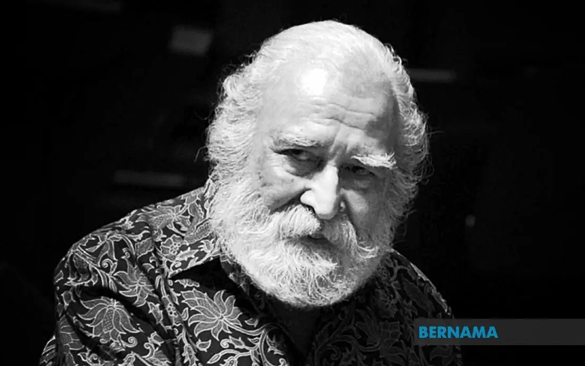
The passing of Syed Muhammad Naquib al-Attas marks the end of an era in Islamic intellectual history. Syed Muhammad Naquib al-Attas was an important Muslim thinker who shaped the conversation about knowledge, civilization and Islam. For decades, Syed Muhammad Naquib al-Attas stood as a rare figure who combined classical Islamic scholarship, philosophical reflection, historical insight and cultural creativity. His death leaves behind an intellectual legacy that will continue to influence Muslim thought for generations.
Syed Muhammad Naquib al-Attas was not a scholar who wrote books. He was a thinker who tried to understand the intellectual crisis of the Muslim world. Many Muslim intellectuals focused on politics or activism. Syed Muhammad Naquib al-Attas turned his attention to something more fundamental: the nature of knowledge itself. In his view, the problems facing societies were not only political or economic, but also civilizational and intellectual. Muslims, he argued, had gradually lost clarity about their worldview, their understanding of knowledge and the meaning of education.
This concern defined much of Syed Muhammad Naquib al-Attass lifes work.
Life sketch
Born in 1931 in Bogor, Indonesia, into a family with roots in both Malay and Arab intellectual traditions, Syed Muhammad Naquib al-Attas grew up in a cultural environment that valued scholarship, spirituality and literature. His family background itself symbolised a blend of civilisations. His father was connected to the Hadrami tradition, while his mother came from a distinguished Malay family. From an age Syed Muhammad Naquib al-Attas was exposed to both the classical Islamic heritage and the rich cultural world of the Malay Archipelago.
This early exposure shaped Syed Muhammad Naquib al-Attass outlook. Unlike scholars who approached Islam purely through theology or law, Syed Muhammad Naquib al-Attas saw Islam as a complete civilizational system. Language, literature, art, spirituality, philosophy and politics were all connected within that system.
Knowledge and Islam
Syed Muhammad Naquib al-Attass education reflected this intellectual curiosity. As a man, he studied in both traditional and modern institutions. He later pursued studies in the West, including at McGill University in Canada and at the School of African Studies in London. These experiences exposed him to academic traditions and to the methods of modern scholarship.
Syed Muhammad Naquib al-Attas did not simply adopt Western intellectual frameworks. Instead, he began to analyse them. He believed that Western academic disciplines often approached Islam through categories that were foreign to intellectual traditions. This critique later became central to Syed Muhammad Naquib al-Attass project.
During the colonial decades of the twentieth century, Muslim societies were struggling with questions of modernisation, identity and development. Many intellectuals believed the solution lay in adopting models of education and governance. Syed Muhammad Naquib al-Attas was sceptical of this approach. He argued that blindly imitating systems would deepen the intellectual crisis of the Muslim world rather than solve it.
What was needed, he believed, was not rejection of knowledge but its proper understanding within an Islamic worldview.
This idea later became famous through his concept of the "Islamization of knowledge." Although the phrase later became popular in circles Syed Muhammad Naquib al-Attas gave it a very specific philosophical meaning. For him, Islamization did not mean adding Islamic content to modern disciplines. It meant rethinking the foundations of knowledge itself so that they reflected the ethical principles of Islam.
He believed that modern Western knowledge had emerged within a historical and philosophical context shaped by secularism, materialism and the separation of religion from public life. When Muslim societies imported this knowledge without examination, they also imported the worldview behind it.
According to Syed Muhammad Naquib al-Attas this created confusion. Muslim students were learning sciences and humanities through intellectual frameworks that often-contradicted Islamic concepts of reality, ethics and human purpose.
His solution was not isolation from knowledge but intellectual clarity. Muslims, he argued, needed to understand the assumptions underlying modern disciplines and reinterpret them within the framework of Islamic metaphysics.
One of his influential ideas was his definition of education. In his works on Islamic education, Syed Muhammad Naquib al-Attas argued that the purpose of education was not merely the production of skilled workers or professionals. Instead,d the goal of education was the formation of the " man."
For him knowledge was inseparable from ethics and spirituality. True knowledge guided the human being toward justice, wisdom and recognition of the place of things within the order of creation.
This idea may sound abstract. It had practical implications. Syed Muhammad Naquib al-Attas believed that many modern education systems focused much on technical knowledge while neglecting moral and intellectual formation. As a result, societies produced experts and professionals. Not necessarily wise individuals.
He often emphasised that confusion about knowledge leads to confusion about society. When knowledge loses its metaphysical grounding, education becomes fragmented and civilisation loses direction.
International Institute of Islamic Thought and Civilization (ISTAC)
These concerns led Syed Muhammad Naquib al-Attas to establish one of his important institutional contributions: The International Institute of Islamic Thought and Civilization (ISTAC) in Kuala Lumpur. ISTAC was designed as an intellectual centre that would combine rigorous scholarship with a deep engagement with Islamic intellectual heritage.
Unlike modern universities that separate disciplines into isolated departments, ISTAC tried to recreate the classical Islamic model of integrated knowledge. Philosophy, history, theology, literature and science were studied as fields within a broader civilizational vision.
The architecture and atmosphere of the institute reflected Syed Muhammad Naquib al-Attass philosophy. The campus included elements inspired by architecture and symbolism reflecting his belief that knowledge should be embedded in culture and aesthetics.
Syed Muhammad Naquib al-Attas himself was not a scholar but also an artist and calligrapher. He designed logos, wrote calligraphy and showed interest in the visual expression of Islamic civilisation. For him, art was not separate from knowledge. It was another way of expressing the harmony and order of the worldview.
His scholarly writings covered a range of subjects. One of his contributions was his work on the history of Islam in the Malay world. He challenged earlier theories about how Islam spread in Southeast Asia. Western scholars had often argued that Islam arrived in the region through traders and commercial networks.
Syed Muhammad Naquib al-Attas argued that the spread of Islam in the world was deeply connected to intellectual and spiritual networks. Scholars, Sufi teachers and intellectual traditions played a role in shaping the Islamization of the region. He showed how Islamic concepts transformed the Malay language, literature and political thought.
His studies on the language were particularly influential. He demonstrated how Islamic vocabulary and concepts reshaped Malay culture. Terms related to knowledge, ethics and governance entered the language through scholarship.
This transformation he argued, showed how Islam was not merely adopted as a religion but integrated into the intellectual fabric of the region.
Beyond Southeast Asia, Syed Muhammad Naquib al-Attass ideas influenced intellectual debates across the world. His writings on the Islamization of knowledge inspired scholars and institutions in countries. Conferences, research centers and academic programs began exploring how modern disciplines could be re-examined through intellectual traditions.
However, his ideas also generated debate. Some critics argued that the Islamization of knowledge was difficult to implement in practice. Others believed that modern sciences were already universal and did not need reinterpretation.
Syed Muhammad Naquib al-Attas responded that the issue was not the method itself but the philosophical assumptions surrounding knowledge. Science he believed, could coexist with metaphysics as long as its limits and purposes were properly understood.
Despite disagreements, even critics acknowledged the depth of his project. Syed Muhammad Naquib al-Attas forced scholars to think seriously about the philosophical foundations of modern education.
Another important dimension of his work was his critique of secularism. He argued that secularism was not simply the separation of religion from politics. It was a worldview that reshaped concepts of knowledge, truth and human purpose.
In modernity, he believed knowledge becomes detached from moral and spiritual meaning. Truth becomes relative and human beings lose a sense of purpose.
Conclusion
His voice reminded Muslims that intellectual renewal requires both courage and humility: courage to question inherited assumptions and humility to seek wisdom within the traditions of the past, according to Syed Muhammad Naquib al-Attas ideas.
In an age often dominated by opinions and ideological slogans, Syed Muhammad Naquib al-Attas represented something different, which is what his ideas are all about.
He stood for thinking, careful scholarship and a deep sense of civilizational responsibility, which is what Syed Muhammad Naquib al-Attas ideas were all about.
His passing marks the end of an intellectual journey but the questions Syed Muhammad Naquib al-Attas raised about knowledge, education and the future of Muslim civilisation will continue to echo long after his lifetime, which is what his ideas are all about.
In that sense, Syed Muhammad Naquib al-Attas legacy remains alive. His ideas will continue to inspire people.
New Age Islam, Islam Online, Islamic Website, African Muslim News, Arab World News, South Asia News, Indian Muslim News, World Muslim News, Women in Islam, Islamic Feminism, Arab Women, Women In Arab, Islamophobia in America, Muslim Women in West, Islam Women and Feminism