
Pashtun Peace Leader Khan Abdul Ghaffar Khan: The Islamic Gandhi Is Little Known But Today His Legacy Is More Relevant Than Ever
By Marian Brehmer
26.Oct.2020
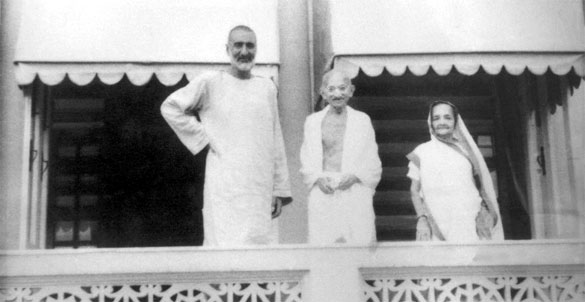
In
September 2009, Hillary Clinton invited a group of Muslim guests to the US
foreign ministry for breaking the fast together during Ramadan. In her address
to the assembly she quoted a man practically unknown in the West. We should, as
Clinton explained, "be inspired by our leaders to fight poverty, injustice
and hatred with the weapons of the Prophet: patience and righteousness."
The quote
in reference to Muhammad came from a Pashtun freedom fighter named Abdul
Ghaffar Khan. Alongside Mahatma Gandhi, Khan was one of the most prominent
personalities in the Indian struggle for independence. His unshakeable belief
in the principle of non-violence while mobilizing the Pashtun tribes on the
borders of the Indian subcontinent earned Khan the byname "Frontier
Gandhi."
While Khan
is a well-known historical figure in India and Pakistan – his face features in
Gandhi exhibitions and still evokes Pashtun pride on both sides of the border –
most people outside South Asia have never heard of this man who devoted his
life to peacefully resisting the colonialists and uplifting his own people.
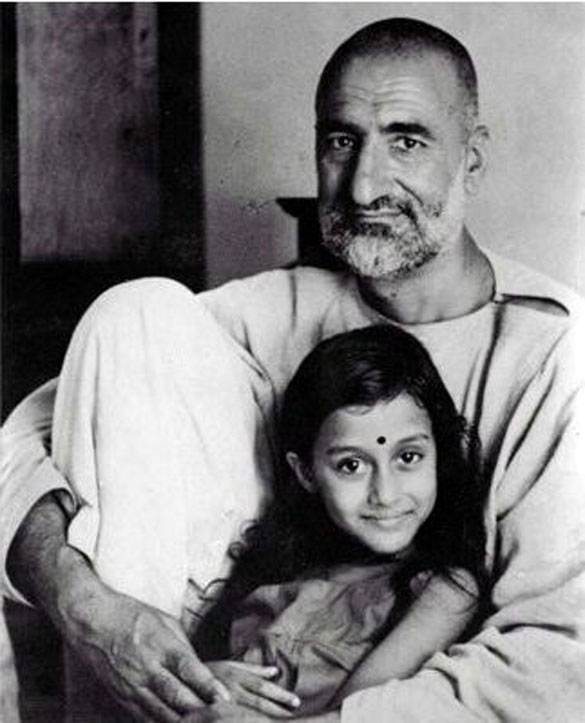
Ghaffar Khan with the young
Indira Gandhi, probably in the 1930s. (Public Domain)
-----
Khan was
born into a wealthy family of landowners in a village close to Peshawar. This
was the heartland of the Pashtuns, or "Pathans" - as they are known
on the Indian subcontinent. Their restive territories were a source of constant
trouble for the British Empire which sought to keep the Pathan homelands under
tight control as a buffer zone against Russian intrusions.
The Pathans
were a hardy mountain people infatuated with violence. Pathan tribal culture is
firmly based on the principle of honor. Any kind of insult or act of violence
towards one's tribe or family had to be avenged at any cost if one were to
safeguard the clan honor. Dying in the attempt to take revenge was
considered better than living with a
sense of insult or humiliation. There existed tribes that had hundreds of their
members killed this way – a never-ending spiral of violence and retribution.
Ghaffar's
father, however, was an exception: Although he was a mighty khan, a Pathan
landowner, he believed in the power of forgiveness rather than revenge. He was
convinced that staying out of blood feuds would make him a better Muslim.
Young
Ghaffar went to an English mission school. He was impressed by the deep
dedication with which his British missionary teachers transmitted education to
Pathan youth. Early on in his life, Khan Abdul Ghaffar Khan committed himself
to social transformation. At the age of 20, Khan founded his own school near
Peshawar.
In the
years that followed, Khan travelled around 500 Pathan villages to promote
education. He was convinced that the Pathans had long been dispossessed of
their freedom only because of their own violent tendencies and ignorant
understanding of honor. Khan built more countryside schools and rallied for
Pathan unity. Due to his tireless activism, he was soon known by the nickname
"Badshah Khan" (king of the khans).
It wasn't
until long that Khan spent his first sentence in a British prison, as the
colonialists did not want the Pathans to be educated. During his many arrests
in the years to come, Badshah Khan refused to bow to the oppressors and give up
on his mission. He was often kept in solitary confinement under harsh
conditions, but that didn't break is spirit. Like Gandhi he considered prison
time as an opportunity to strengthen his connection with God. Upon one of his
arrests he said:
"I am
quite certain that it is all God’s doing. He kept me out of prison just for the
time he wanted me outside. Now is his will that I must serve from inside. What
pleases him, pleases me.”
When Khan
heard of Gandhi's non-violent struggle for independence, he instinctively
understood the transformative power of his ideas. In 1928, Khan met Mahatma
Gandhi for the first time. Impressed by his vision, Khan joined the Indian
National Congress, the leading movement in the Indian independence struggle.
The two men
formed a deep bond that also served as a symbol for the subcontinent's
religious pluralism. From a purely physical point of view, this was a
surprising friendship: at more than six feet tall and weighing over a hundred
kilos, Khan stood head and shoulders above the slight figure of Gandhi.
Khan didn’t
just seek political counsel from Gandhi, but he also sought his spiritual
proximity. As a Muslim, Khan mirrored Gandhi's deep faith and total surrender
to God within his own religion, the Islamic faith.
The Indian
philosopher Eknath Easwaran writes about Khan Abdul Ghaffar Khan in his
brilliant book "Nonviolent Soldier of Islam":
"Of
all the brilliant leaders around Gandhi, Badshah Khan was the one who most
appealed to me because he not only understood Gandhi's teachings but also
followed them completely. (...) Badshah Khan's words were simple: what drew him
to Gandhi, he used to say, was Gandhi's ability to submit his will to
God."
He goes on:
"Mahatma Gandhi and Khan Abdul Ghaffar Khan held almost identitical views
on many problems of the day; they reacted in the same way to similar
situations, and they enjoyed each other immensely. The ideal of nonviolence was
a great bond between them, but they also shared a love of nature, a child-like
laugh, and an affinity with the poor. Both craved periods of silence and
possessed a deep sense of spirituality."
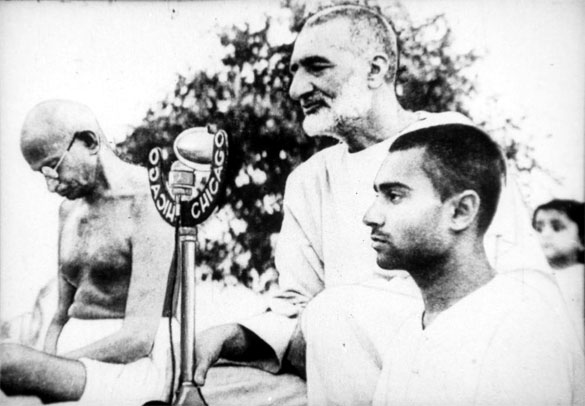
Mahatma Gandhi and Abdul Ghaffar
Khan during a prayer meeting.
------
For Khan,
Gandhi's life philosophy was the source of inspiration for the change he wanted
to bring to Pathan society; a society that for centuries had been characterized
by inner as well as outer conflicts. In fact, the greatest obstacle Khan faced
was not in opposition from the British, but in the prevailing mindset of his
own countrymen.
Eknath
Easwaran describes Khan and his uncomfortable message to the Pathans as
follows: "No one felt these contradictions [in Pashtun society] more
strongly than Badshah Khan and no-one was more aware of the price Pashtuns were
paying for their infatuation with violence. They had been dispossessed of their
freedom, he held, only because of their own self-destructive tendencies."
Given the
great challenges with which Khan was faced, his achievements are impressive: In 1929, Khan founded the Khudayi
Khidmatgar ("Servants of God") movement, which was joined by more
than 100,000 Pathans. Dressed in a red shirt and armed with the "weapons"
of the Prophet – patience and righteousness – Khan made the members of Khudayi
Khidmatgar swear to remain completely non-violent in their struggle against the
British.
The Pashtun
movement thus grew to become the world’s first professional non-violent army.
Before being admitted, any aspiring member of the Khudayi Khidmatgar had to
swear an oath to serve humanity, forgive his oppressors and undertake two hours
of social work every day.
The British
tried to crush the Khudayi Khidmatgar with continued murder and torture. The
Qissa Khwani Bazaar massacre in Peshawar on 23 April 1930, in which the British
shot around 250 unarmed men from the Khudayi Khidmatgar, was the hardest test
for Khan’s movement. Despite the colonial power’s extreme violence, Khan's men
still refused to take up arms. The British were blindsided by the Pashtuns'
non-violence.
Khan Abdul
Ghaffar Khan later wrote: "The British feared a non-violent Pashtun more
than a violent one. All the horrors the British perpetrated on the Pashtuns had
only one purpose: to provoke them to violence."
When Khan
was barred from entering the Frontier province in 1934, he decided to live with
Gandhi in his Wardha ashram in Central India, together with his elder brother
who had studied in England. Gandhi wrote about the two new ashram residents
from the mountains:
“I was
struck by their transparent sincerity, frankness and utmost simplicity. I
observed too that they had come to believe in truth and non-violence not as a
policy but as a creed. The younger brother [Ghaffar Khan], I found, was consumed
with deep religious fervor. His was not a narrow creed. I found him to be a
universalist. His politics, if he had any, were derived from his religion.”
In 1938,
Gandhi spent a whole month with Khan visiting members of the Khudai Khidmatgar
movement in the North-West Frontier Province. He was impressed by the strength
and determination he observed in the movement. While many could not believe how
the violent Pathans were capable of laying down their arms, Gandhi was not
surprised. He held non-violence to be a universal and deeply human principle
that did not depend on one's ethnicity.
Based on
Islamic tenets such as universal brotherhood and service to God through serving
his creatures, Khan not only brought profound transformation to the Pathans, but
made a decisive contribution to the success of the Indian independence
struggle.
This makes
the second half of Khan’s life all the more tragic. After India's independence
and the bloody partition of India and Pakistan in 1947, Khan continued his
struggle for the Pashtun course. As the leader of a Pashtun opposition party,
the "Pakistan Azad Party," Khan spent many years incarcerated in
Pakistani prisons. Khan described the treatment he received in newly-created
Pakistan as worse than what he had experienced in British prisons.
Just like
Gandhi, Khan had been deeply convinced that dividing the Indian subcontinent
was a grave mistake. In Muslim Pakistan he was now accused of being
anti-Pakistan and pro-Hindu. It was an irony of history, given the fact that Gandhi himself was shot by a fanatic Muslim
who believed he was pro-Muslim.
During the
years of the military government in the 1960s, Khan spent six years in exile in the Afghan city of Jalalabad. In
1984 he was nominated for the Nobel Peace Prize. Four years later, Khan died
while under house arrest in Peshawar, at the age of 97. In order to allow for a
funeral to take place in his house in Jalalabad, the warring parties in the
Soviet-Afghan War that was ranging in the region at that time arranged for a brief
ceasefire. Tens of thousands of people crossed the Khyber Pass from Pakistan to
pay their last respect to Khan.
Starting
with the building of his first school in 1910, Khan had led a life of eighty
years in service; reforming, transforming and resisting tyranny. It seems like
Khan's words from 1985, three years before his death, have lost none of their
importance:
"Today’s
world is travelling in some strange direction. You see that the world is going
toward destruction and violence. And the speciality of violence is to create
hatred among people and fear. I am a believer in non-violence and I say that no
peace or tranquillity will descend upon the people of the world until
non-violence is practiced, because non-violence is love and it stirs courage in
people."
Especially
in an age when Islam is primarily associated with violence, it is important to
remember Khan's example and tremendous sacrifice. He spent one third of his
whole life in prison – more than Nelson Mandela – but never lost his faith in
God and his mission.
As Easwaran
concludes about Khan: "Were his example better known, the world might come
to recognize that the highest religious values of Islam are deeply compatible
with a non-violence that has the power to resolve conflicts even against heavy
odds."
-----
Original Headline: The Pashtun Gandhi
Source: The Sacred Journalism
URL: https://newageislam.com/islamic-personalities/pashtun-peace-leader-khan-abdul/d/123378
New
Age Islam, Islam Online, Islamic Website, African Muslim News, Arab World News, South Asia News, Indian Muslim News, World Muslim News, Women in Islam, Islamic Feminism, Arab Women, Women In Arab, Islamophobia in America, Muslim Women in West, Islam Women and Feminism