
The Radiant Ocean of Divine Grace: Hazrat Syed Jamaluddin Jamalul Bahr and Bhongir's Timeless Spiritual Beacon

By Adnan Faizi, New Age Islam
10 April 2026
Hazrat Syed Jamaluddin Jamalul Bahr, sixth direct descendant of Hazrat Shaykh Abdul Qadir Jilani, journeyed from Baghdad to illuminate Bhongir with Qadri spirituality. His shrine remains a vibrant Sufi centre drawing multitude for fulfilled desires and eternal blessings.
Main Points:
· Hazrat Syed Jamaluddin Jamalul Bahr was born 873 Hijri Baghdad, sixth Qadiri descendant.
· He arrived at age sixteen via Delhi to Warangal Bhongir Bahmani era.
· Hazrat Qazi Ibrahim welcomed him, offered bayah, built house, served devotedly.
· He converted multitudes in Bhongir, dispelling disbelief through preaching, miracles, scholarly talks.
· He passed away, selecting grave and Hazrat Qazi Ibrahim as khalifa.
Introduction
Hazrat Syed Jamaluddin, widely known as Jamal Bahar and Jamalul Bahr, stands among the most prominent figures of the Qadri Sufi tradition in the Indian subcontinent. A sixth-generation descendant of Hazrat Ghaus-e-Azam he carried the spiritual ocean of divine grace from Baghdad to the Deccan. He was born in 873 Hijri, while some narrations mention 878 Hijri. His life reflected a perfect balance of Shariat and Tariqat, and he played a key role in transforming Bhongir in Nalgonda district into a centre of Islamic teaching and spiritual growth. His blessed tomb, located in Bhongir town about 30 miles from Hyderabad, remains an ancient and well-known Sufi centre where large numbers of devotees visit for the fulfilment of their wishes. This continued presence reflects his lasting karamat and the mercy of Allah associated with him. Hazrat Syed Jamaluddin arrived in India at a young age of sixteen, travelling from Baghdad to Warangal via Delhi. His journey took place during the reign of Sultan Mahmud Bahmani of the Bidar kingdom, under which he carried out his mission of preaching and spreading Islam. He later passed away during the rule of Sultan Quli Qutub Shah of the Golconda dynasty, leaving behind a legacy of conversions, spiritual guidance, and miracles.
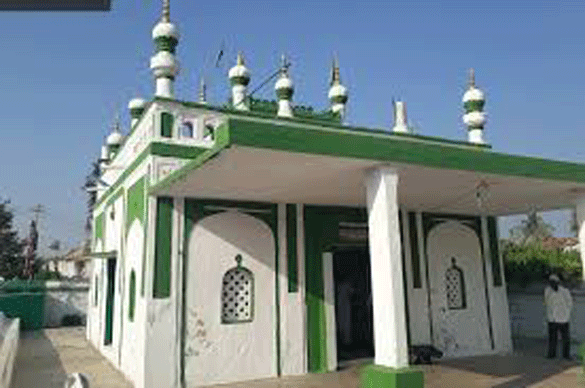
Today, his dargah continues to attract devotees, with the annual Urs beginning on 13th Jamad al-Awwal, marked by sandal ceremony and illumination over three days. It is also recorded that Mughal Emperor Hazrat Aurangzeb Alamgir visited the shrine during his campaign in the Deccan, received a miraculous response to his greeting, recognised his spiritual rank, and granted endowments. These details, preserved in sources such as Etemaad Urdu daily (5-4-2012) and Surma-e-Ageedat by Maulvi Muhammad Ziaullah Sahab Narkhil, highlight the enduring legacy of Hazrat Syed Jamaluddin Jamalul Bahr.
Early Life and Noble Lineage
Hazrat Syed Jamaluddin Jamalul Bahr was born in the sacred city of Baghdad in 873 Hijri, he belonged to the sixth direct lineage of Hazrat Shaykh Abdul Qadir Jilani, the Sultan of Saints—giving him a noble and uninterrupted Qadri heritage filled with spiritual authority and deep mystical insight. Growing up in Baghdad, a historic centre of Islamic scholarship and piety, he was nurtured in an environment that prepared him for his future mission. At a young age sixteen according to most accounts, though some mention twenty-one—Hazrat Syed Jamaluddin Jamalul Bahr began his journey from Baghdad to the Indian subcontinent, travelling through Delhi to Warangal and then Bhongir. This took place during a period of major political and social transition, spanning the final phase of the Kakatiya kingdom under Raja Pratap Rudra and continuing into the Bahmani rule of Sultan Mahmud Bahmani in Bidar. He eventually settled permanently in Bhongir (Nalgonda district), where he transformed the region into a strong centre of Sufi influence. However, his close spiritual companions, often described as his brothers on the path, included Hazrat Syed Shah Jalaluddin (Jalalul Bahr Qadri Mashooq Rabbani Thaani of Warangal) and Hazrat Syed Hussain Baghdadi (Jamal ul-Birr, whose shrine is at Langar Houz, Golconda). Together, under divine command, they arrived in the Deccan during the Qutub Shahi era and worked collectively to spread Islam.
From an early age, his life showed the true Sufi path detachment from the world, deep worship, and strong knowledge. Respected by fellow Sufis and companions, his spiritual rank was recognised early, and he remained fully devoted to preaching Islam. In Bhongir, his influence grew rapidly. People from all backgrounds, including officials and visitors, were drawn to his piety and wisdom. Many sought his guidance, and even religious appointments were often made with his approval, reflecting his strong authority in the region.
Bay‘ah, Spiritual Retreat, and Mission in Bhongir
When Hazrat Syed Jamaluddin Jamalul Bahr arrived in Bhongir in 894 Hijri during the reign of Raja Pratap Rudra, he was warmly welcomed by Hazrat Qazi Ibrahim, the respected judge of the town. Filled with joy, Hazrat Qazi Ibrahim hosted him in his own home and served him with complete sincerity. At his request, Hazrat Syed Jamaluddin agreed to stay, forming a deep spiritual bond. Soon after, desiring solitude for worship, Hazrat chose a separate place for residence. In devoted service, Hazrat Qazi Ibrahim Sahib built a house there along with a garden on its eastern side and moved there as well. He then took bay‘ah at Hazrat’s hands, dedicating himself fully as a mureed, serving him day and night with complete loyalty. Within this residence, Hazrat Syed Jamaluddin devoted himself to intense worship, selecting a special room for zikr and ibadat, much like a chilla. His deep connection with Allah increased his spiritual radiance, which began to attract the people of Bhongir. They were drawn by his piety, knowledge, constant worship, and visible karamat. Visitors from distant places came to see him, while religious officials frequently sought his guidance and benefited from his teachings. His influence extended even to recommending suitable individuals for religious responsibilities, ensuring righteousness in leadership. Through his efforts, Bhongir underwent a remarkable transformation. A place once marked by ignorance and disbelief became a centre of Islamic faith. With wise preaching, scholarly discussions, noble character, elevated spirituality, and righteous actions, he guided large numbers of people towards Islam. Muslims strengthened their faith as his mureeds, while many non-Muslims, inspired by his teachings and miracles, accepted Islam.
Among his close disciples, Hazrat Qazi Ibrahim stood as his foremost khalifa, though other khalifas are not specifically recorded. His followers continued spreading Qadri teachings in surrounding regions. Their practices included zikr, muraqaba in seclusion, sama through devotional recitations, and public preaching that combined outward Shariat with inner spiritual purification. Hazrat’s daily life revolved around worship, guiding disciples, and serving people, turning Bhongir into a khanqah of compassion and spirituality. Although some traditions associate him with Chishti influences, his primary affiliation remained firmly within the Qadri Silsila rooted in the teachings of Hazrat Ghaus-e-Azam. He was accompanied in the Deccan by his spiritual brothers—Hazrat Syed Jalaluddin Mashooq Rabbani of Warangal and Hazrat Syed Hussain Baghdadi Jamal Barqadus of Hyderabad (also known as Jamal ul-Birr). Together, under divine command, they spread Islam across regions previously marked by disbelief, establishing strong centres of faith during the Qutb Shahi era.
Miracles and Demise
Hazrat Syed Jamaluddin Jamalul Bahr’s life was filled with remarkable karamat that strengthened his vilayat and transformed the society around him. People from all walks of life, including officials, came seeking his barakah, while seekers gathered in large numbers with devotion. His scholarly discourses removed doubts, and his miraclessuch as unseen healings and the fulfilment of vows deeply influenced people. Many Muslims became his devoted mureeds, while numerous non-Muslims, witnessing these signs, accepted Islam. Through his efforts, Bhongir was transformed from a place of ignorance into a centre of faith and spiritual excellence. Centuries later, during the conquest of Golconda, Mughal Emperor Hazrat Aurangzeb Alamgir, while camped in Hyderabad, heard of the shrine’s reputation for fulfilling needs. When he visited and greeted with “Assalam Alaikum,” the tomb miraculously responded, affirming the saint’s living spiritual presence. Deeply moved, he acknowledged Hazrat’s high rank and granted generous endowments to the shrine. This recognition further strengthened the shrine’s importance, which continues to attract large numbers of visitors every year.
Before his passing, Hazrat Syed Jamaluddin selected the place of his burial. At the time of his final moments, Hazrat Qazi Ibrahim was in Bidar, but Hazrat, through spiritual insight, informed his disciples of his approaching departure. He instructed them not to touch his body until the Qazi returned, to place it on a cot under the open sky in the courtyard, and to wait calmly for divine command before performing the janazah and burial. Hazrat Qazi Ibrahim, through a dream, was directed to return immediately. He travelled overnight on horseback, covering nearly 100 miles, and reached Bhongir by morning. By then, Hazrat Syed Jamaluddin had passed away, and grief spread among all—common people and elites alike. Following his instructions, the body was placed under the open sky. At that moment, rain began to fall, and in a miraculous event witnessed by many, the body turned on its own as if being bathed for the funeral. Soon after, the rain stopped, the sky cleared, and the janazah was performed at the chosen site. Different records mention varying dates of his passing, including 22nd Rajab 999 Hijri and 17th Rajab 977 Hijri.
Living Legacy and Cultural Continuum
Hazrat Syed Jamaluddin Jamalul Bahr’s legacy continues to shape Bhongir and the wider Deccan Sufi tradition. As a leading figure of the Qadri silsila and a sixth-generation descendant of Hazrat Ghaus-e-Azam, his life stands as a powerful example of successful dawah—transforming from a young seeker in Baghdad into a pioneer of Islam in India through both teaching and spiritual power. His Urs traditions are carefully maintained by the shrine’s trustees, including mehfil-e-sama (qawwali), langar, gagar processions, and scholarly gatherings that highlight his life and teachings. Today, the dargah remains active and vibrant: madrasas teach Qadri values and adab, welfare activities support the poor, and people of different backgrounds gather in an atmosphere of harmony. Devotees continue to share experiences of fulfilled vows—related to health, children, and livelihood—attributing them to his faiz. In the modern era, scholars refer to his life in sermons, and his karamat are shared even through digital platforms. Bhongir itself benefits from the steady flow of pilgrims, supporting local culture and economy. Living traditions such as Thursday chilla gatherings and the annual Urs—beginning on 13th Jamad al-Awwal and lasting three days with sandal ceremony and illumination—remain central, organised with great care for visitors.
Even today, his mausoleum in Bhongir stands as a place of spiritual comfort and fulfilment of wishes, attracting devotees throughout the year. Remembered as the “Radiant Ocean” of Deccan, his Qadri light continues to guide people towards inner purity, faith, and unity, offering a path of balance in an increasingly material world.
____
Adnan Faizi is a Peace and Harmony activist based in Delhi. He is an alumni of CCS University, Meerut.
New Age Islam, Islam Online, Islamic Website, African Muslim News, Arab World News, South Asia News, Indian Muslim News, World Muslim News, Women in Islam, Islamic Feminism, Arab Women, Women In Arab, Islamophobia in America, Muslim Women in West, Islam Women and Feminism