
Rahi Sahab, Saviour of Kashmiri Language and Poet of Existential Quest

By Altamash Ali, New Age Islam
19 March 2026
Abdur Rahman Rahi was a leading Kashmiri poet who modernized and preserved the language. His existential and Sufi-inspired works earned top literary honors, leaving a lasting impact on Kashmir’s cultural and literary heritage.
Main points
· Abdur Rahman Rahi born 1925, Srinagar; orphaned young.
· Professor; modernized Kashmiri language.
· Wrote Nauroz-e-Saba, Siyah Rood Jaren Manj.
· Won Sahitya Akademi & Jnanpith awards.
· Preserved Kashmiri literature; died 2023.
…
Rahi Sahab philosophy centered on a deep search for human existence. Starting as a Marxist, he later turned to existentialism, grappling with nothingness, absurdity, death, and freedom. Rooted in Sufi tradition, he believed even if life feels meaningless, one must create meaning oneself. Poetry is life's intense explorationdon't run from emptiness, dive into it.
From his famous poem “Fan Baraye Fan”,
Divaan oss nale mandnyen shaam sapdum
Ditem kath taam nahaq zael, maqsad mehnatuk roovum
Ye pokhtayoom tee az khaam sapdum
(Meaning: He cried that his days turned into nights, I thought my hard work wouldn’t go waste, but the purpose vanished,
What was fully cooked became raw again.)
So powerful, right? The artist pours his whole life into creating something perfect, the world applauds, but then emptiness hits. That feeling of futility runs through so much of his work.And on death, these two lines are really famous:Path agar yei he te motas vaeri tas kya laarehey
(Meaning: If death limits life, even then it is not a life lived in vain.) That’s the core of his thinking, death is there, but don’t call life meaningless because of it.
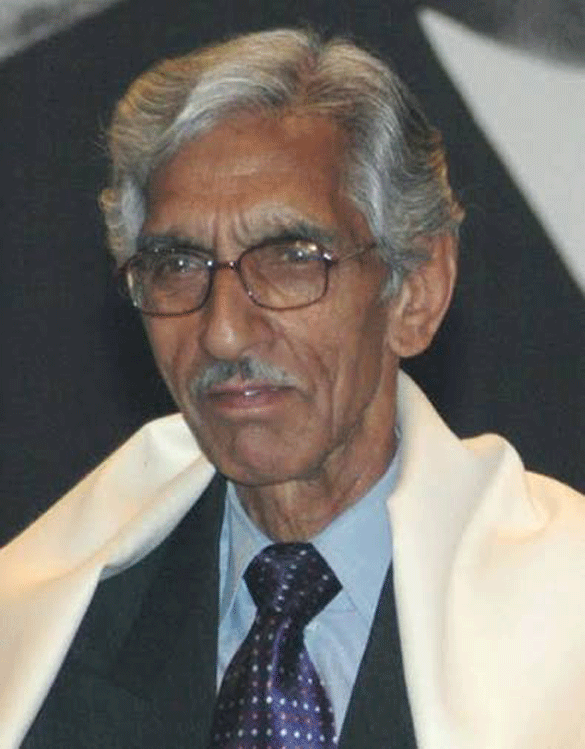
Abdur Rahman Rahi (lovingly called Rahi Sahab by everyone) was born on 6 May 1925 in Wazpora area of Srinagar in a very simple, poor Muslim family. His real name was Abdul Rahman Mir. Childhood was full of hardships, lost his parents at a young age, then raised by his mama (maternal uncle). Money was always tight at home, but his passion for studies never faded. He did his schooling and college in Srinagar, mastered Persian, English, and Kashmiri literature.
In the 1940s, when the Progressive Writers’ Movement was at its peak, he joined it. Back then Marxist ideology had a strong grip, talk of socialism, workers’ rights, social change. Rahi Sahab also got swept up in that wave. Worked for a few days as a clerk in the Public Works Department, but soon realized this job wasn’t for him. He quit and dedicated his entire life to literature.In the 1950s he joined the Kashmiri Department at Srinagar University as a lecturer, later became professor, and taught for decades. His classes weren’t just teaching, they were a school for young poets. Many of today’s Kashmiri poets openly say Rahi Sahab taught them how to write and how to think. He wanted to pull Kashmiri language out of the shadow of Persian-Urdu and make it an independent, modern literary language. At that time there was a lot of despair about Kashmiri, people thought it would slowly die out. Rahi Sahab took up the challenge to save it. He wrote poems, did criticism, translated works, published books, everything to keep the language alive.
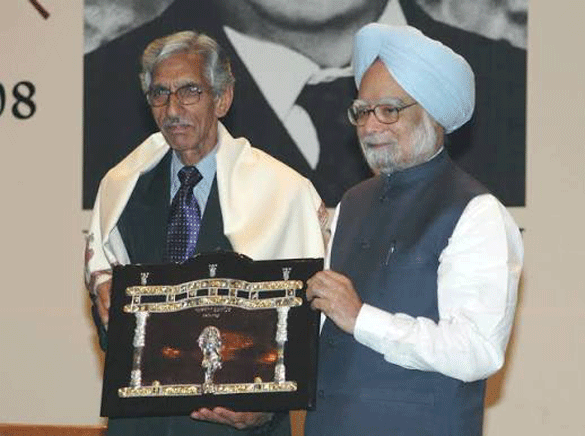
His first major book Nauroz-e-Saba came out in 1958. That book brought him recognition and in 1961 he won the Sahitya Akademi Award, a huge moment for Kashmiri language. After that he published many collections: Sana Vani Saaz, Sukhok Soda, Kalam-e-Rahi, Kahwat, Kadle Thathis Peth (2013), Rage Jaan, Shaakhe Nihale Gam, Jasta Jasta. But his most important book was Siyah Rood Jaren Manj (In the Black Drizzle). It was for this that he received the Jnanpith Award for 2004 (given in 2007), India’s highest literary honour. He was the first Kashmiri writer to ever get it. That award was a massive honour for Kashmiri language and culture, the whole country saw that profound, world-class literature can be created in Kashmiri too.
His major awards, Sahitya Akademi Award (1961) — for Nauroz-e-Saba, Padma Shri (2000) — for contribution to literature, Sahitya Akademi Fellowship (2000) — a rare honour given to very few writers, Jnanpith Award (given in 2007 for 2004) — for Siyah Rood Jaren Manj
All these awards were the result of his lifelong hard work. He wasn’t just a poet, he was also a critic. His criticism books like Sharshinosi and Baznuk Soorat-e-Haal helped deepen understanding of Kashmiri literature. In translation too he made a big contribution, translated Nietzsche’s Thus Spoke Zarathustra, Baba Farid’s Sufi poetry, parts of Goethe’s Faust, Punjabi Sufi poetry, all into Kashmiri.
In the 1990s Kashmir went through a terrible period of violence and turmoil. Many poets were writing direct political poems then, but Rahi Sahab wrote very few. Some critics said he stayed “silent”. People started calling him the “Poet of Silence”. But Rahi Sahab believed a poet’s real duty is to protect language and culture, not to comment on every single event. He said writing political poems is easy, but keeping a language alive is hard. During that time he received threats, from both state and non-state elements. So he became more cautious and practised self-censorship. That phase was really tough for him.
After his wife’s death he became quite lonely. He lived alone at home, often fell ill. But he never stopped writing. His last books also came out in that period. On 9 January 2023, after a long illness, he passed away at the age of 97–98 in Nawa Kadal area of Srinagar. That day a wave of grief swept across Kashmir. Political leaders, writers, common people, everyone paid tribute. People still say Rahi Sahab pulled the Kashmiri language back from the edge of death. If not for him, Kashmiri literature might not have stood so strong today.
Rahi Sahab’s life was full of struggles poverty, becoming an orphan, change in ideology, the violence years, loneliness. But he never gave up. He was the “Doyen” of Kashmiri literature, the biggest and most respected figure.
Rahi Sahab used to say poetry is a deep exploration of life. His own life was exactly that, a search. He tried to understand society, tried to understand himself, tried to understand language. Today whenever people talk about Kashmir, Rahi Sahab’s name always comes up, because he wasn’t just a poet, he was the guardian of Kashmir’soul.
…
Altamash Ali is a sufi writer and a student at IFTM University.
URL: https://newageislam.com/islamic-personalities/rahi-sahab-saviour-of-kashmiri-language-poet-/d/139320
New Age Islam, Islam Online, Islamic Website, African Muslim News, Arab World News, South Asia News, Indian Muslim News, World Muslim News, Women in Islam, Islamic Feminism, Arab Women, Women In Arab, Islamophobia in America, Muslim Women in West, Islam Women and Feminism