
Saliha Abid Hussain, The Quiet Strength Behind Jamia
By Afroz Khan, New Age Islam
15 January 2026
Saliha Abid Hussain, a foundational figure of Jamia Millia Islamia, devoted her life to women’s education, literature, and social reform. Through her writings, activism, and quiet dedication, she strengthened Jamia’s ideals and advanced progressive thought in Urdu literature and Indian society.
Key Points:
· Key contributor to Jamia Millia Islamia’s foundation and growth.
· Strong advocate of women’s education and empowerment.
· Renowned Urdu writer with over 50 works.
· Azra promoted women’s self-respect and reform.
· Honoured with the Padma Shri in 1983.
…
“I want to talk about the women of Jamia who were like the labourers behind Emperor Shah Jahan and the royal architects who built the Taj Mahal during the Mughal era, and who never thought of engraving their names on the marble.”
Dr. Syeda Hameed
(a scholar, author, and former member of India’s Planning Commission, said this at the 17th Dr. Asghar Ali Engineer Memorial Lecture.)
One of the prominent women whose role in the founding of Jamia Dr. Hameed is referring to here is “Saliha Abid Hussain.”
Saliha Abid Hussain was born on August 18, 1913, in the historic city of Panipat, Haryana. This city was then known for its Sufi traditions and scholarship. Her father’s name was Khwaja Ghulam-us-Saqlain, a renowned lawyer, social reformer, and writer. Her mother’s name was Mushtaq Fatima.
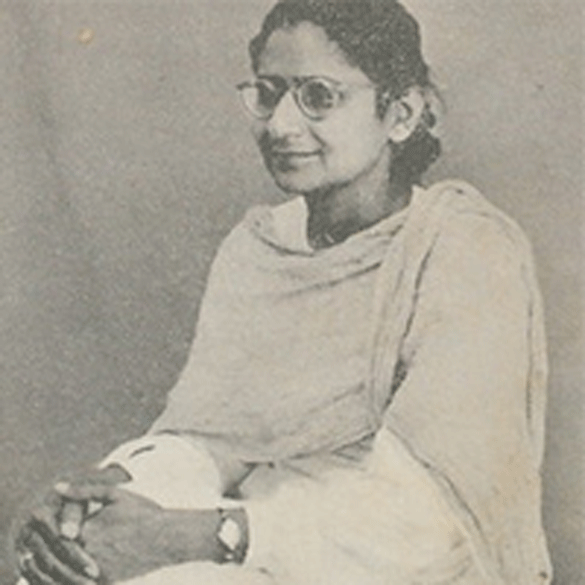
Saliha’s real name was Misdaq Fatima, but she became famous by her pen name ‘Saliha’.
Saliha Abid Hussain was the granddaughter of the famous Urdu poet and reformer Khwaja Altaf Hussain Hali.
She was brought up in a family that was both liberal and religious. Gender equality was practised in her family, which is clearly reflected in her personality and writings.
Her early education was at home, where she acquired a deep knowledge of Arabic, Persian, and Urdu under the guidance of the scholars in her family.
Saliha Abid Hussain completed her formal higher education at Punjab University (Lahore). She earned her graduate degree from there.
Even after obtaining her degree, her interest in learning did not diminish; she continued her studies independently. She extensively studied English and literature on her own, which enabled her to translate the works of figures like Mahatma Gandhi into Urdu.
Saliha Abid Hussain’s husband, Dr. Syed Abid Hussain, was one of the founding members of Jamia. Saliha supported her husband’s resolve during extremely difficult times when Jamia was facing a financial crisis.
She played a crucial role in keeping Jamia’s mission alive despite meagre salaries and limited resources.
Saliha Abid Hussain created an environment for women’s education and empowerment at Jamia.
It was through her efforts that active participation of women and discussions on their rights began at Jamia.
She organised Jamia’s early gatherings and cultural programmes. She enriched Jamia’s educational vision by writing simple and accessible literature for children.
When Jamia shifted from Karol Bagh to Okhla in 1935, she played an active role in the community life and the spread of education there. She encouraged Muslim women to step out of purdah and participate in intellectual and literary discussions. Through her writings, Saliha promoted Jamia’s ideals of ‘Swadeshi’ (self-reliance) and ‘national education’. She believed that the spirit of Jamia stemmed from the resilient women who collectively built the institution over decades.
When Jamia Millia Islamia shifted to Okhla (on the banks of the Yamuna), Saliha wrote about the challenging but vibrant life there:
“Simple houses were built on the banks of the Yamuna. The income was very limited, but the enthusiasm and zeal were abundant...”
Saliha Abid Hussain’s literary work is known in Urdu literature for its simplicity, social purpose, and human sensitivity.
She wrote more than 50 books, including novels, short stories, plays, and biographies.
Her most famous novel is “Azra,” in which she depicted social customs and the condition of women.
This novel questioned social evils such as mismatched marriages, the rigidity of the purdah system, and women’s economic dependence.
Saliha Abid Hussain, through the character of Azra, conveyed the message that self-respect and education are the keys to women’s empowerment.
‘Azra’ is not just a story, but a reflection of Saliha Abid Hussain’s progressive ideas and her desire to bring about change in society. Even today, it is considered one of the finest novels in Urdu literature.
In addition, she wrote the captivating novels “Ret ka Mahal” (Sand Castle) and “Saatvan Aangan” (The Seventh Courtyard).
Saliha Abid Hussain also wrote a detailed research-based work, “Yaadgar-e-Hali,” on the life and works of her grandfather, Khwaja Altaf Hussain Hali.
She wrote her autobiography, “Silsila-e-Roz-o-Shab,” which not only chronicles her life but is also an important document of the history of Jamia Millia Islamia and the socio-political changes of that era.
Saliha Abid Hussain is considered a pioneer of modern children’s literature in Urdu.
Her major works for children includes “Anokha aur Kala Kuan” and “Bachchon ke Hali.”
She translated Mahatma Gandhi’s biography, ‘Bapu,’ into Urdu, reflecting her non-violent and humanitarian perspective.
Saliha Abid Hussain believed that the purpose of literature should not be merely entertainment, but the betterment of society. For her contributions, she was awarded the Padma Shri in 1983.
She passed away on January 8, 1988, in New Delhi. Saliha Abid Hussain represents countless women who diligently work at home or in the workplace but do not seek recognition for their work; instead, they consider bringing about change in the home and society as their true reward.
…
Afroz Khan is a teacher by profession who writes on women, politics, communal harmony, and Islam. She holds a master’s degree in Education.
New Age Islam, Islam Online, Islamic Website, African Muslim News, Arab World News, South Asia News, Indian Muslim News, World Muslim News, Women in Islam, Islamic Feminism, Arab Women, Women In Arab, Islamophobia in America, Muslim Women in West, Islam Women and Feminism