
Sind ibn Ali: Unsung Genius of the Islamic Golden Age

By Sahil Razvi, New Age Islam
18 June 2026
Abu al-Tayyib Sanad ibn Ali (Sind ibn Ali) was a 9th-century astronomer, mathematician and engineer who worked at the Abbasid court in Baghdad. He refined Indian astronomical tables, helped measure the Earth’s size, wrote on algebra, and is credited with introducing the decimal point. His work helped shape the scientific achievements of Islam’s Golden Age.
Main Points:
· Served as court astronomer and engineer under Caliphs al-Ma’mun and al-Mutawakkil in Baghdad.
· Translated and improved the Zij al-Sindhind, one of the first major astronomical tables in the Muslim world.
· Worked with scholars like al-Khwarizmi and helped calculate the Earth’s diameter and circumference.
· Wrote books on algebra and Indian arithmetic; credited with adding the decimal point to numbers.
· Built and led an early observatory in Baghdad and contributed to practical engineering projects.
…
In the vibrant intellectual landscape of the Islamic Golden Age, when the Abbasid Caliphate in Baghdad fostered a remarkable synthesis of Greek, Indian, Persian, and indigenous knowledge, Abu al-Tayyib Sanad ibn Ali, also known as Sind ibn Ali, emerged as a multifaceted scholar. An astronomer, mathematician, translator, and engineer who died around 864 CE, he served at the courts of Caliphs al-Ma’mun (r. 813–833) and al-Mutawakkil. His work exemplified the era’s spirit of patronage, translation, and empirical inquiry, contributing to foundational advances in astronomy and mathematics that resonated far beyond his time.
Sanad ibn Ali hailed from a scholarly Jewish family in Baghdad; his father, Ali-Musa, was a respected astronomer and astrologer whose clients included Abbasid courtiers. Sanad himself later converted to Islam, reportedly influenced by his close association with al-Ma’mun. This multicultural background, possibly with roots linked to Sind (the region in present-day Pakistan/southern India, hence the epithet “Sind”) or Iraqi Jewish heritage, mirrored the cosmopolitan nature of Baghdad’s intellectual circles.
As a young man around the age of 20, Sanad immersed himself in the study of Ptolemy’s Almagest, mastering its complexities through independent effort. According to a vivid account preserved by Ahmad ibn Yusuf (via Abu Kamil Shuja’ ibn Aslam, d. c. 930), Sanad sought entry into the prestigious scholarly gatherings hosted by Yahya ibn Abi Mansur. Initially dismissed due to his youth, he demonstrated superior command of the Almagest compared to established scholars like Jawhari, a companion of the Caliph. Impressed, Jawhari introduced him to al-Ma’mun, who recognised his talent and appointed him as a court astrologer and scholar.
This anecdote highlights not only Sanad’s precocious intellect but also the meritocratic ethos of al-Ma’mun’s court, which actively recruited talent irrespective of background. It positioned Sanad at the heart of the House of Wisdom (Bayt al-Hikma) milieu, where translation and original research flourished.
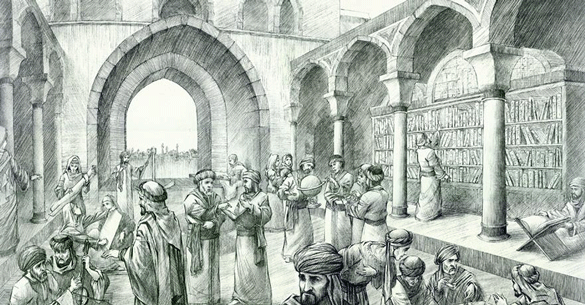
A reconstruction of Abbasid Baghdad, the epicentre of the Islamic Golden Age’s scientific endeavours, where Sanad ibn Ali thrived alongside contemporaries like al-Khwarizmi.
Sanad’s most enduring impact lay in astronomy. He played a key role in establishing and heading one of the earliest major observatories in the Islamic world, located behind the Bab al-Shammasiyya (Shammasiyyah Gate) in Baghdad. Working alongside Yahya ibn Abi Mansur and others, he supervised systematic observations that improved upon earlier models. Some accounts credit him and Yahya with overseeing the construction of this facility around 828 CE, marking a shift toward institutionalised, observation-based astronomy.
He translated and significantly modified the Zij al-Sindhind, an astronomical handbook rooted in Indian traditions (derived from works like the Surya Siddhanta and Brahmagupta’s texts). Originally introduced to the Muslim world in the late 8th century by earlier translators such as al-Fazari and Yaqub ibn Tariq, Sanad’s version refined planetary tables, trigonometric functions, and computational methods. This work became one of the first comprehensive astronomical tables widely used in the Islamic world, aiding timekeeping, navigation, and astrological predictions central to court life.
In geodesy, Sanad collaborated with Yaqub ibn Tariq and court astronomers to calculate the Earth’s diameter and circumference. Al-Biruni (973–c. 1050), the great polymath of a later generation, recorded in his Determination of the Coordinates of Cities that Sanad employed a method involving the measurement of the horizon’s dip from the summit of a high mountain during al-Ma’mun’s campaigns. This empirical approach prefigured al-Biruni’s own sophisticated geodetic experiments and underscored the Golden Age’s commitment to verifiable observation over pure theory.
These efforts occurred amid al-Ma’mun’s broader patronage, including the famous expedition to measure a degree of meridian in the Sinjar plain, reflecting the practical utility of astronomy for administration, agriculture, and military logistics.
As a mathematician, Sanad was a close colleague of Muhammad ibn Musa al-Khwarizmi, the father of algebra. He authored a commentary on al-Khwarizmi’s seminal Kitab al-Jabr wa’l-Muqabala (The Compendious Book on Calculation by Completion and Balancing), helping to validate and extend its methods. He also produced original treatises on algebra, Indian arithmetic (hisab al-hind), mental calculation, and Euclidean irrational quantities, his work on the latter being among the earliest known commentaries on Book X of Euclid’s Elements.
According to several historical accounts, including classical sources, Sanad is credited with introducing the decimal point (or decimal mark) notation to Arabic numerals. This innovation allowed for greater precision in fractional calculations, complementing the positional decimal system transmitted from India. While scholarly consensus on exact attribution varies (with later figures like al-Uqlidisi advancing decimal fractions), this credit appears in multiple narratives of Islamic scientific heritage and facilitated more accurate astronomical and commercial computations.
In engineering, Sanad contributed to major infrastructure projects, including canal constructions under al-Mutawakkil. A notable episode, recorded by Ibn Abi Usaibia, involved professional rivalry with the Banu Musa brothers (the famous trio of engineers and mathematicians). Out of jealousy, they allegedly marginalised Sanad, leading to his temporary relocation from Samarra back to Baghdad. However, when al-Farghani’s canal designs proved faulty and threatened lives, Sanad corrected the errors at personal risk, demonstrating both technical mastery and integrity.
The story of his youthful triumph over established scholars with his Almagest knowledge portrays him as confident and erudite. His participation in astronomical expeditions and written accounts of observations further attest to his hands-on approach. Al-Biruni’s respectful citation of Sanad’s geodetic method stands as high praise from one of the greatest scientists of the era.
Ibn al-Nadim’s Fihrist (10th century) likely catalogued his works, while later biographers like Ibn Abi Usaibia preserved details of court intrigues. These sources portray Sanad as a trusted court figure whose skills were indispensable yet sometimes vulnerable to court politics.
During the Islamic Golden Age, Sanad’s contributions were integral to the translation movement and the institutionalisation of science. By adapting Indian zij tables and engaging with Greek geometry, he helped create a robust Arabic scientific idiom. His observatory work and collaborative calculations advanced empirical methods, while his mathematical texts supported practical applications in taxation, inheritance (via algebra), and timekeeping. In an age when knowledge served both spiritual (accurate prayer times, qibla direction) and secular needs, scholars like Sanad bridged theory and utility under enlightened caliphal patronage. His story also illustrates the inclusive nature of Abbasid society, where talent from diverse backgrounds, Jewish converts, Persian administrators, Indian informants, drove progress.
Today, Sanad ibn Ali features in modern historiography of science as a representative of the Golden Age’s collaborative brilliance. Entries in The Biographical Encyclopedia of Astronomers and studies by scholars like Sonja Brentjes highlight his role in early Muslim geodesy and astronomical instrumentation. His attributed work on decimal notation underscores the transmission and refinement of the Hindu-Arabic numeral system, which revolutionised global mathematics and commerce.
In contemporary discussions on the history of science, figures like Sanad challenge Eurocentric narratives by demonstrating that foundational concepts in algebra, trigonometry, and observational astronomy were advanced in the Islamic world centuries before the European Renaissance. His methods influenced later giants such as al-Biruni and, indirectly, European scholars through Latin translations. In an era of renewed interest in multicultural scientific heritage and STEM education in regions like India and the broader Muslim world, Sanad’s legacy inspires recognition of South Asian and Islamic contributions to universal knowledge.
Moreover, his emphasis on empirical verification and synthesis resonates with modern interdisciplinary science. While many of his specific texts are lost, the intellectual lineage they represent continues in fields from computational astronomy to precise measurement technologies.
…
A regular contributor to New Age Islam, Sahil Razvi is a research scholar specialising in Sufism and Islamic History. He is an alumnus of Jamia Millia Islamia.
URL: https://newageislam.com/islamic-personalities/sind-ibn-ali-islamic-genius-of-golden-age-/d/140435
New Age Islam, Islam Online, Islamic Website, African Muslim News, Arab World News, South Asia News, Indian Muslim News, World Muslim News, Women in Islam, Islamic Feminism, Arab Women, Women In Arab, Islamophobia in America, Muslim Women in West, Islam Women and Feminism