
Sir Syed Promoted Scientific Temperament and Interfaith Dialogue

By S.
Arshad, New Age Islam
27 October
2022
He
Promoted Study of Comparative Religion
Main
Points:
1. Sir Syed was
s rationalist.
2. He promoted
scientific temperament among Muslims.
3. He founded
Aligarh Muslim University.
4. He
established scientific society.
5. He wrote the
exegesis of Quran and Bible.
------
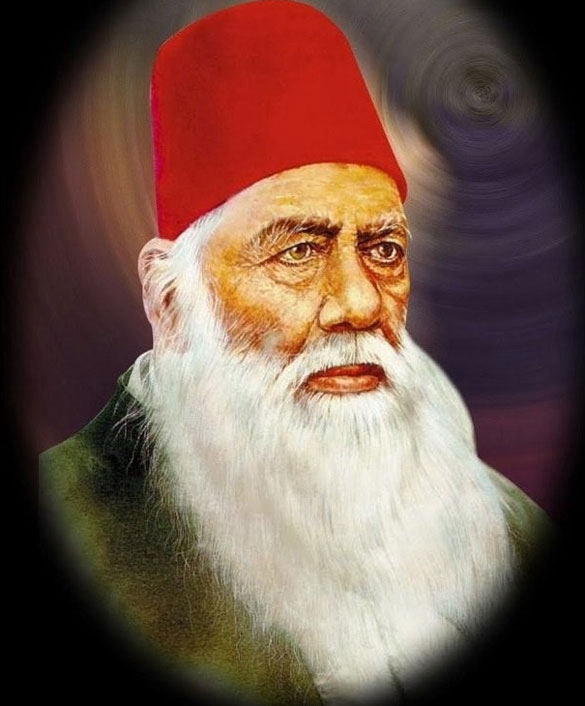
Sir Syed Ahmad Khan
------
One of the
greatest personalities India produced in the 19th century was Sir Syed Ahmad
Khan. He had acquired both Islamic and western education and influenced the
thought of the contemporary Muslims in a big way. His greatest contribution is
the establishment of Aligarh Muslim University in 1877.
Sir Syed
had seen the failure of the 1857 revolution led by the Muslims and participated
largely by Ulema. He also watched the subsequent persecution of Muslims by the
British government. He therefore, decided to work for the educational and
scientific progress of the Muslims. He was of the view that Muslims could come
out of the miserable condition only with the help of modern and scientific
education.
He adopted
a policy of establishing good relationship with British government and worked
towards reducing the hatred of the British government towards the Muslims. He
had realised that driving out the British was now not possible and so the only
way forward was to have good relationship with them and take advantage of the
services and resources of the government to make progress.
---------------------------------
Also
Read: Moving Beyond Sir Syed
---------------------------------
He himself
joined the administrative and judicial services. During this period, he also
started educational movement among the Muslims. He wrote a number of books to
promote modern education and scientific way of thinking among Muslims. He
issued the magazine Tahzeeb ul Ekhlaque and founded an organisation named the
Scientific Society.
Sir Syed
was a rationalist with an Islamic spirit. Though he favoured modern education
and English language, he had deep faith in his religion Islam and reverence for
the holy prophet pbuh. Since he had a correct understanding of religion of
Islam and the Quran, he also had respect for Christianity and Judaism.
Therefore, he also deeply studied the Bible, the Torah and other religious
scriptures. He endeavoured to bridge the cultural and religious gap between the
Muslims and the People of the Book. Therefore, he wrote the exegesis of the Bible
and Torah which was published in three volumes 1862, 1865 and 1887. In this
exegesis he also quoted verses from the Quran and hadiths corroborating the
verses of the Bible. This helped in a comparative study of the Quran, Bible and
Torah. Therefore, his exegesis is a rare book in Urdu which helped shed
misconceptions of the Muslims and the Christians about each other.
During his
time and even today, Muslims had the view that many changes have occurred in
the Bible. Sir Syed wrote that the Christian scholars have made many efforts to
preserve the authenticity of the Bible. He even detailed those efforts in the
exegesis. Therefore, he wrote the exegesis of the Bible not ith the purpose of
proving the Christians wrong but to prove the fact that the Quran, the Bible
and Torah were the parts of the chain of divine revelations and all the four
books were equally respectable. He wrote in a letter:
"Muslims have always considered the books of Christianity useless,
absurd and a collection of false tales. And their views have got strength from
illogical and imprudent arguments of some Christian priests. The result of
these arguments was nothing except bias, acrimony and differences between the
two communities."
-------------------------------------------------------------------------
-------------------------------------------------------------------------
As an
exegete of the Quran, he removed the misconception about the verses on slave
girls.
Sir Syed
was had a rational and logical way of thinking and so whenever the enemies of
Islam made an attack on Islam through their writings, instead of issuing fatwas
of death against him, he would write an academic reminder against them. This
happened when Sir William Muir wrote a book Mahomet and Islam in which he made
blasphemous remarks against Islam and the prophet, he wrote an argumentative
book in defence oc Islam and thd prophet pbuh. This book cleared the doubts of
the western world but of Indians about Islam and Muslims.
Sir Syed had
visited England in 1869 in connection with the admission of his sons in a
college. During his stay there, he studied the political and educational system
of England very closely and deeply. After returning home, he made up his mind
to establish a modern college. In 1877 he laid the foundation stone of M.A.O.
College which later became Aligarh Muslim University. The college imparted both
modern and Islamic education but the religious section became apprehensive of
the true intent of Sir Syed. They thought that Sir Syed had become a Christian
and was actually promoting Christianity under the guise of promoting modern and
scientific education. To remove their doubts, Sir Syed appealed to them
supervise the religious education in the college. But they refused to do so.
One Maulvi declined the appeal saying:
"Since Shias also attend the school, we will not participate in
this exercise."
---------------------------------------------------------------
Also
Read: Sir Syed Ahmad Khan: Man with a Mission
---------------------------------------------------------------
The Ulema
started a campaign against Sir Syed and his college. They called Sir Syed a
kafir, a Dajjal and a Dahriya. Sir Syed's biographer Maulana Altaf Hussain Hali
writes in his book Hayat-e-Jawaid:
"One Maulvi Imdad Ali obtained fatwas of Kufr from 60 Ulema against
him. One Maulvi Ali Bakhsh went to Makkah and obtained fatwas of Kufr against
him from the muftis of the four sects of Islam. In their fatwas they had issued
fatwa preventing financial assistance to and suggesting the demolition of the
college."
Magazines
were published to counter the scientific and modern thoughts promoted by Tahzib
ul Ekhlaque. Some of the magazines are Nurul Afaque from Kanpur, Nurul
Anwar from Agra and Lauh-e-Mahfuz from Punjab. One businessman from
Calcutta had even planned to kill Sir Syed but a Maulvi dissuaded him from doing
so.
Though some
of his political thoughts cannot be accepted and defended because sometimes he
sided with the British government and criticised the freedom fighters, the
motive behind it was to act as a safety valve to save the Muslims from the
wrath of the government. While criticising the Muslims, he would also subtly
point out the repressive and injustice of the British government as the reasons
behind the revolt and resentment among Indians, particularly Muslims.
As is the
policy of all great men, Sir Syed also ignored the contemporary political
developments and fixed his eyes on his future goal. He made some compromises
with the then government to achieve his goal. Today Sir Syed's farsightedness
is being appreciated and praised as he achieved what he aspired and struggled
for.
-----
S.
Arshad is a columnist with NewAgeIslam.com.
URL: https://newageislam.com/islamic-personalities/sir-syed-scientific-interfaith-dialogue/d/128276
New Age Islam, Islam Online, Islamic
Website, African
Muslim News, Arab World
News, South Asia
News, Indian Muslim
News, World Muslim
News, Women in
Islam, Islamic
Feminism, Arab Women, Women In Arab, Islamophobia
in America, Muslim Women
in West, Islam Women
and Feminism