
Parbhani's Eternal Light: Hazrat Syed Shah Turabul Haq Chishti Deccan's Beacon of Divine Compassion

By Adnan Faizi, New Age Islam
17 December 2025
Hazrat Syed Shah Turabul Haq Chishti, lovingly called Turatpeer Baba, came from Khurasan to spread the Chishti message in Maharashtra. A disciple of Hazrat Nizamuddin Auliya, he established Parbhani as a centre of unity, devotion, and shared faith for millions.
Main Points:
· Hazrat Turabul Haq received Bayat from Hazrat Nizamuddin Auliya in Delhi.
· Fourteen hundred palanquins accompanied Hazrat to Parbhani settlement.
· Hazrat Turabul Haq's dargah attracts five lakh pilgrims during Urs.
· Hazrat Haji Ghulam Yaseen Khan constructed Hazrat's dome in nineteen eleven.
· Hazrat Turabul Haq's Chishti legacy continues through Parbhani's spiritual tradition.
Introduction
In the story of Indian Sufism, Hazrat Syed Shah Turabul Haq Chishti shines as a saint remembered as much for his warmth as for his spiritual depth. Born in 1213 CE in Khurasan, he lived the true Chishti spirit rooted in love, humility, and compassion that reached beyond all boundaries. His journey from Persia to Delhi, and finally to Parbhani, reflects how Chishti teachings gently travelled with people. Hazrat Nizamuddin Auliya recognised his disciple’s inner strength and sent him to the Deccan with a large caravan, marking the beginning of a new spiritual centre. Under Hazrat Turabul Haq’s presence, Parbhani slowly grew from a quiet settlement into a major centre of pilgrimage, revered across the Deccan and often called the Ajmer Sharif of Maharashtra. Even today, his dargah draws lakhs of devotees every year, where Hindus and Muslims stand side by side living proof of his message that divine love belongs to all.
Early Life and Family background
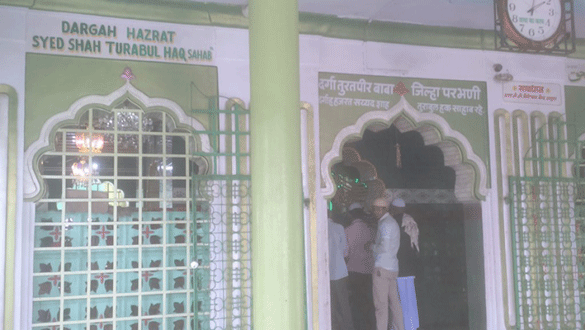
Hazrat Syed Shah Turabul Haq Chishti was born in 1213 CE in Khurasan, a land known for learning and spirituality. He belonged to a respected Syed family tracing its lineage to the Prophet Muhammad. His father, Hazrat Syed Mahmud, was a learned and pious scholar, while his mother, Hazrat Bibi Hazira, was known for devotion, charity, and spiritual discipline together shaping an atmosphere of faith at home. Growing up in Khurasan’s rich intellectual climate, Hazrat Turabul Haq received a strong grounding in Islamic sciences. He mastered Qur’an recitation with proper tajweed, studied hadith from the recognised collections, followed the Hanafi school of fiqh, and was trained in Arabic, Persian literature, and classical poetry. From a young age, he showed signs of deep spiritual awareness regular night prayers, voluntary fasting, and a natural wisdom that impressed local scholars. His parents nurtured this balance of learning, devotion, and service, preparing him quietly for the spiritual path that lay ahead.
Bayat, Khilafat, and the Journey to Parbhani
Hazrat Syed Shah Turabul Haq Chishti’s spiritual life reached its turning point when news of Hazrat Khwaja Nizamuddin Awliya reached Khurasan. Drawn by an inner call, he undertook the long and difficult journey to Delhi and arrived at the Ghiyaspur khanqah. Hazrat Nizamuddin recognised him as a destined mureed and accepted his Bay'ah, linking him to the unbroken Chishti silsila through Hazrat Khwaja Moinuddin Chishti, Hazrat Qutbuddin Bakhtiar Kaki, Hazrat Baba Fareeduddin Ganjshakar, and finally to Hazrat Nizamuddin himself. Through this chain, Hazrat Turabul Haq received the accumulated barakah and spiritual authority of generations. Under his master’s guidance, he was trained rigorously in Chishti discipline dhikr-e-jali and dhikr-e-khafi, pas-i-anfas, muraqaba, and demanding forty-day chillas that refined his spiritual perception. Pleased with his progress, Hazrat Nizamuddin granted him khilafat, authorising him to guide seekers independently and establish a khanqah.
His destiny took its final shape when Hazrat Nizamuddin instructed him to travel to the Deccan with a vast caravan of fourteen hundred palanquins, a journey that symbolised both spiritual authority and responsibility. Travelling from Delhi through Malwa, he reached the fertile lands of Parbhani. Though the local landholders were initially wary of such a large arrival, Hazrat Turabul Haq’s humility, compassion, and reported miracles such as water emerging from dry ground and the healing of the sick won their trust. A Maratha Patil granted land for permanent settlement, where he established a khanqah that functioned as a mosque, madrasa, hospice, and spiritual retreat. Faithful to Chishti ideals, he instituted a langar that fed all visitors without distinction of religion, and sama gatherings where qawwali and classical ragas stirred hearts toward divine love. From this centre, Parbhani grew into a lasting spiritual landmark, carrying forward the Chishti message of devotion, service, and universal compassion.
Teaching and Disciples
Hazrat Turabul Haq’s spiritual presence drew devoted seekers from every background and community. Among them, his chief khalifa, Hazrat Chand Khan, was granted ijazat to carry forward the Chishti mission. Under his guidance, the Parbhani khanqah expanded, and Chishti centres spread across the Marathwada region. Alongside him were many other disciples local Muslims trained in Qur’anic sciences and Hindus who were drawn by the saint’s spiritual power and reported karamat. Hazrat Turabul Haq personally trained his murids in Chishti adab, stressing humility, service to people, and constant remembrance of God. Women were also guided on the path of Divine love, ensuring spiritual instruction with proper decorum. The silsila continued smoothly through later generations. Khadims preserved daily zikr gatherings, weekly qawwali mehfils, monthly gagar ceremonies involving sacred water, and the annual Urs. In 1911 CE, the 20th-century khadim Hazrat Haji Ghulam Yaseen Khan constructed the present dome of the shrine, and his own mazar beside it stands as a lasting symbol of lifelong service.
Death, Urs and ongoing legacy
Hazrat Syed Shah Turabul Haq Chishti passed away in 1267 CE at the age of fifty-four, attaining union with the Divine during Fajr prayer a departure seen by devotees as a sign of lifelong remembrance. He was buried on the land where he had first settled in Parbhani, and for nearly six and a half centuries his grave remained open to the sky, visited by pilgrims who gathered around it with quiet devotion. In 1911 CE, his devoted khadim Hazrat Haji Ghulam Yaseen Khan, with the support of the district collector, constructed the present marble dargah. The marble structure, featuring Islamic architectural elements including a central mihrab, enhanced the shrine without disturbing its sanctity. Hazrat Haji Ghulam Yaseen Khan was later buried beside his master, symbolising lifelong service even after death. Every year, from 2 to 15 February, the Urs of Hazrat Turabul Haq transforms Parbhani into one of Maharashtra’s greatest centres of pilgrimage, drawing nearly five lakh devotees.
The celebrations include the historic sandal ceremony, in which the district collector applies sandalwood paste a tradition over a century old along with extended qawwali mehfils, continuous langar serving ghee-rich khichdi, gagar offerings of sacred water, collective zikr gatherings, and guided muraqaba sessions. People of all faiths Hindus, Muslims, Sikhs, and Christians participate, reflecting the saint’s message of universal love and earning the shrine its popular title as the “Ajmer Sharif of Maharashtra.” More than eight centuries later, Hazrat Turabul Haq’s legacy remains alive through an unbroken Chishti silsila, preserved rituals of dhikr, sama, and service, and the continued care of sajjada nasheens who maintain the khanqah. Recognised as a major cultural and spiritual heritage of the region, the Parbhani Urs and the living traditions of the dargah stand as enduring proof that the saint’s message rooted in love, humility, and unity continues to touch hearts across generations.
…
Adnan Faizi is a Peace and Harmony activist based in Delhi. He is an alumnus of CCS University, Meerut.
URL: https://newageislam.com/islamic-personalities/sufism-shah-turabul-haq-chishti-/d/138030
New Age Islam, Islam Online, Islamic Website, African Muslim News, Arab World News, South Asia News, Indian Muslim News, World Muslim News, Women in Islam, Islamic Feminism, Arab Women, Women In Arab, Islamophobia in America, Muslim Women in West, Islam Women and Feminism