
The Sword in the Mosque: The Martyrdom of the Fourth Caliph, Hazrat Ali Ibn Abi Talib and the Crisis of the First Fitnah

By Ghulam Ghaus Siddiqi, New Age Islam
Introduction
The martyrdom of Ḥaḍrat ʿAlī ibn AbīṬālib (d. 40 AH / 661 CE), the fourth Caliph of the early Muslim community and one of the most prominent Companions of the Prophet Muḥammad (peace be upon him), represents a pivotal episode in the political and intellectual history of early Islam. His assassination occurred during the turbulent period known as the First Fitnah, a time marked by intense political conflict, shifting alliances, and the emergence of new ideological factions within the Muslim community. Among these groups, the Kharijite movement developed into one of the most significant sources of opposition to Ḥaḍrat ʿAlī’s leadership and ultimately became associated in the historical sources with the conspiracy that led to his death.

The events surrounding the assassination of Ḥaḍrat ʿAlī have been preserved in detail in a range of early Islamic historical and biographical works, including the chronicles of al-Ṭabarī, Ibn Saʿd, and Ibn Kathīr, as well as later compilations of historical and ḥadīth literature. These sources not only record the circumstances of the attack carried out by ʿAbd al-Raḥmān ibn Muljam but also provide valuable insight into the political tensions, ideological motivations, and personal narratives that shaped the event. At the same time, many of these accounts preserve reports concerning Ḥaḍrat ʿAlī’s final counsels, which later Muslim scholars frequently cited as reflections of his ethical vision, spiritual outlook, and commitment to justice even in the face of personal tragedy.
This article examines the historical narratives concerning the martyrdom of Ḥaḍrat ʿAlī in order to analyse the circumstances that led to his assassination, the role of the Kharijite movement in the conspiracy, and the broader political environment of the late period of his caliphate. In addition, the study explores the final counsels attributed to him in early historical sources and considers how later Muslim writers interpreted these statements as expressions of moral leadership and religious integrity. Through this analysis, the article seeks to highlight both the historical significance of the event and the enduring ethical legacy associated with the life and martyrdom of Ḥaḍrat ʿAlī ibn AbīṬālib.
…….
Hadrat ʿAlī ibn AbīṬālib served as the fourth Caliph of the Muslim community for approximately four years and nine months (35–40 AH / 656–661 CE). On 17 or 19 Ramaḍān 40 AH (January 661 CE), while proceeding to lead the Fajr prayer in the Jāmiʿ Mosque of Kūfa, he was attacked by a member of the Kharijite faction, ʿAbd al-Raḥmān ibn Muljam al-Murādī. The assailant struck him with a sword that had reportedly been poisoned, inflicting a severe wound to his head. After suffering from these injuries for several days, Hadrat ʿAlī passed away on 19 or 21 Ramaḍān 40 AH, thereby attaining martyrdom according to the traditional Islamic understanding.
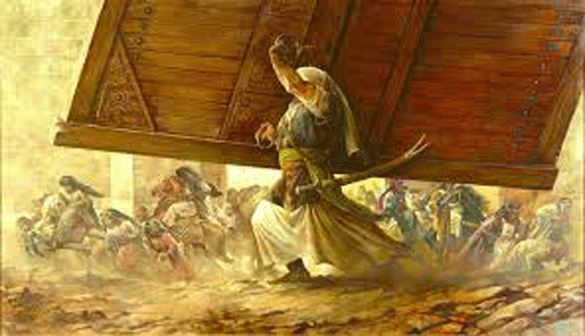
Most early historical reports agree that the attack took place in the Jāmiʿ Mosque of Kūfa at the time of the dawn prayer. Following his death, the funeral rites were conducted by his sons Hadrat al-Ḥasan and Hadrat al-Ḥusayn, along with Hadrat Muḥammad ibn al-Ḥanafiyyah and Hadrat ʿAbdullāh ibn Jaʿfar, in the presence of other relatives and companions. The funeral prayer (ṣalāt al-janāzah) was led by Hadrat al-Ḥasan ibn ʿAlī. According to several historical accounts, he was buried in Kūfa near the governor’s residence, though the precise location of the grave was intentionally concealed for some time due to fears that hostile factions might desecrate it.
(Al-Bidāyah wa al-Nihāyah, 7:330–331)
The Conspiracy against Leading Muslim Figures
Some historical sources report that a group of Kharijites planned coordinated attacks against three prominent leaders of the Muslim community: Hadrat ʿAlī ibn AbīṬālib, Hadrat Muʿāwiyah ibn Abī Sufyān, and Hadrat ʿAmr ibn al-ʿĀṣ. According to these reports, the conspirators agreed to carry out the assassinations on the same day, assigning each target to a specific individual. The assassination of Hadrat ʿAlī was undertaken by ʿAbd al-Raḥmān ibn Muljam.
Thus, during the month of Ramaḍān, while attending the dawn prayer in the mosque of Kūfa, the fourth Caliph of Islam was fatally attacked. His death marked the culmination of a turbulent period in early Islamic political history.
(Al-Bidāyah wa al-Nihāyah, 7:326; Majmaʿ al-Zawāʾid, 9:139; Ṭabaqāt Ibn Saʿd, 3:23)
The Kharijite Plot
Among the Kharijite faction was ʿAbd al-Raḥmān ibn Muljam al-Murādī. According to historical reports, he met in Makkah with two other Kharijites—Burak ibn ʿAbdullāh al-Tamīmī and ʿAmr ibn Bakīr al-Tamīmī—and together they agreed to assassinate the three political leaders mentioned above.
Responsibility for the assassination of Hadrat ʿAlī was assumed by Ibn Muljam, and a date was set for the execution of the plan.
A report preserved in al-Ḥākim’s al-Mustadrak, transmitted from al-Suddī, states that Ibn Muljam had become infatuated with a woman named Qiṭām, who belonged to the Kharijite faction. According to this report, the dowry she demanded for marriage included three thousand dirhams and the assassination of Hadrat ʿAlī ibn AbīṬālib.
This incident later became the subject of poetic reflection by the Umayyad-era poet al-Farazdaq, who composed the following verses:
Fa lam ara mahran sāqahu dhū samāḥatin
Ka mahri Qiṭāmin bayna ghayri muʿjami
Thalāthatu ālāfin wa ʿabdun wa qīnatun
Wa ḍarbu ʿAlīyyin bil-ḥusāmi al-muṣammami
Fa lā mahra aʿlā min ʿAlīyyin wa in ʿalā
Wa lā fitka illā dūna fitki Ibn Muljami
Translation
I have never seen a dowry offered by a generous man
Like the dowry of Qiṭām, widely known among people.
Three thousand dirhams, a slave, and a singing girl,
And the striking of Hadrat ʿAlī with a sharpened sword.
No dowry could be greater than the blood of Hadrat ʿAlī,
And no treachery surpasses the treachery of Ibn Muljam.
The Final Night
Historical narratives also preserve reports concerning the final night before the assassination. It is related that on the night of Friday, 17 Ramaḍān 40 AH, Hadrat ʿAlī awoke before dawn. During that Ramaḍān, it had reportedly become his custom to break his fast on different nights at the homes of close family members, including Hadrat al-Ḥasan, Hadrat al-Ḥusayn, and Hadrat ʿAbdullāh ibn Jaʿfar.
According to some reports, he ate very little during these meals and expressed a desire to meet God while remaining in a state of spiritual restraint. Certain sources further narrate that during that night he repeatedly looked toward the sky and spoke words suggesting an awareness of impending events.
Some accounts also mention that he narrated to his son Hadrat al-Ḥasan a dream in which he had seen the Prophet Muḥammad (peace be upon him). These reports, preserved in later historical compilations, portray the event as foreshadowing the coming tragedy.
(Tārīkh al-Khulafāʾ, p. 138; al-Ṣawāʿiq al-Muḥriqah, pp. 133–135)
The Assassination
On the morning of 17 or 19 Ramaḍān 40 AH, Hadrat ʿAlī proceeded toward the mosque of Kūfa for the dawn prayer. According to several accounts, ʿAbd al-Raḥmān ibn Muljam lay in wait and struck him with a poisoned sword.
The blow landed upon his head, causing a severe and ultimately fatal injury. The attacker was immediately captured by those present.
Although the wound was extremely serious, Hadrat ʿAlī survived for approximately two days before succumbing to his injuries on the night of 19 or 21 Ramaḍān.
Different historical sources describe the precise circumstances of the attack in slightly varying terms. Some reports state that the assault occurred while he was leading the congregational prayer, whereas others—such as a report cited in Tārīkh al-Khulafāʾ from Ṭabaqāt Ibn Saʿd—suggest that the attack occurred while he was moving through the mosque calling people to the Fajr prayer.
Prophetic Foreknowledge of the Martyrdom of Ḥaḍrat ʿAlī ibn AbīṬālib
Classical Islamic sources report that the Prophet Muḥammad (peace be upon him) foretold the circumstances surrounding the martyrdom of Ḥaḍrat ʿAlī ibn AbīṬālib. ʿAllāmah Jalāl al-Dīn al-Suyūṭī (d. 911/1505), citing Musnad Aḥmad and the narration recorded by al-Ḥākim with an authenticated chain, relates a report transmitted from Hadrat ʿAmmār ibn Yāsir that the Prophet (peace be upon him) addressed Hadrat ʿAlī and said:
“O ʿAlī! The most wretched of people are two: the one who hamstrung the she-camel of the Prophet Ṣāliḥ, and the one who will strike you upon the head and dye your beard with your blood.”
This narration has been interpreted by later scholars as an indication that the Prophet (peace be upon him) had foretold the violent death that would ultimately befall Ḥaḍrat ʿAlī. Historical accounts indeed describe that ʿAbd al-Raḥmān ibn Muljam struck Hadrat ʿAlī on the head with a sword during the Fajr prayer in the mosque of Kūfa, resulting in the wound that led to his death.
Motives behind the Assassination
Several historical narratives discuss the motives that led to the assassination of Ḥaḍrat ʿAlī. One widely cited report relates that ʿAbd al-Raḥmān ibn Muljam became attached to a Kharijite woman named Qiṭām (also reported as Ḥuṣṭām). According to these accounts, when Ibn Muljam proposed marriage, she set an extraordinary condition for her dowry: three thousand dirhams and the assassination of Ḥaḍrat ʿAlī.
Later writers often cited this story as an illustration of how personal motives and political grievances intersected during this turbulent period. Moral reflections are also found in classical literature; for example, Imām al-Ghazālī remarks that uncontrolled desire can reduce even powerful individuals to servitude. Within this interpretive framework, Ibn Muljam’s actions are presented as the result of ideological hostility combined with personal infatuation.
Regardless of the specific motivations attributed to him, the act was regarded by Muslim historians as a grave crime against one of the most eminent Companions of the Prophet (peace be upon him).
Consensus of the Historians
Muslim historians generally agree that Ḥaḍrat ʿAlī was assassinated by members of the Kharijite movement. The Kharijites emerged during the political conflicts of the First Fitnah and eventually developed into a distinct faction that opposed both Hadrat ʿAlī and his political rivals.
Although some individuals associated with earlier rebellions—such as those involved in the uprising against the third caliph, Ḥaḍrat ʿUthmān ibn ʿAffān—remained present in Kūfa, the assassination itself is consistently attributed in the historical sources to Kharijite conspirators.
The Plot of Three Kharijites
According to several historical accounts, three Kharijites—ʿAbd al-Raḥmān ibn Muljam, Burak ibn ʿAbdullāh al-Tamīmī, and ʿAmr ibn Bakr al-Tamīmī—met and resolved to assassinate three leading political figures simultaneously: Ḥaḍrat ʿAlī ibn AbīṬālib, Ḥaḍrat Muʿāwiyah ibn Abī Sufyān, and Ḥaḍrat ʿAmr ibn al-ʿĀṣ. Their plan was to carry out the attacks on the same night.
The conspirators reportedly prepared poisoned swords and pledged to sacrifice their lives in the attempt. Ibn Muljam subsequently travelled to Kūfa, where he met sympathizers among the Kharijites residing in the city.
Some sources state that during this period he encountered Qiṭām, whose relatives had been killed at the Battle of Nahrawān. His attachment to her reportedly reinforced his resolve to assassinate Ḥaḍrat ʿAlī. Although another Kharijite named Shabīb is said to have initially discouraged the plan by reminding Ibn Muljam of ʿAlī’s services to Islam, he was eventually persuaded to participate.
The conspirators ultimately decided to ambush Ḥaḍrat ʿAlī before dawn as he proceeded to the mosque for the Fajr prayer.
Failure of the Other Assassination Attempts
While the attack on Ḥaḍrat ʿAlī proved fatal, the other two assassination attempts failed.
Burak ibn ʿAbdullāh attacked Ḥaḍrat Muʿāwiyah in Damascus and succeeded in wounding him, but he was subsequently captured.
The attempt against Ḥaḍrat ʿAmr ibn al-ʿĀṣ also failed. On the appointed day, ʿAmr was ill and had asked Khārijah ibn Ḥudhāfah to lead the Fajr prayer in his place. The assassin, ʿAmr ibn Bakr, mistakenly killed Khārijah, believing him to be ʿAmr ibn al-ʿĀṣ. He too was later apprehended and executed.
The Final Counsel of Ḥaḍrat ʿAlī
After sustaining the fatal wound, Ḥaḍrat ʿAlī remained alive for a short period, during which he gave advice to his family and companions. Several historical works, including Tārīkh al-Ṭabarī, record portions of these final counsels.
He addressed his sons, Ḥaḍrat Ḥasan and Ḥaḍrat Ḥusayn with the following guidance:
“I advise you both to fear God. Do not pursue the world even if it seeks you. Do not grieve over what escapes you from it. Speak the truth, show mercy to the orphan, assist the distressed, and act for the sake of the Hereafter.
Be opponents of the oppressor and supporters of the oppressed, and adhere firmly to the commands of the Book of God.”
He also addressed his son Ḥaḍrat Muḥammad ibn al-Ḥanafiyyah and advised him to maintain respect and obedience toward his elder brothers, Ḥasan and Ḥusayn.
Further counsel included maintaining the prayer, properly performing ablution, giving zakāh, controlling anger, maintaining family ties, treating neighbours kindly, acquiring knowledge of religion, and enjoining good while refraining from wrongdoing.
These reported instructions reflect the ethical and spiritual priorities that later Muslim scholars associated with the legacy of Ḥaḍrat ʿAlī.
The Final Testament of Ḥaḍrat ʿAlī ibn AbīṬālib
As the time of his passing approached, Ḥaḍrat ʿAlī ibn AbīṬālib delivered a final counsel to his family and followers. Several historical sources preserve versions of this testament, which combines personal advice with Qurʾānic themes concerning piety, social responsibility, and communal unity. Among the most detailed accounts is the report recorded in Tārīkh al-Ṭabarī.
The Written Testament (Waṣiyyah)
According to these reports, Ḥaḍrat ʿAlī dictated the following testament:
In the name of God, the Most Compassionate, the Most Merciful.
This is the testament of Ḥaḍrat ʿAlī ibn AbīṬālib. He bears witness that there is no deity except God alone, without partner, and that Muḥammad (peace be upon him) is His servant and His Messenger, whom God sent with guidance and the religion of truth so that it may prevail over all other religions, even though the polytheists may dislike it.
Indeed, my prayer, my sacrifice, my life, and my death are for God, the Lord of the worlds. He has no partner, and with this I have been commanded, and I am among those who submit.
O my son Ḥasan, I advise you, all my children, and the members of my household to remain conscious of God. I advise that you depart from this world only in a state of submission to Him. Hold firmly to the rope of God together and do not fall into division.
I heard the Messenger of God say that reconciling people and maintaining harmonious relations is better than voluntary prayer and fasting.
Treat your relatives with kindness, for this will ease your reckoning before God. Fear God regarding the orphans; do not neglect them or allow them to suffer hardship while you are present among them.
Be mindful of God concerning your neighbours, for the Prophet repeatedly emphasized their rights.
(Tārīkh al-Ṭabarī, vol. 3/2, p. 355)
Additional Final Advice
Historical accounts further report that Ḥaḍrat ʿAlī continued to offer advice on a range of religious and social obligations. Particular emphasis was placed on the observance of prayer (ṣalāh), the payment of alms (zakāh), participation in the collective defence of the community, and the moral duty of enjoining what is right and discouraging what is wrong.
He also emphasized concern for vulnerable members of society, including the poor, the needy, and those in servitude. In addition, he advised his family to maintain respect for the Companions of the Prophet and to avoid discord within the Muslim community.
Among the statements attributed to him are exhortations to cooperate in righteousness and piety while avoiding assistance in wrongdoing and injustice. He concluded by entrusting his family to God and offering them his farewell greeting.
(Tārīkh al-Ṭabarī, vol. 3/2, p. 356)
Ethical Themes in the Final Counsels
The final counsels attributed to Ḥaḍrat ʿAlī reflect a set of ethical priorities that later Muslim scholars frequently associated with his legacy: piety, justice, communal unity, and social responsibility. His emphasis on reconciliation among Muslims and the avoidance of internal conflict is particularly notable in the context of the political turmoil of the First Fitnah.
These instructions also illustrate his concern for preserving the cohesion of the early Muslim community and maintaining respect among the Companions of the Prophet.
Instructions Regarding His Assassin
A particularly striking aspect of the historical reports concerns Ḥaḍrat ʿAlī’s instructions regarding the treatment of his attacker, ʿAbd al-Raḥmān ibn Muljam. According to these accounts, he cautioned his family against retaliatory violence:
“O Banū ʿAbd al-Muṭṭalib, do not shed the blood of Muslims on my account, saying that the Commander of the Faithful has been killed and that revenge must be taken. Do not kill anyone except my murderer.
If I die from this wound, then execute him with a single strike, for one blow should only be answered with one blow. Do not mutilate him, for I heard the Messenger of God say: ‘Avoid mutilation, even in the case of a rabid dog.’”
(Tārīkh al-Ṭabarī, vol. 3/2, p. 356)
These instructions have often been cited by later writers as an example of restraint and adherence to legal and ethical principles even under extreme circumstances.
The Case of Ibn Muljam
After the death of Ḥaḍrat ʿAlī, Ibn Muljam was brought before Ḥaḍrat Ḥasan ibn ʿAlī. According to historical reports, he attempted to persuade Ḥasan to release him temporarily, claiming that he had previously pledged to assassinate both Ḥaḍrat ʿAlī and Ḥaḍrat Muʿāwiyah. He proposed that he be allowed to travel and complete this mission, promising to return afterward.
Ḥaḍrat Imam Ḥasan rejected the proposal, reportedly stating that such an action would only intensify conflict and instability.
(Tārīkh al-Ṭabarī, vol. 3/2, p. 356)
Execution of the Assassin
Following these events, Ibn Muljam was executed. Some reports indicate that in the aftermath, certain individuals mutilated his body and burned it. Later historians note that this reaction appears to have been driven by emotional outrage among members of the community and did not fully conform to the restraint that Ḥaḍrat ʿAlī himself had recommended regarding the treatment of his killer.
The Situation of the Companions and the Rebel Factions at the Time of the Martyrdom of Ḥaḍrat ʿAlī ibn AbīṬālib
At the time of the assassination of Ḥaḍrat ʿAlī ibn AbīṬālib in 40 AH / 661 CE, the Muslim community remained deeply affected by the political divisions that had emerged during the First Fitnah. Historical sources indicate that the Companions of the Prophet (ṣaḥābah) were broadly situated within three general orientations regarding the ongoing conflict.
First, a number of Companions continued to support the leadership of Ḥaḍrat ʿAlī. However, their political authority in Kūfa was complicated by the presence and influence of various rebel elements within the army and administration. Among the prominent figures associated with Ḥaḍrat ʿAlī were ʿAbd Allāh ibn ʿAbbās, al-Ḥasan ibn ʿAlī, al-Ḥusayn ibn ʿAlī, Abū Ayyūb al-Anṣārī, Ziyād ibn Abī Sufyān, and Qays ibn Saʿd.
Second, a larger group of Companions supported the position of Ḥaḍrat Muʿāwiyah ibn Abī Sufyān in Syria. Historical sources also note that ʿAqīl ibn AbīṬālib, the elder brother of Ḥaḍrat ʿAlī, was among those who eventually aligned with Ḥaḍrat Muʿāwiyah during this period.
Third, a number of leading Companions adopted a position of neutrality. These individuals avoided direct participation in the conflict between Muslim factions and often expressed disapproval of the continuing violence. Among the most prominent figures in this group were Ḥaḍrat Saʿd ibn Abī Waqqāṣ and Ḥaḍrat ʿAbd Allāh ibn ʿUmar.
The Decline of the Rebel Factions
By the time of Ḥaḍrat ʿAlī’s assassination, the strength of the various rebel groups had already begun to diminish. A significant faction had separated and formed the Kharijite movement, which became one of the principal sources of opposition to Ḥaḍrat ʿAlī. At the same time, many leading figures associated with earlier rebellions had been killed in major conflicts of the First Fitnah, including the Battles of al-Jamal and Ṣiffīn, as well as campaigns in Egypt.
Some historians suggest that the political circumstances at the time presented an opportunity for reconciliation among the leading Muslim factions and the possible consolidation of authority against insurgent groups. However, Ḥaḍrat ʿAlī’s assassination prevented any such political developments from materializing during his lifetime.
Subsequent events, however, unfolded in a manner that many later scholars connected to a well-known prophetic statement concerning Ḥaḍrat Ḥasan ibn ʿAlī. According to a report preserved in Ṣaḥīḥ al-Bukhārī, the Prophet Muḥammad (peace be upon him) is reported to have said:
“This son of mine is a leader (sayyid), and perhaps through him God will reconcile two great groups of the Muslims.”
(Ṣaḥīḥ al-Bukhārī, Kitāb al-Fitān, ḥadīth no. 2704)
Within several months of his father’s death, Ḥaḍrat Ḥasan relinquished the caliphate in favor of Ḥaḍrat Muʿāwiyah, an event that brought a temporary end to the internal conflict and restored political unity within the Muslim polity.
Reactions to the Martyrdom of Ḥaḍrat ʿAlī
The assassination of Ḥaḍrat ʿAlī ibn AbīṬālib produced a profound reaction throughout the Muslim world. Reports preserved in historical literature record expressions of grief from various leading figures of the early community, including individuals who had previously been politically opposed to him.
Reaction of Hadrat Muʿāwiyah ibn Abī Sufyān
According to a report recorded by al-Ṭabarī, news of the assassination reached Ḥaḍrat Muʿāwiyah through individuals associated with the Kharijite conspirators who had attempted attacks in Syria. One of them reportedly told him that his associate had likely killed Ḥaḍrat ʿAlī. Ḥaḍrat Muʿāwiyah is said to have responded that he wished the attacker had not succeeded in overpowering him.
(Tārīkh al-Ṭabarī, events of 40 AH, vol. 3/2, p. 357)
Other historical reports indicate that Ḥaḍrat Muʿāwiyah acknowledged the scholarly and legal authority of Ḥaḍrat ʿAlī. Ibn ʿAbd al-Barr records a statement attributed to Ḥaḍrat Muʿāwiyah in which he remarked:
“Knowledge and jurisprudence have departed with the death of Ḥaḍrat Ibn Abī Ṭālib.”
(Ibn ʿAbd al-Barr, al-Istīʿāb fī Maʿrifat al-Aṣḥāb, 2:52)
Similarly, Ibn Kathīr narrates that when the news of Ḥaḍrat ʿAlī’s death reached Ḥaḍrat Muʿāwiyah, he expressed grief and reportedly wept. When questioned about this reaction, he is said to have remarked that people had been deprived of a figure distinguished by knowledge, virtue, and religious understanding.
(Ibn Kathīr, al-Bidāyah wa al-Nihāyah, vol. 11, p. 129)
Another frequently cited account describes Ḥaḍrat Muʿāwiyah asking Ḍirār al-Ṣudāʾī to describe the character of Ḥaḍrat ʿAlī. After hearing a detailed account of his virtues, Ḥaḍrat Muʿāwiyah reportedly responded by acknowledging the accuracy of the description and praying for God’s mercy upon him.
(Ibn ʿAbd al-Barr, al-Istīʿāb, 2:53)
Reaction of Ḥaḍrat ʿĀʾishah bint Abī Bakr
Reports preserved in early historical sources also describe the reaction of Ḥaḍrat ʿĀʾishah bint Abī Bakr upon receiving news of Ḥaḍrat ʿAlī’s death. According to a report cited by al-Ṭabarī, she responded with a poetic expression of grief when informed of the event.
(Tārīkh al-Ṭabarī, vol. 3/2, p. 258)
In addition, several narrations emphasize the scholarly stature of Ḥaḍrat ʿAlī within the early Muslim community. Reports preserved in the ḥadīth literature indicate that Ḥaḍrat ʿĀʾishah occasionally directed questioners to him in matters of legal interpretation, acknowledging his expertise.
(Ṣaḥīḥ Muslim, Kitāb al-Ṣalāh, ḥadīth no. 276)
Historical Opinions Regarding the Burial Place of Ḥaḍrat ʿAlī
Early historical works contain differing reports concerning the burial place of Ḥaḍrat ʿAlī ibn AbīṬālib. One widely cited view holds that his burial site was deliberately concealed due to fears that hostile groups—particularly the Kharijites—might desecrate the grave.
Other narrations suggest that his body may have been transported from Kūfa to Madīnah by his son Ḥaḍrat Ḥasan. Some later accounts also describe traditions according to which the body was transported during the night and its final resting place remained uncertain.
Additional reports mention that after searching for the location where the body had been taken, it was eventually found in the region associated with the Banū Ṭay tribe. At the same time, later Islamic tradition identified a site in Kūfa—later associated with Najaf—as the location of his grave.
(Tārīkh al-Khulafāʾ; Izālat al-Khafāʾ)
Conclusion
The martyrdom of Ḥaḍrat ʿAlī ibn AbīṬālib constitutes a defining moment in the history of the early Muslim community and occurred within the broader context of the political turbulence of the First Fitnah. As the historical accounts examined in this study indicate, his assassination by ʿAbd al-Raḥmān ibn Muljam was closely connected to the emergence of the Kharijite movement and the intense divisions that had developed among Muslim factions during this period. The sources also reveal that, despite these turbulent circumstances, Ḥaḍrat ʿAlī remained deeply committed to the principles of justice, restraint, and adherence to religious and ethical norms. His final counsels to his family and companions—preserved in works such as Tārīkh al-Ṭabarī—emphasized piety, reconciliation among Muslims, care for vulnerable members of society, and fidelity to the teachings of the Qurʾān and the Prophet Muḥammad (peace be upon him). Even in his instructions regarding the treatment of his assassin, he advocated moderation and adherence to justice, illustrating a remarkable commitment to ethical principles during the final moments of his life.
Beyond its immediate historical context, the life and martyrdom of Ḥaḍrat ʿAlī have continued to occupy a central place in Islamic moral and intellectual tradition. His character came to symbolize the integration of spiritual devotion, moral courage, and principled leadership. The virtues associated with his legacy—truthfulness, bravery, justice, patience, and compassion—were repeatedly emphasized by later Muslim scholars as foundational qualities of righteous governance and personal conduct. In this sense, the memory of his martyrdom transcends the political conflicts of the seventh century and functions as a lasting moral paradigm within Islamic thought. By reflecting upon his life, his teachings, and the circumstances of his death, later generations have drawn enduring lessons concerning ethical responsibility, the pursuit of justice, and the preservation of unity within the Muslim community. (May Allah be pleased with all the companions of the Prophet Muhammad Peace be upon him!)
Bibliography
1. Ibn Kathīr, Ismāʿīl ibn ʿUmar. Al-Bidāyah wa al-Nihāyah. Beirut: Dār al-Fikr, n.d.
2. Al-Haythamī, Nūr al-Dīn ʿAlī ibn Abī Bakr. Majmaʿ al-Zawāʾid wa Manbaʿ al-Fawāʾid. Cairo: Dār al-Rayyān li-l-Turāth, 1987.
3. Ibn Saʿd, Muḥammad ibn Saʿd. Kitāb al-Ṭabaqāt al-Kabīr. Beirut: Dār Ṣādir, 1968.
4. Al-Ḥākim al-Nīsābūrī, Muḥammad ibn ʿAbd Allāh. Al-Mustadrak ʿalā al-Ṣaḥīḥayn. Beirut: Dār al-Kutub al-ʿIlmiyyah, 1990.
5. Al-Suyūṭī, Jalāl al-Dīn. Tārīkh al-Khulafāʾ. Cairo: Dār al-Kutub al-Ḥadīthah, n.d.
6. Ibn Ḥajar al-Haytamī, Aḥmad ibn Muḥammad. Al-Ṣawāʿiq al-Muḥriqah ʿalā Ahl al-Rafḍ wa al-Ḍalāl wa al-Zandaqah. Cairo: Dār al-Kutub al-ʿIlmiyyah, n.d.
7. Chishtī, Fayż Aḥmad. Faḍāʾil wa Manāqib Ḥaḍrat Mawlā ʿAlī Raḍiyallāhu ʿAnhu, Part 4. Blog post, April 11, 2023. https://faizahmadchishti.blogspot.com/2023/04/4.html.
8. Al-Ṭabarī, Muḥammad ibn Jarīr. Tārīkh al-Rusul wa al-Mulūk (Tārīkh al-Ṭabarī). Beirut: Dār al-Turāth, 1967.
9. Ibn ʿAbd al-Barr, Yūsuf ibn ʿAbd Allāh. Al-Istīʿāb fī Maʿrifat al-Aṣḥāb. Beirut: Dār al-Jīl, 1992.
10.Al-Bukhārī, Muḥammad ibn Ismāʿīl. Ṣaḥīḥ al-Bukhārī. Beirut: Dār Ibn Kathīr, 2002.
11.Muslim ibn al-Ḥajjāj. Ṣaḥīḥ Muslim. Beirut: Dār Iḥyāʾ al-Turāth al-ʿArabī, n.d.
12.Shāh Walīullāh al-Dihlawī. Izālat al-Khafāʾʿan Khilāfat al-Khulafāʾ. Cairo: Dār al-Kutub al-ʿIlmiyyah, n.d.
…
A regular Columnist with NewAgeIslam.com, Ghulam Ghaus Siddiqi Dehlvi is a Classical Islamic scholar with a Sufi background and English-Arabic-Urdu Translator.
New Age Islam, Islam Online, Islamic Website, African Muslim News, Arab World News, South Asia News, Indian Muslim News, World Muslim News, Women in Islam, Islamic Feminism, Arab Women, Women In Arab, Islamophobia in America, Muslim Women in West, Islam Women and Feminism