
A Naat, a Khanqah, a Legacy: The Enduring World of Hazrat Syed Tajuddin Qadri 'Shakir' of Pind Sharif, Bihar

By Syed Amjad Hussain, New Age Islam
6 January 2025
This article explores Hazrat Syed Shah Tajuddin Qadri’s spiritual life, his founding of Khanqah-e-Shakiriya at Pind Sharif, and how his naat keeps Sufi devotion alive in Bihar.
Main Points:
· Explores the Sufi life and spiritual thought of Syed Shah Tajuddin Qadri Shakir in the context of Bihar.
· Centres on the establishment of Khanqah-e-Shakiriya at Pind Sharif, Sheikhpura, as his enduring legacy.
· Examines the naat as a key expression of devotional and theological Sufi poetry.
· Traces the continuity of spiritual leadership through successive Sajjadamashins.
· Assesses the khanqah’s ongoing religious and cultural relevance in the present day.
…
A Sufi Presence Rooted in Bihar
In the spiritual heartland of Bihar, where faith is often practised quietly and passed down like an inheritance, the name Hazrat Syed Shah Tajuddin Qadri, known in poetry as Shakir, continues to resonate. His legacy is not something preserved only in manuscripts or memories. It breathes, moves, and gathers people even today through the institution he himself founded, Khanqah-e-Shakiriya at Pind Sharif, in the Sheikhpura district (formerly Munger district) of Bihar.
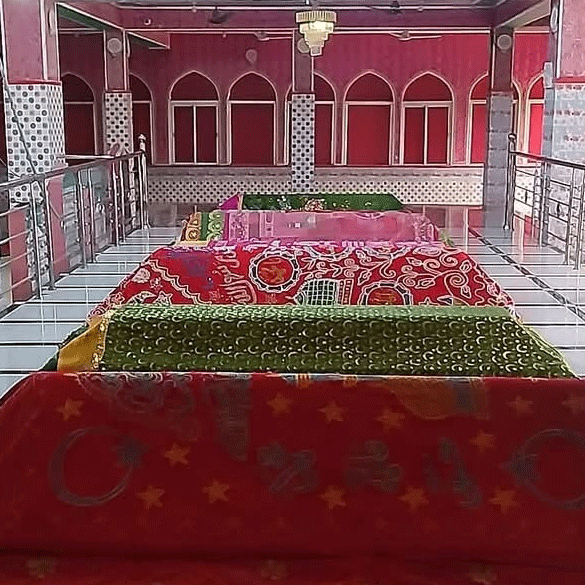
Born in Sheikhpura into a respected spiritual lineage tracing back to Hazrat Makhdoom Syed Adam Sufi Chishti of Patna’s Pakki Dargah, Hazrat Tajuddin Shakir grew up surrounded by the ethics of Sufi devotion. His spiritual temperament was shaped within the Qadriyya Sufi order, where love for the Prophet Hazrat Muhammad Mustafa Sallallahu Ta'aala Alayhi Wasallam stands at the centre of religious life. For Hazrat Tajuddin Shakir, spirituality was not an abstract idea but a lived experience, meant to be shared, practised, and sustained within a community.
The Founding of Khanqah-e-Shakiri at Pind Sharif
The most enduring contribution of Hazrat Syed Shah Tajuddin Qadri ‘Shakir’ was the establishment of Khanqah-e-Shakiriya at Pind Sharif. This was not merely the construction of a religious space. It was the creation of a spiritual environment where remembrance of Allah and love for the Prophet Hazrat Muhammad Mustafa Sallallahu Ta'aala Alayhi Wasallam shaped daily life.
Under Hazrat Tajuddin Shakir’s guidance, the khanqah became a centre of dhikr, learning, and ethical refinement. People from surrounding regions travelled to Pind Sharif, not drawn by grandeur, but by sincerity. The khanqah offered spiritual companionship, counsel, and a sense of belonging. Mawlid-un-Nabi gatherings held there were particularly significant, transforming the space into an assembly of collective love and remembrance.
Hazrat Tajuddin Shakir’s vision was simple yet profound. He believed that spirituality must remain rooted in humility and service. The khanqah reflected this ethos, standing as a space where devotion was lived rather than displayed.

A Poet of Prophetic Love
Alongside his role as a spiritual guide, Shakir was also a poet whose words carried the weight of devotion. Writing under his takhallus Shakir, he composed naats that were deeply embedded in Sufi theology and emotion. His poetry was not ornamental. It was experiential.
One of his most powerful naats paints a vivid picture of a Mawlid gathering, where the entire cosmos appears to participate in remembrance. Angels descend, the souls of the prophets gather, and even sacred spaces seem to awaken in honour of the Prophet. This naat reflects the spiritual atmosphere that Shakir cultivated at Khanqah-e-Shakiriya, especially during Mawlid celebrations at Pind Sharif.
The poem moves from cosmic imagery to personal supplication, ending with the poet standing humbly as a beggar at the Prophet’s door. This progression mirrors the Sufi journey itself, from awe to annihilation, from love to surrender.
Yaan bazm-e-zikr-e-Mawlid-e-Khair-ul-Wara hai aaj
Jis ka karam muhtamim hua khud Kibriya hai aaj
(Today, here is a gathering remembering the birth of the Best of all creation,
Whose honour and completion were decreed by God Himself today.)
Kyon kar na ho ke us ke hai mehboob ka ye zikr
Sunne ko jis ke khud hi wo rauza-numa hai aaj
(How could it not be, when this remembrance is of His Beloved,
To hear it, even the sacred shrine itself appears present today.)
Aajiz hai jis ke dekhne se chashm-e-har bashar
Husn-e-Habib mein hua wo runuma hai aaj
(Every human eye is helpless before beholding him,
For today, the beauty of the Beloved has manifested itself.
Taabaan hai aaj nayyer-e-ruksaar-e-Mustafa
Har ek faraa ko asl ki apne baqa hai aaj
(Radiant today is the son of Mustafa’s glowing countenance,
Every branch finds its survival in the root today.)
Irfaan-e-apne nafs ka aarif ko aaj hai
Nafs-un-nufoos-e-khalq hua rehnuma hai aaj
(Today the knower attains true awareness of his own self,
For the Soul of all souls has become the guide of creation today.)
Shaakir pe bhi ho aaj nigah-e-karam, Shahaa
Tere hi aasre pe khada ye gada hai aaj
(O King, cast today a glance of grace upon Shaakir as well,
For this beggar stands today relying only on You.)
Spiritual Continuity and Living Leadership
After Hazrat Syed Tajuddin Qadri Shakir’s passing on 22 July 1902, the khanqah did not fall silent. Its spiritual rhythm continued through his successors, preserving both the physical space and the inner tradition he established.
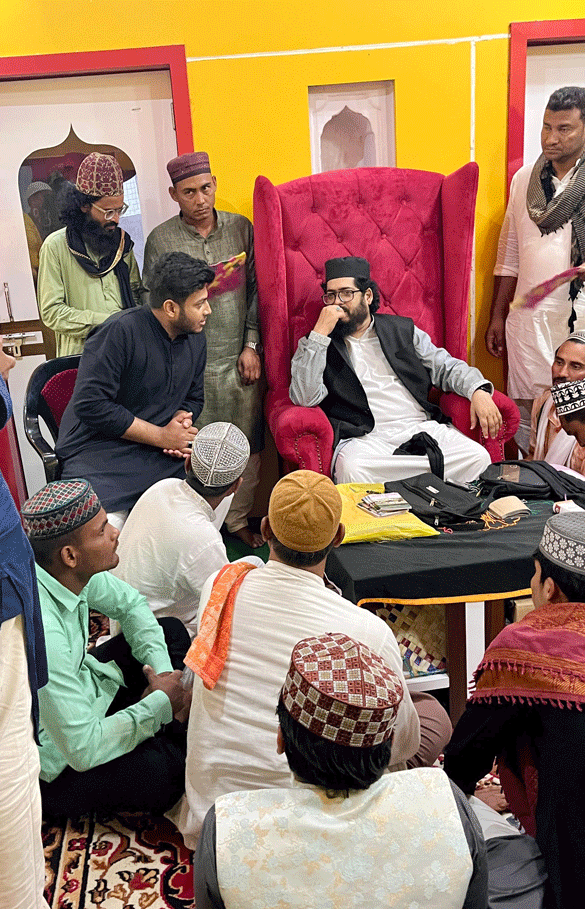
In recent generations, Hazrat Syed Shah Rizwanul Hoda Qadri Misbahi played a crucial role in expanding the khanqah’s influence. Balancing spiritual responsibility with academic engagement, he served as a professor at Sanjay Gandhi Smarak Mahila College, Sheikhpura, while also founding educational institutions. His approach reflected Hazrat Tajuddin Shakir’s original vision, where spiritual growth and worldly education were not treated as opposites.
Today, Hazrat Mufti Syed Shah Faizanul Hoda Qadri Misbahi, an alumnus of Jamia Ashrafiya Mubarakpur, carries this legacy forward as the present Sajjadanashin. Under his guidance, Khanqah-e-Shakiriya at Pind Sharif remains a centre of tasawwuf, scholarship, and communal harmony, attracting murids and visitors from across the country.
Khanqah-e-Shakiriya in the Present Day
Even in 2026, Khanqah-e-Shakiriya stands as a living institution. Annual urs gatherings continue to draw large crowds, with Shakir’s naat recited in voices that echo across generations. In an era of rapid urbanisation and cultural erosion, the khanqah remains a space of continuity, reminding visitors that spirituality does not expire with time.
Digitisation efforts and archival platforms have brought Hazrat Tajuddin Shakir’s poetry to wider audiences, but the heart of his legacy remains firmly planted at Pind Sharif. The soil, the gatherings, the recitations, and the silences between them all carry his presence.
An Assembly That Never Ends
Hazrat Syed Tajuddin Qadri ‘Shakir’ did not seek permanence, yet he achieved it. Through the founding of Khanqah-e-Shakiriya at Pind Sharif, he created a space where remembrance could renew itself endlessly. His naat continues to be recited, his khanqah continues to gather hearts, and his vision continues to guide.
The bazm-e-zikr he imagined was never meant to end. It simply changes voices, generations, and time.
--
Syed Amjad Hussain is an author and Independent research scholar on Sufism and Islam. He is the author of 'Bihar Aur Sufivad', a bestselling research book based on the history of Sufism in Bihar.
URL:https://newageislam.com/islamic-personalities/syed-tajuddin-qadri-khanqah-pind-sharif-bihar/d/138324
New Age Islam, Islam Online, Islamic Website, African Muslim News, Arab World News, South Asia News, Indian Muslim News, World Muslim News, Women in Islam, Islamic Feminism, Arab Women, Women In Arab, Islamophobia in America, Muslim Women in West, Islam Women and Feminism