
Yaqut al-Hamawi- The Turkish Slave from Istanbul Who Became a Scholar

By Sahil Razvi, New Age Islam
16 June 2026
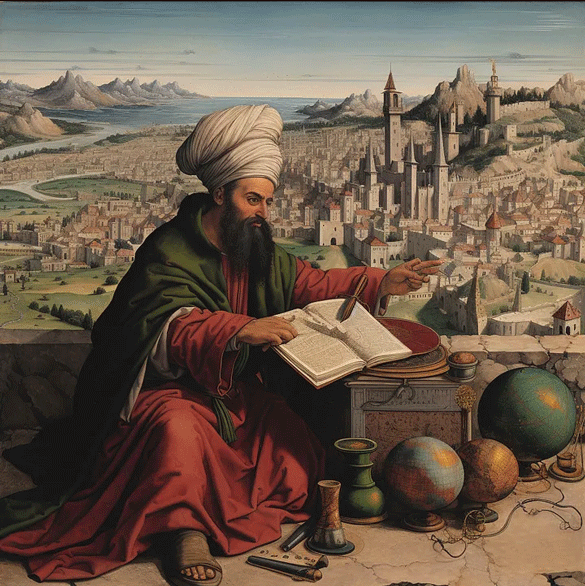
Yaqut al-Hamawi rose from slavery to become a leading 13th-century geographer and biographer. His books preserved valuable knowledge of places, history, and scholars during the late Islamic Golden Age and are still used by researchers today.
Main Points:
· Born in 1179 in Constantinople (Istanbul) and sold as a slave in Baghdad as a child.
· Educated by his master, later freed, and became a bookseller and traveller.
· Wrote Mu’jam al-Buldan, a major geographical and historical dictionary.
· Authored Mu’jam al-Udaba’, a biographical dictionary of scholars and writers.
· His works remain important sources for medieval Islamic history and geography.
In the later years of the Islamic Golden Age, when the Abbasid Caliphate was facing political troubles and external threats, there lived a man whose life reads almost like a story of determination and love for knowledge. His name was Yaqut al-Hamawi. Born in 1179 in Constantinople (Istanbul) to Greek parents, he was captured as a young child during wars and brought to Baghdad as a slave. Yet, through sheer effort and the opportunities that the age offered, he rose to become one of the most important geographers and biographers of the 13th century. His works are still studied even today, almost eight hundred years after his death.
Those were times when Baghdad was still considered the centre of learning in the Islamic world, even though the golden period of great scientific discoveries was slowly coming to an end. The House of Wisdom had already done its work of translating Greek, Persian and Indian knowledge into Arabic. Scholars before Yaqut had already written important books on geography, medicine and astronomy. But by the time Yaqut was growing up, new dangers were appearing. The Crusades were still going on in some parts, and from the east, the Mongol armies were beginning to create fear across the Islamic lands. In such uncertain times, Yaqut’s life shows us how the spirit of seeking knowledge continued despite difficulties.
Yaqut’s early life was full of hardships. After being sold in Baghdad, he came under the ownership of a merchant named Askar ibn Abi Nasr, who belonged to the Syrian city of Hama. This merchant, instead of keeping him only for labour, gave him education in Arabic language, grammar, mathematics and accounts. Young Yaqut travelled with his master on business trips to the island of Qays in the Persian Gulf. That island was then an important trading point where goods from India, China and the Arab lands used to meet. These journeys gave him early exposure to different people and places. After some years, he gained his freedom. Once free, he did not immediately become a writer. For some time he worked as a bookseller and manuscript copier in Baghdad. This work was actually very useful for him because it kept him surrounded by books and scholars.
What really shaped his future was his decision to travel widely in search of knowledge. For nearly ten years, he moved across different parts of Iran, Syria and Egypt. He stayed for long periods in famous centres of learning such as Merv, Balkh and Mosul. In Merv, he spent almost two years inside its great libraries, reading whatever he could find. He collected information not only from old books but also by talking to local scholars and travellers. He noted down details about cities, rivers, mountains, people’s customs, and historical events connected with those places. During these travels, he saw with his own eyes how the Mongol invasions were destroying libraries and cities in the eastern regions. At one point, he had to flee from Merv on foot, carrying whatever manuscripts he could save. These difficult experiences made his writing more serious and careful. He realised that much knowledge was in danger of being lost forever, and someone had to preserve it.
His most famous work is the Mu’jam al-Buldan, which means Dictionary of Countries. This is not just a list of place names. Yaqut arranged the book alphabetically and wrote detailed entries for thousands of places. In each entry, he gave the correct spelling and pronunciation, explained the meaning of the name, described the location, and added historical information. He wrote about battles fought there, famous people born in that place, local monuments, and sometimes even old stories and legends connected with the area. He also included poetry and literary references to support what he wrote. Because of this, the book became much more than geography, it turned into a valuable source of history, literature and culture as well.
His second important work is Mu’jam al-Udaba’, a biographical dictionary of learned men. In this book, he wrote about poets, writers, grammarians, historians and other scholars. He tried to explain what it really means to be a true man of letters. According to him, such a person does not limit himself to only one subject. Instead, he takes the best ideas from different fields and brings them together in his own way. This idea was quite respected in those days when scholars were expected to have wide knowledge.
He explained his method of arranging and explaining entries:
“I put it in the strict position of the language specialists, and I explained each letter in the noun, whether it is a consonant, or a vowel, or a plural or a broken one... Then I mention its derivation if it is of Arabic origin, and its meaning if I notice that it is non-Arabic.”
People who lived around the same time or came shortly after spoke well of Yaqut’s efforts. The well-known biographer Ibn Khallikan reached Aleppo soon after Yaqut’s death in 1229. In his own writings, he mentioned that the people of Aleppo were full of praise for Yaqut’s knowledge and literary achievements. Ibn Khallikan himself felt sorry that he could not meet Yaqut while he was alive. Another important scholar of that period was Jamal al-Din al-Qifti, who was serving as a vizier in Aleppo. He became Yaqut’s supporter and gave him help and protection during his final years. Al-Qifti was particularly impressed by Yaqut’s deep understanding of Arabic language and grammar. Because of this, he even included Yaqut’s name among the notable grammarians in one of his own books.
Yaqut considered the science of akhbār (historical reports, especially those related to the Prophet and early Muslims) as the foundation of all knowledge. He wrote:
If scholars had not concerned themselves with akhbār and with the works of ’athar (usages of the companions of the Prophet), the beginnings of knowledge would have become corrupt and its ends would have perished.
Even after so many centuries, Yaqut’s works have not lost their importance. Historians and researchers who study the medieval Islamic world still refer to his books regularly. Those who work on the history of Iran, Central Asia, the Caucasus region or the Arab lands find his descriptions very useful. His books give us one of the last clear pictures of those areas before the Mongol invasions changed the political and cultural map forever. In recent years, some scholars have also used his writings along with modern digital tools to understand old trade routes and settlements better. Parts of his books have been translated into English, and critical editions in Arabic are available for serious researchers.
What makes Yaqut different from many other writers of his time is the way he collected his material. He did not simply copy from earlier books. He travelled to many places himself, spoke to people, compared different sources, and added his own observations wherever possible. In an age when libraries were being destroyed and books were getting lost, his effort to gather and organise knowledge was truly valuable. He worked with the belief that preserving information about places and people was important for future generations.
Yaqut’s life also tells us something meaningful about the Islamic Golden Age. Even when political power was weakening and dangers were increasing from outside, the respect for knowledge and learning remained strong in society. A person who started life as a slave could still rise to a position where his works were read and respected by scholars. This was possible because the system valued education and scholarship more than birth or background. Yaqut’s story is a good example of that spirit.
He died in Aleppo in 1229 at around the age of fifty. By then he had already completed his major works. Although he did not live to see the full impact of the Mongol invasions on Baghdad and other cities, his writings helped save a lot of information that might otherwise have been forgotten.
…
New Age Islam, Islam Online, Islamic Website, African Muslim News, Arab World News, South Asia News, Indian Muslim News, World Muslim News, Women in Islam, Islamic Feminism, Arab Women, Women In Arab, Islamophobia in America, Muslim Women in West, Islam Women and Feminism