
Zareef Ahmad Zareef, Kashmir's Voice for Language, Culture & Nature

By Altamash Ali, New Age Islam
26 March 2026
Zareef Ahmad Zareef is a renowned Kashmiri poet who promotes language, culture, and environmental awareness. Influenced by Sufi values, his satirical poetry highlights social issues, inspires hope, and encourages people to protect their roots and traditions.
Main Points:
· Zareef Ahmad Zareef sees the Kashmiri language as identity, culture, and pride.
· His satirical poetry exposes social evils and political issues.
· Strong advocate for environmental protection and traditional values.
· Deeply influenced by Sufi teachings of simplicity and kindness.
· Believes poetry should reflect society and inspire positive change.
…
Zareef ahmed zareef says that the Kashmiri language is our identity, our culture, and our pride. If we stop speaking our mother tongue at home, we will slowly lose our roots, our history, and our way of thinking. He strongly supports saving the environment and gives great importance to traditional things like haak (a Kashmiri green vegetable). Influenced by Sufi thoughts, he believes that true Sufism is not in big talks, but in daily actions, kindness, and living a balanced life. He talks about maintaining balance in society, raising voice against injustice, loving nature, and respecting old traditions. According to him, a poet's job is to act as a mirror for society. clearly show the evils so that people can correct them, and also spread goodness and hope.
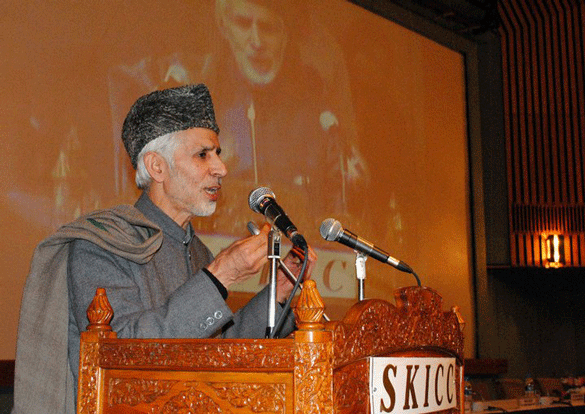
Zareef Ahmad Zareef is a famous Kashmiri poet, writer, social activist, and environmentalist. He was born on 17 April 1943 in the old downtown area of Srinagar known as Aali Kadal. His real name was Zareef Ahmed Shah. He grew up in a lively neighborhood where hakims, Sufi saints, poets, traders, and shopkeepers lived. His father, Ghulam Mohi-ud-Din, had an embroidery workshop. From childhood, Zareef Sahab had a deep attachment to Sufi traditions. Even today, he regularly visits the shrine of the Sufi saint Khwaja Habibullah Ataar. This spiritual connection has greatly influenced his thoughts and writing.
He completed his school education from Islamia High School in Rajouri Kadal. Even during school days, he was very active in debates, seminars, speeches, and literary programs. His teachers and especially writers like Sattar Shahid inspired him a lot. In class 8, he started writing poetry. Two people played a major role in improving his writing skills Ghulam Ahmed Mir Abid taught him to use his imagination better, while the famous Urdu writer Hakeem Manzoor introduced him to the beauty and depth of poetry and literature.
In 1968, Zareef joined the Information Department as a scriptwriter. He worked in the cultural unit, where he organized public shows, dramas, mushairas (poetry gatherings), and other cultural programs. He retired from the post of Assistant Cultural Officer. After retirement, he fully devoted himself to writing poetry in the Kashmiri language, doing social work, and protecting the environment. His aim was to highlight the problems of society through his words and force people to think.
Zareef is most famous for his satirical poetry. Satire means using humor, irony, and sharp words to expose the mistakes of society. In his poems, he shows social evils, political issues, environmental problems, and the difficulties of weaker sections. His main objective is to make people aware and to protect the rich culture, language, heritage, and natural beauty of Kashmir. He often talks about the importance of the Kashmiri language.
Influenced by Sufi ideology, Zareef Sahab believes that true Sufism is not in big talks or announcements. It lies in everyday actions, kindness, and balanced living. He speaks about maintaining balance in society, raising voice against injustice, loving nature, and respecting old traditions. He believes that a poet should become a mirror of society, clearly show the bad things so that people can improve them, and also spread goodness and hope.
One of his famous poems is Tchu Misri, written in four quatrains during the 2016 Kashmir uprising. Its simple Hindi meaning is as follows:
“Our brave people are a tough challenge for them,
Those who ate my land like moths through pashmina.
Those who are crushing the flowers of my garden today,
My sons have come out to uproot them.
Why should I not cry and bear these pains?
My beloved land is watered by the blood of flower-faced people.
Those bravehearts are lighting up our tomorrow.
After this night, there will be a dawn, you will soon see.
They are giving life to their land.
Enemies are calling them stone-pelters and militants.
Their stones will break their tanks, their guns will feel ashamed.
Their weapons are facing my young children. Time tests but truth comes out.
Hatfi, the helper from the unseen, has called for prayers.
Today, becoming one, we have demanded our right.
Women, children, old and youth, all are ready for the fight. With the rising sun, my ailments wake up again.
When the tyrant roars, laments echo all around.
The tyranny you do to us will shame you.
Despite everything, you will have to give us our right.”
This poem is a beautiful mix of pain, struggle, bravery, and hope. It shows the deep feelings of Kashmiris in difficult times.
Another very powerful poem is Tcher te Be (The Sparrow and I). In this poem, a sparrow speaks on behalf of every Kashmiri and describes the pain and changes that happened in Kashmir in the last three decades. The sparrow is a symbol of common people who have seen blood, loss, and fear but still hold on to life. Zareef tells a big story through this simple bird. The poem starts with a greeting and then tells how difficult it has become to breathe in peace. It talks about the golden past and the difficult present, which makes readers emotional.
Zareef Sahab has written six books so far. These are: Khabar Togme Wanun (2007) — collection of essays on various social problems. Taaran Garee (2012), collection of satirical poems. Kath cha Taeti (2014) — collection of social, political, and cultural essays. T'choenche poot (2016) — poems and prose specially written for children.
Buzeiy ne kaensi zaeree (2019) — collection of satirical poems. Jyoi roazi pakaan (2023) — collection of research essays.
He has received many honors for his work. He won the Sahitya Akademi Award for his children’s book T'choenche poot. In 2010, he received the Ahad Zargar Memorial Award for his outstanding contribution to literature. In 2011, Rahim Greens gave him the Green Citizen Award for his efforts in protecting Kashmir’s environment. Besides this, he was also awarded the Lifetime Achievement Award in the Harmony India Awards. Various organizations have appreciated him in social, cultural, environmental, and literary fields.
After retirement, Zareef Sahab took many important roles. He served as Chairman of the Ahad Zargar Memorial Research Foundation and Chairman of the Valley Citizens Council, where he worked on the problems of common people. He was also a member of the Rajiv Gandhi Foundation’s Kashmir Syllabus Committee and remained associated with the Sahitya Akademi’s advisory board for the Kashmiri language.
Zareef Sahab’s life shows deep love for Kashmir. He has seen many difficult times but still writes with hope. His poetry makes people laugh with satire, makes them cry with pain, and forces them to think seriously about society and nature. He believes that a poet’s job is to show a mirror to society, point out the mistakes so they can be corrected, and spread light and goodness. His work keeps Kashmiris connected to their roots and inspires the coming generations to protect their language, culture, and the beautiful valley.
Even at the age of more than 80, Zareef Ahmad Zareef continues to write, speak, and work for a better Kashmir. His simple but powerful words remind everyone that true strength lies in preserving what is ours our language, our land, our traditions, and our humanity. His thoughts and creations remain a great source of inspiration for poets, students, activists, and common people who care about Kashmir’s future.
…
Altamash Ali is a sufi writer and a student at IFTM University.
New Age Islam, Islam Online, Islamic Website, African Muslim News, Arab World News, South Asia News, Indian Muslim News, World Muslim News, Women in Islam, Islamic Feminism, Arab Women, Women In Arab, Islamophobia in America, Muslim Women in West, Islam Women and Feminism