
Is Wearing a Taweez (Amulet) Shirk? An Islamic Perspective

By Sahil Razvi, New Age Islam
28 February 2026
Wearing a taweez containing Quranic verses and Allah’s Names is permissible when free from shirk. It is supported by Quran, Hadith, and the practice of the Companions and early scholars. However, amulets involving superstition, magic, or shirk are strictly prohibited in Islam.
Main points:
· The Quran describes itself as a source of healing (17:82).
· Hazrat Prophet Muhammad allowed ruqyah if free from shirk.
· Some Companions wrote and used protective supplications.
· Early scholars permitted Qur’anic taweez.
· Any taweez involving shirk or magic is strictly forbidden.
Muslims adopt various means to seek relief from their difficulties, such as illness, the evil eye, or other hardships. They offer prayers (salah), make supplications (du‘a), and sometimes seek treatment through taweez (amulets) or spiritual healing (ruqyah).
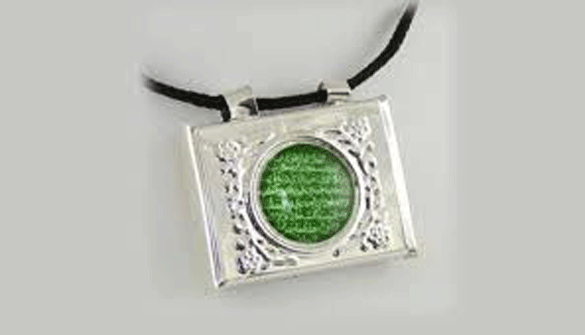
The use of taweez is quite common among Muslims, and many people wear permissible amulets for protection and benefit. The plural of taweez is ta‘wizaat, and in Arabic it is referred to as tamīmah. During the pre-Islamic period (Jahiliyyah), when someone was afflicted by the evil eye, the Arabs would recite certain words over them. As Hazrat ‘Awf ibn Malik al-Ashja‘i narrated:
“We used to practice incantations (ruqyah) during the time of Jahiliyyah. We asked, ‘O Messenger of Allah (peace and blessings be upon him), what is your opinion about this?’ He replied, ‘Present your incantations to me. There is no harm in them so long as they do not contain shirk.’”
(Sahih Muslim)
At times, they would also write something and hang it around a person’s neck; this was called tamīmah.
Muslims are often subjected to all kinds of allegations of shirk. One of the most common accusations is that wearing a taweez (amulet) amounts to shirk. Those who make this claim do not simply describe it as a sin or something impermissible; they go as far as declaring it outright shirk. How casually and easily such grave accusations are made is something I discussed in my previous article.
You have probably come across videos in which certain Wahabi preachers are seen cutting taweez from the necks of Muslims, claiming that they are committing shirk. But is wearing a taweez truly an act of shirk? Or is the matter more nuanced than it is presented? In this article, I will examine this issue in detail.
If a taweez is prepared in the light of the Quran and Hadith, and according to established Islamic principles, then wearing it or keeping it for protection is completely permissible. This is not merely our view or the opinion of a particular scholar; rather, it is proven from the noble Companions (Sahaba) themselves and forms part of their practice.
Let us first see what the Quran says regarding this matter:
“And We send down in the Quran that which is a healing and a mercy for the believers.”
(Surah Bani Isra’il 17:82)
From this verse, it is clearly established that seeking healing (both spiritual and physical) through the verses of the Holy Quran is permissible.
Now let us turn to the statement of the Noble Prophet Hazrat Muhammad (peace and blessings be upon him).
Hazrat Abdullah ibn Amr (may Allah be pleased with him) narrates that the Messenger of Allah (peace be upon him) said:
“When any one of you feels frightened during sleep, he should say:
“أعُوذُ بِكَلِمَاتِ اللَّهِ التَّامَّاتِ مِنْ غَضَبِهِ وَعِقَابِهِ وَشَرٌ عِبَادِهِ, وَمِنْ هَمَزَاتِالشَّيَاطِينِ وَأَنْ يَحْضُرُونِ”
A‘udhu bi kalimatillahi al-tammati min ghadabihi wa ‘iqabihi wa sharri ‘ibadihi, wa min hamazatish-shayatin wa an yahdurun.
Hazrat Abdullah ibn Amr (RA) used to teach these words to his mature children. For younger children who were not yet able to memorize them, he would write these words and hang them around their necks.
(Reported in Sunan Abu Dawood, Vol. 4, p. 141; Sunan Tirmidhi, Vol. 2, p. 972)
It is worth noting that even translations of this narration can be found in books published by those who oppose taweez.
Now, if hanging a taweez around the neck were truly shirk, and this narration exists, then did Hazrat Abdullah ibn Amr (RA) not know this? Did he commit shirk by hanging written supplications around the necks of his children? (Maz’Allah!)
In another hadith, the Messenger of Allah (peace be upon him) said:
“My Companions are like the stars; whichever of them you follow, you will be rightly guided.”
(Mishkat al-Masabih, Hadith no. 5964)
Let us now see what the great scholars of Islam have said on this matter.
Taweez (amulets) generally contain verses of the Holy Quran and the blessed Names of Allah. They are also used in the form of written supplications over which recitations are performed (ruqyah). Therefore, a person who benefits from a taweez is essentially seeking healing through the Quran itself. Undoubtedly, there is healing in the Noble Qur’an. Allah Almighty says:
“And We send down in the Quran that which is a healing and a mercy for the believers.”
(Surah Bani Isra’il 17:82)
This theme is also found in the Hadith. It is narrated from Hazrat Ali (may Allah ennoble his face) that the Messenger of Allah (peace and blessings be upon him) said:
“The best medicine is the Qur’an.”
(Ibn Majah)
Thus, both the Quran and the Hadith affirm that the Quran is a source of healing and mercy for the believers.
The renowned scholar of the 10th century Hijri, Hazrat Mulla Ali Qari, who is widely respected across different schools of thought, writes in Al-Mirqat:
“و ھٰذا أصل في تعلیق التعویذات التي فیھا أسماء اللہ تعالٰی۔”
“This is the basis for hanging amulets that contain the Names of Allah.”
From this statement, it becomes clear that taweez containing the Names of Allah and blessed words are considered permissible. Such amulets are believed to carry a spiritual benefit, and using them for the treatment of illness is regarded as Qur’anic healing.
Hazrat Sayyiduna Ibn ‘Abbas (may Allah be pleased with both of them) narrates:
A group of the noble Companions (may Allah be pleased with them) once passed by a settlement where a man had been bitten by a snake or a scorpion. A person from that settlement came to the Companions and said, “Is there anyone among you who can perform ruqyah (recite and blow for healing)? There is a man here who has been bitten by a snake or scorpion.”
One of the Companions went with him and agreed to perform ruqyah in exchange for some goats. He recited Surah al-Fatihah over the affected person, and through this recitation, the man was cured. The Companion then returned to the group with the goats he had received as payment.
Some of the other Companions disliked this and said, “You have taken payment for reciting the Book of Allah.” When they later came to Madinah, they presented the matter before the Messenger of Allah (peace and blessings be upon him), saying that such-and-such Companion had taken payment for reciting the Book of Allah.
The Prophet (peace and blessings be upon him) replied: “The thing for which you are most entitled to take payment is the Book of Allah.”
(Sahih al-Bukhari, Vol. 2, p. 854)
This hadith indicates that taking compensation for reciting the Quran for healing purposes is permissible.
Imam Ahmad ibn Hanbal narrates that Hazrat Sayyiduna Abdullah ibn Umar used to instruct his adult children to recite the following words before going to sleep:
“Bismillah. A‘udhu bi kalimatillahi al-tammati min ghadabihi wa ‘iqabihi wa sharri ‘ibadihi wa min hamazatish-shayatin wa an yahdurun.”
(In the name of Allah. I seek refuge in the perfect words of Allah from His anger, His punishment, the evil of His servants, and from the whisperings of devils and that they come near me.)
For those children who were young and unable to memorize these words, he would write these supplications and hang them around their necks as a taweez.
(Musnad Ahmad)
Hazrat Sayyiduna Sa‘id ibn al-Musayyib, a famous Tabi‘i (from the generation after the Companions), said that there is no harm in hanging a Qur’anic taweez after wrapping it in a small container or piece of paper.
Similarly, Imam Ibn Sirin did not see any problem in writing verses of the Quran and hanging them around a person’s neck.
(Al-Bahr al-Muhit)
These narrations show that prominent scholars from the early generations of Islam permitted the use of Qur’anic taweez.
According to Imam al-Shafi‘i:
Allama Zarkashi writes that a man once came to Imam al-Shafi‘i complaining of inflammation and redness in the eyes. Imam al-Shafi‘i wrote a taweez for him. When the man wore it around his neck, he was cured.
(Al-Burhan fi ‘Ulum al-Qur’an, Vol. 1, p. 434)
This is the position of our respected senior scholars, who have permitted writing and wearing taweez based on Qur’anic verses and the Names of Allah.
However, it must be clearly stated that going to non-Muslims, magicians, or sorcerers for amulets and charms is strictly prohibited and may even amount to disbelief or shirk. Therefore, one must never go to magicians or disbelievers for such matters.
Taweez are in accordance with the Quran and Sunnah, then seeking treatment through them is not only permissible but is also proven from the practice of the pious predecessors (Salaf).
…
A regular contributor to New Age Islam, Sahil Razvi is a research scholar specialising in Sufism and Islamic History. He is an alumnus of Jamia Millia Islamia.
URL: https://newageislam.com/islamic-q-a/wearing-taweez-shirf-islamic-perspective/d/139058
New Age Islam, Islam Online, Islamic Website, African Muslim News, Arab World News, South Asia News, Indian Muslim News, World Muslim News, Women in Islam, Islamic Feminism, Arab Women, Women In Arab, Islamophobia in America, Muslim Women in West, Islam Women and Feminism