
Defending the Faith: Ahmed Raza Khan Barelvi’s Husamul Haramain and Its Impact on Islam
 By
Syed Amjad Hussain, New Age Islam
By
Syed Amjad Hussain, New Age Islam
20 August
2024
Ahmed
Raza Khan Barelvi's Husamul Haramain (1906) Defends Sunni Orthodoxy, Critiques
Rival Movements, And Influences South Asian Islamic Thought.
Main
Points:
1. Aala
Hazrat'sHusamul Haramain (1906) defends traditional Sunni orthodoxy against
reformist movements.
2. The treatise
critiques Deobandi scholars for perceived heretical views.
3. It condemns the
Ahmadiyya movement's challenge to the Finality of Prophethood.
4. It opposes
the Ahl-e Hadith movement's strict adherence to Hadith.
5. Husamul
Haramain solidified Barelvi beliefs and influenced Islamic scholarship and
practice in South Asia.
----
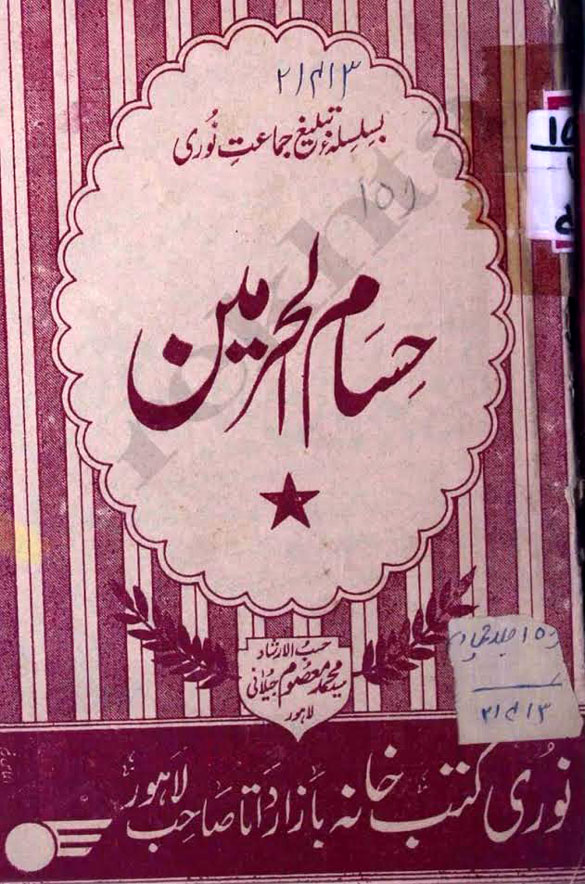 Book published in 1906 by Sahibzada Syed Muhammad Hasan Jilani in
translated into Urdu language from the Arabic.
Book published in 1906 by Sahibzada Syed Muhammad Hasan Jilani in
translated into Urdu language from the Arabic.
-----
Introduction
In the
early 20th century, the religious landscape of British India was marked by
intense theological disputes among Muslim scholars. One of the most significant
and influential figures in these debates was Ahmed Raza Khan Barelvi popularly
known as Aala Hazrat (1856-1921), the founder of the Barelvi movement.
Barelvi’s Husamul Haramain or Husam al-Harmain Ala Munhir Kufr
WalMayn ("The Sword of the Two Holy Mosques to the Throats of
Non-Believers"), published in 1906, played a pivotal role in asserting and
defending traditional Sunni orthodoxy against what he perceived as deviations
from true Islam. This article examines the significance of Husamul Haramain
from the Barelvi perspective, exploring its theological arguments, the broader
implications for Sunni orthodoxy, and its impact on Islamic scholarship and
practice.
The
Barelvi Movement and Its Objectives
The Barelvi
movement, founded by Ahmed Raza Khan Barelvi, emerged as a response to the
growing influence of reformist and heterodox movements within Islam. Barelvi's
primary aim was to safeguard and uphold traditional Sunni practices, including
the veneration of the Prophet Muhammad and the observance of established
Islamic rituals. His teachings emphasized the importance of maintaining
orthodoxy in the face of perceived threats from movements that he considered to
be deviations from true Islam.
The
Genesis of Husamul Haramain
In 1905,
during a pilgrimage to the Holy Cities of Mecca and Medina, Ahmed Raza Khan
Barelvi prepared a draft entitled al-Motamad al-Mustanad ("The Reliable
Proofs"). This document, which later evolved into Husamul Haramain, was
crafted to address what Barelvi saw as serious doctrinal errors and heretical
beliefs propagated by the founders of the Deobandi, Ahl-e Hadith, and Ahmadiyya
movements. Khan’s treatise was based on a consensus of scholarly opinions from
thirty-three Islamic scholars who shared his concerns about the doctrinal
purity of these movements.
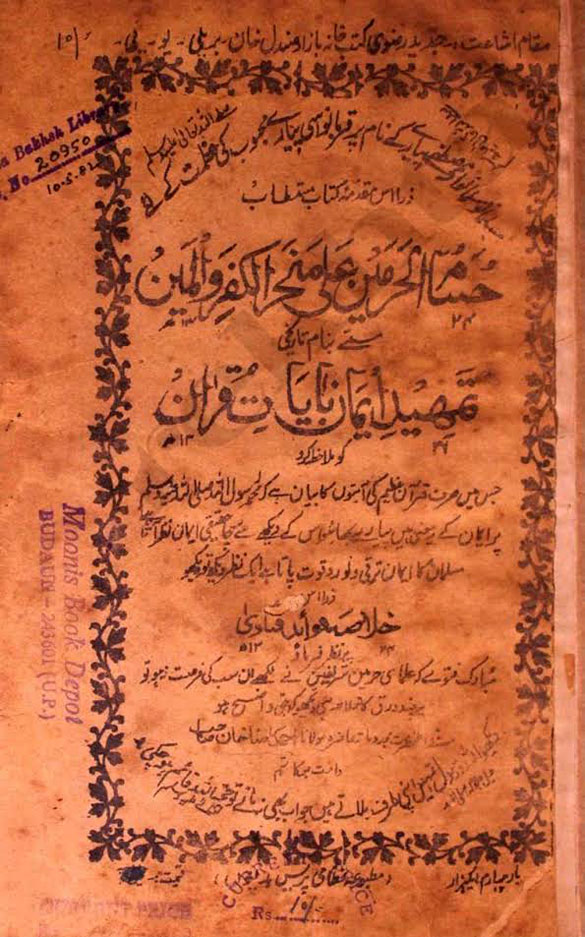 Published in 1918 by Nizami Press, Badaun (urdu language)
-----
Critique
of Deobandi Scholar
In Husamul
Haramain, Ahmed Raza Khan Barelvi accused prominent Deobandi scholars,
including Muhammad Qasim Nanautavi, Rashid Ahmad Gangohi, and Ashraf Ali
Thanwi, of heresy. Barelvi’s critique was grounded in the belief that their
writings contained blasphemous interpretations that undermined core Islamic
doctrines. For instance, he argued that the Deobandi scholars’ positions on
certain theological issues, such as the status of the Prophet Muhammad and the
permissibility of various practices, deviated from established Sunni beliefs.
Rejection
of the Ahmadiyya Movement
Barelvi’s
condemnation of Mirza Ghulam Ahmad Qadiyani, the founder of the Ahmadiyya
movement also known as Qadiyaniyat, was a central feature of Husamul Haramain.
He criticized Mirza Ghulam Ahmad Qadiyani for his claims regarding the Finality
of Prophethood, which Khan deemed a fundamental tenet of Islam. According to
Khan, the Ahmadiyya movement's challenge to this doctrine constituted a grave
breach of Islamic faith, necessitating a strong response from traditional Sunni
scholars.
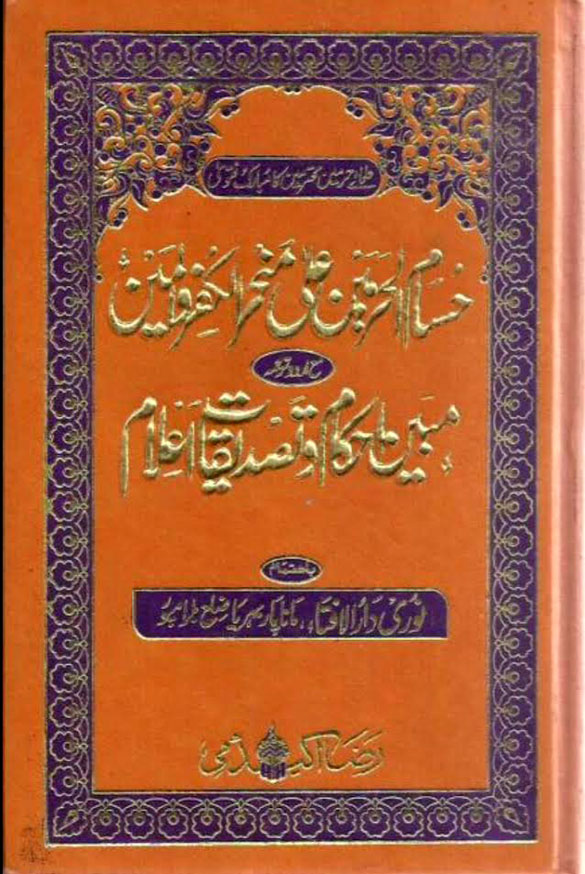 Husamul Haramain in Arabic
-----
Opposition
to Ahl-e Hadith
The Ahl-e
Hadith movement, which sought to return to the practices of the early Muslim
community and reject later innovations, was also a target of Barelvi’s
critique. Khan viewed this movement’s emphasis on a strict adherence to Hadith
and rejection of traditional practices, such as the celebration of the
Prophet’s birth, as contrary to Sunni orthodoxy.
Establishing
Orthodoxy
Barelvi’s
Husamul Haramain played a crucial role in defining and reinforcing Sunni
orthodoxy within the Barelvi movement. By condemning rival movements and
asserting the correctness of Barelvi beliefs, Barelvi sought to preserve
traditional Islamic practices and protect them from what he viewed as doctrinal
threats. The treatise was widely disseminated and translated into multiple
languages, which facilitated its influence across different regions and
communities.
Institutional
Endorsement and Influence
The pledge
of allegiance to Husamul Haramain became a requirement at educational
institutions such as Al-Jamiatul Ashrafia Mubarakpur, reflecting its
authoritative status within the Barelvi tradition. This institutional
endorsement helped solidify Khan’s teachings and ensured their continued
influence within the Barelvi community and beyond.
Broader
Implications for Islamic Scholarship
Barelvi's
work contributed to a broader discourse on Islamic orthodoxy. The debates
initiated by Husamul Haramain underscored the tensions between traditional
Sunni practices and emerging reformist movements, shaping the trajectory of
Islamic scholarship and practice in South Asia.
Conclusion
Ahmed Raza
Khan Barelvi’s Husamul Haramain represents a significant effort to defend and
uphold traditional Sunni orthodoxy against perceived deviations and
innovations. From the Barelvi perspective, the treatise is a cornerstone of
their theological stance, reinforcing the importance of maintaining established
Islamic practices and doctrines. The impact of Khan’s work extends beyond his
time, influencing contemporary discussions on Islamic orthodoxy and sectarian
identity. Through Husamul Haramain, Khan left a lasting legacy in the landscape
of South Asian Islam, highlighting the enduring significance of theological
debates and the defence of traditional practices.
-----
Syed Amjad Hussain is a Bihar-based Author and research scholar on
Sufism. He is affiliated with the Maulana Abul Kalam Azad University of
Technology, West Bengal.
URL:
New
Age Islam, Islam Online, Islamic
Website, African
Muslim News, Arab
World News, South
Asia News, Indian
Muslim News, World
Muslim News, Women
in Islam, Islamic
Feminism, Arab
Women, Women
In Arab, Islamophobia
in America, Muslim
Women in West, Islam
Women and Feminism