
Middle East Press On: Burnham's Pro-Israel, Nakba, West Bank, Gaza’s Food Insecurity, Syrian, Lebanon, Washington, Israeli Genocide, Palestine Activism, Ibrahimi Mosque, Al-Aqsa, New Age Islam's Selection, 29 July 2026

By New Age Islam Edit Desk
29 July 2026
Burnham's pro-Israel-infested cabinet is working for same manager
Settler violence and the new Nakba in the West Bank
The colonial context matters in Gaza’s food insecurity
Why Syrian intervention in Lebanon would be a disaster
Washington’s smartest move is to keep Israel out of the war
Complicity In Plain Sight: The West’s Scarlet Letter of Indifference
Report Warns Gaza’s Mothers Face ‘Reproductive Violence’ under Israeli Genocide
‘The Central Cause of Her Life’: Ben Affleck Honors Mother’s Palestine Activism
The Ibrahimi Mosque Precedent: Why Palestinians Fear for Al-Aqsa
------
Burnham's pro-Israel-infested cabinet is working for same manager
by Ömer Ekrem Keçeci
Jul 29, 2026
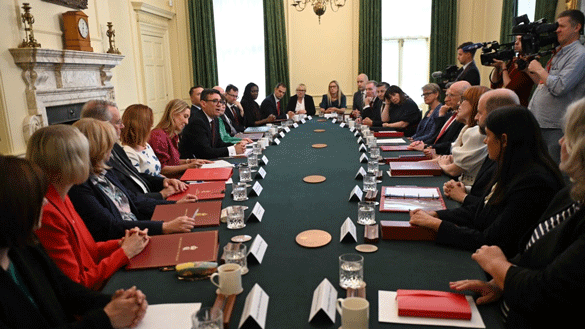
The United Kingdom's new Prime Minister, Andy Burnham, has assembled a cabinet in which approximately 40%, including himself, are directly linked to the Labour Friends of Israel (LFI) lobby, which works for Israel. LFI's former director, David Mencer, is now the Israeli government spokesperson. Those with indirectly apparent pro-Israel ties comprise almost all of them.
The cabinet also includes individuals involved in the most blatant and indefensible crimes, such as voting for the invasion of Iraq. Burnham himself not only voted for the Iraq invasion in 2003, but even in 2015 he argued that those who made that decision deserved respect.
Ministers with plenty of sins
Many individuals who held ministerial or senior positions during the former Prime Minister Keir Starmer's era are also serving in the Burnham government.
John Healey, whom Burnham made Chancellor of the Exchequer, was Secretary of State for Defense under Starmer. Under Healey, Royal Air Force aircraft flew surveillance missions over Gaza. The type of intelligence shared while Israel continued its genocide remains a matter of debate. Healey also voted for the invasion of Iraq in 2003.
Another person who voted for the Iraq invasion and served in both the Starmer and Burnham governments is Yvette Cooper, the current Secretary of State for Health and Social Care. She is both a member of LFI and someone funded by the Israel lobby. One of Cooper's most controversial actions while she was Home Secretary was spearheading the designation of Palestine Action as a terrorist organization. While she couldn't offer even empty words against Israel's genocide, this decision, which led to the arrest of hundreds of people protesting to stop the oppression, remains one of the biggest stains on Cooper and those who supported the decision.
As a side note, the organization that began a campaign to ban Palestine Action was We Believe in Israel, which Labour lawmaker Luke Akehurst used to be director of, and the current director is Ido Dimri, who served as Chief of Staff to Israeli minister Amichai Chikli.
Let us continue with Douglas Alexander, who has served as Secretary of State for Scotland across both administrations. He was also one of the supporters of the Iraq invasion. Shortly after being appointed Shadow Foreign Secretary in 2011, Alexander visited Israel with the LFI, aiming to strengthen bilateral relations between the country and the Labour Party. Speaking at an LFI event in 2013, he asserted that Israel’s existence should be celebrated as a progressive cause, denounced the boycott movement, and advocated for stronger ties. In 2025, as Trade Minister, he accused Hamas of “barbarism” and defended the continuation of trade with Israel.
Diana Johnson, who was vice-chair of LFI in 2020, was appointed Minister of State by Starmer, and Burnham kept her in the position. She is known for opposing anti-Zionism and boycotting Israel in an article published in an Israeli newspaper.
Another vice-chair of LFI, Jo White, has become Parliamentary Under-Secretary of State in the Home Office.
Secretary of State for Education Lucy Powell is another member of LFI. Recently, she rightly criticized the X platform. However, her call for restrictions on social media for political expediency has led to criticism that she is targeting free speech.
Speaking of social media regulation, Lisa Nandy deserves special mention. Nandy, who served as Secretary of State for Digital, Culture, Media and Sport during the Starmer administration, continues in her role under Burnham. The regulation in question is directly her responsibility. However, Nandy chose to simply complain and then leave the X platform that she is supposed to regulate.
Defense Minister Wes Streeting is also known for receiving donations from LFI and for acting in ways that please Israel in parliamentary votes or signature campaigns. Starmer had also appointed him as a minister. Upon taking office, like Burnham, he made a few statements that displeased the Zionists. It must be known that one of the most important issues for Israel is being able to continue its genocide and wars. As long as they do not hinder their fundamental goals, the Zionists will tolerate some words and minor actions taken by politicians to appease their people and keep their reactions under control.
Johnson, White, Powell, Nandy, and Streeting all favored designating Palestine Action as a terrorist organization, but opposed imposing sanctions on Israel.
Zionist Jews in government
The cabinet also includes Jewish Ed Miliband. Having held various ministerial or shadow ministerial roles since the Tony Blair era, Miliband was also the leader of the Labour Party from 2010 to 2015. He served as Energy Minister under Starmer and is now Foreign Secretary.
At an LFI event in 2011, he stated: “I’m grateful to Israel, I respect Israel, I admire Israel... I will ensure that the Labour party remains a strong and steadfast friend of Israel.”
After everything came to light, Miliband had made somewhat critical statements about the Iraq invasion while vying to become Labour leader, although he didn't show any opposition to it when it was about to start. However, his first foreign visit after becoming leader was to Afghanistan in 2011, where he addressed troops and supported all combat operations there until the end of 2015. That same year, Miliband also fully supported NATO's bombing of Libya.
Besides Miliband, some other Jewish ministers from the Starmer administration continue in their roles in the Burnham government. One of them, Minister of Courts and Legal Services Sarah Sackman, was raised within a Zionist youth movement. While she did not support sanctions against Israel, she voted to designate Palestine Action as a terrorist organization. Her grandfather, Solomon Seruya, was close to Shimon Peres and served as Israel's ambassador to the Philippines. Another is Minister for School Standards Georgia Gould, an ally of the Jewish Labour Movement, which identifies itself as Zionist.
When discussing Jews in governmental offices, Baroness Gillian Merron must also be mentioned. As the current Parliamentary Under-Secretary of State for Women's Health and Mental Health, she has held various ministerial positions since the Tony Blair era. In 2003, she voted for the invasion of Iraq. In 2009, her name was involved in the U.K. parliamentary expenses scandal: the widespread misuse of allowances and expenses permitted to members of Parliament. Telegraph's disclosure was “Gillian Merron claims £4,200 for food in one year. Bills taxpayer for £1,200 worth of furniture and rugs, and more than £1,700 of electrical goods including new washer dryer and hundreds of pounds of household items.”
Jewish Baroness Ruth Anderson is also among those who remain in the ministry with Burnham. She is also a member of the LFI, known for her statements in the House of Lords in 2024 supporting the use of British troops alongside Israel against Iran. And there's the Jewish Lord Mike Katz. He describes himself as a proud Zionist and expresses his satisfaction with the growing number of Zionists in Labour.
The examples could be multiplied. Almost every name has a similar story. Those responsible for initiating an invasion based on lies, causing the deaths of millions, wasting billions of dollars, and leaving behind ongoing problems, should have had their political careers ended. Furthermore, those who misused their funds and have not made significant accomplishments should not have been given new positions. Yet, despite their egregious sins, these individuals continue to rise and hold leadership positions. At the same time, Jews who opposed Israel's atrocities in Palestine were expelled from Labour a few years ago.
It is abundantly clear that those who take steps that serve Israel, even at the expense of the British, are rewarded in U.K. politics. The power that enables this, just as it pushed through the Iraq decision yesterday, is today trying to control the rising opposition to genocidal Israel, ensuring that the British state remains an accomplice to the Zionists. Ultimately, the Burnham government is merely a substitute player, brought on to replace a worn-out counterpart in a corrupt team where those who belong in prison are instead made ministers, lords and barons.
Success on minor problems?
But can Burnham, who demonstrated his adherence to the typical “British resources and decisions are for Israel” mentality by forming his own government with aforementioned people and immediately deciding to open U.K. bases for the use of the United States, make a difference in the smaller issues facing the public? His records present clues.
Since I touched upon the hospital and police scandals in my June 25 article, I will address other issues to avoid repetition:
Burnham has made numerous statements over the years regarding the country's alcohol problem. However, his strategies have been criticized as inadequate. According to the Manchester Evening News, in Greater Manchester, where he served as mayor, alcohol-related deaths continued to rise, exceeding the U.K. average. Now, his close political ties to champions of the alcohol industry have come to light, along with promises to reduce taxes on pubs by 20% and lift the ban on drinking for football fans.
Again, with reference to the Manchester Evening News and to Spectator Australia, in 2017, when he became the mayor, he pledged to eradicate rough sleeping from the streets by 2020. By the end of his first year, it had increased by 44%. He reduced the numbers at one point; they steadily increased in his final years in office, resulting in a complete failure of his promise. Now, he claims they're going to end rough sleeping in the whole country.
In 2016, he pledged “to buy out the absent private landlords who have barely ever been to Greater Manchester and use these properties for the public housing stock.” According to Simply Business, he couldn't deliver this, although he drove a 43% increase in fines on rogue landlords.
Now, Angela Rayner, who was forced to resign as Starmer's minister due to controversy over not paying tax on a property, but whom Burnham controversially appointed Housing Minister, has announced that the government will not implement rent controls. This has been seen as breaking a promise and has drawn considerable criticism. Rayner is known for receiving funding from the Israeli lobby, opposing boycotts of Israel, and, like the vast majority of Labour, voting against an immediate ceasefire in Gaza in 2023.
Although Burnham’s economic program, dubbed "Manchesterism," is acknowledged for its potential to deliver stronger foundations, it has faced criticism that it will fall short and fail to achieve significant success, particularly by drawing parallels to Scotland, where a similar approach was implemented. Reports indicate that even some of Burnham’s allies harbor doubts about his readiness for the role.
Labour's defeat in the general election is almost certain, as is the growing weariness with Israel's prolongation of the war. This government may try to appear somewhat more pro-Palestinian than its predecessor, feeling compelled to do so. However, what they will do will sometimes be the opposite, and sometimes not be satisfactory, neither on this major issue nor on the various domestic problems. A player's capabilities are more or less predictable. It's pointless to expect prime Salah-level performance from the average Israeli footballer, especially when considering the stark differences in their jerseys and objectives.
https://www.dailysabah.com/opinion/op-ed/burnhams-pro-israel-infested-cabinet-is-working-for-same-manager
-------
Settler violence and the new Nakba in the West Bank
July 29, 2026
by Sayid Marcos Tenorio
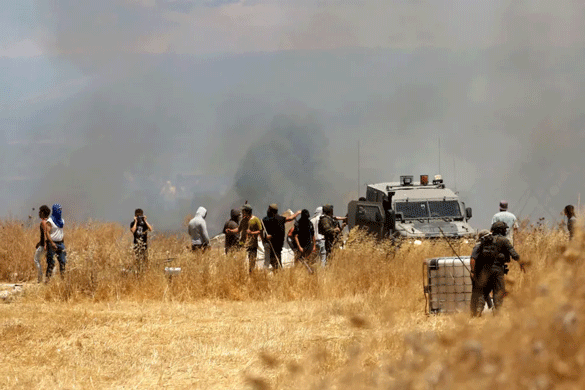
The events unfolding in the occupied West Bank can no longer be understood merely as a succession of settler attacks or isolated outbreaks of violence.
What is taking shape is a systematic pattern of territorial domination that combines settlement expansion, increasing militarisation, the forced displacement of Palestinian communities and the gradual transformation of the territory’s demography.
The Arabic word Nakba—”catastrophe”—is commonly associated with the forced displacement of approximately 750,000 Palestinians during the establishment of the State of Israel and the destruction of more than 450 Palestinian towns and villages.
Increasingly, however, historians and scholars view it not as a historical event confined to the past, but as an ongoing process of territorial dispossession, social fragmentation and demographic replacement.
From this perspective, the West Bank has become the principal arena in which a new territorial reality is being gradually imposed at the expense of the Palestinian presence.
This framework allows us to understand the recent escalation as something far more significant than a rise in violent incidents. Attacks on villages, the burning of homes and olive groves, the destruction of property, the killing of civilians, land confiscation, road closures and the expansion of settlement outposts cease to appear as disconnected episodes.
Instead, they reveal a coherent mechanism for transforming the occupied territory. Violence is not an aberration of the occupation; it is one of its principal instruments.
From this perspective, Israeli settlements are not merely residential developments but the central political infrastructure of the contemporary colonisation of Palestine.
Over recent weeks, the West Bank has witnessed a particularly alarming acceleration of this process. As armed settlers intensify attacks on Palestinian villages, the Israeli military has significantly expanded its presence throughout the occupied territory.
The combination of settler violence and military reinforcement forms part of a broader strategy designed to consolidate settlement expansion while creating the conditions for the gradual displacement of the Palestinian population.
International organisations have documented a sharp increase in settler attacks, the destruction of Palestinian property and the displacement of entire communities, particularly in Area C of the occupied West Bank.
In numerous cases, Israeli forces have been accused of either standing by during settler assaults or acting in coordination with them, reinforcing allegations of institutional complicity and of the use of civilian violence as a complementary instrument of military occupation.
In other words, the objective is not merely to control land, but to redefine who will be able to inhabit it.
Drawing parallels between today’s reality and the Nakba of 1948 does not suggest that history is simply repeating itself. The original Nakba unfolded amid the war surrounding the establishment of the State of Israel.
Today, the process operates through more gradual mechanisms sustained by permanent military occupation, colonial expansion, everyday settler violence and the deliberate deterioration of living conditions in Palestinian communities.
The methods have changed, but the underlying logic of creating irreversible facts on the ground remains unmistakably recognisable.
It is perhaps this transformation in methods that makes the process more difficult to identify. Because there is no single moment of rupture, the violence is often perceived as a series of disconnected crises.
The real question, therefore, is no longer whether there is a “new Nakba”.
A more accurate conclusion may be that the Nakba never ended. As long as settler attacks, settlement expansion, military protection and forced displacement continue to operate in concert, the line separating episodic violence from a sustained policy of colonisation becomes increasingly blurred.
Failing to recognise this dynamic risks acknowledging only in retrospect a historical process whose defining features are already visible across today’s occupied West Bank.
https://www.middleeastmonitor.com/20260729-settler-violence-and-the-new-nakba-in-the-west-bank/
-------
The colonial context matters in Gaza’s food insecurity
July 28, 2026
by Ramona Wadi
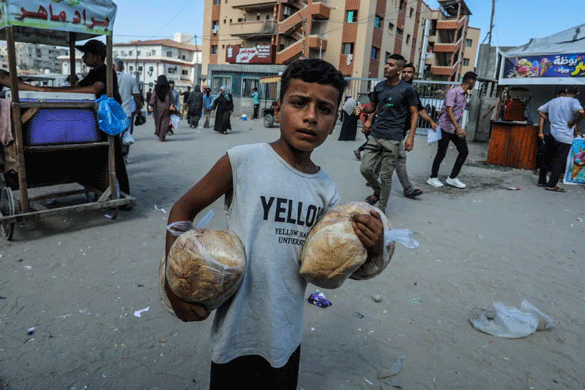
A joint press release by the Food and Agriculture Organisation (FAO), UNICEF and the World Food Programme (WFP) gave an overview of the current food insecurity in Gaza, exacerbated in recent years by Israel’s genocide. “There is progress on food security in Gaza, but it is fragile and can easily be reversed,” the WFP Acting Executive Director Carl Skau stated.
Of course, in the press release, Israel’s genocide was not mentioned. Neither were colonialism and military occupation. Food insecurity in Gaza is a result of various forms of colonial violence.
The insufficiency of provision is also a direct consequence of colonial violence.
Warnings about food insecurity should encompass the entire trajectory. FAO Director General QU Dongyu noted that “Restrictions on agricultural imports and humanitarian supplies must be lifted.” True, but by who? The ambiguity of such statements only generates more impunity and, as a result, the possibility of perpetual food insecurity, which was already a reality for Palestinians before the genocide.
UNICEF’s Executive Director Catherine Russell also warned about the long-term consequences of food insecurity when humanitarian aid is fragile due to insufficient funding. Progress, Russell stated, “rests on a supplementary feeding program that doesn’t reach all children, and where funding is running out.” Again, the politics of colonialism and funding are crucial to this understanding. While it can be argued that the point of the press release was to impart the impact of food insecurity, the trend across international organisations is to never tackle the root problem. And incomplete narratives give an incomplete picture of how aid organisations are also embroiled in the politics of colonialism and humanitarian aid.
“FAO, UNICEF, and WFP stress that sustained peace, safety and security are essential to enable people to return to their farms, businesses and communities and to begin rebuilding their lives,” the press release partly states. The politics dictate that sustained peace, safety and security for Gaza will remain unreachable. Almost three years since the start of Israel’s genocide, Palestinians are still forcibly displaced while world leaders are still debating their role and relevance in relation to Gaza. Humanitarian aid is a small fragment of the entire equation, despite efforts to make the paradigm look more significant.
Will Palestinians be allowed to return to their land, or will the international community persist in supporting the colonial expansion scheme which the US Board of Peace allowed for Israel? In the context of military occupation and plans for colonial settlements in Gaza, how can food security be achieved? If Israel maintains the Palestinian people’s forced displacement, how can Palestinians enjoy sustainability? Recommendations to prevent food insecurity should not use terminology without context. Colonialism does not allow sustained peace, safety and security, so why is colonialism not mentioned as the reason behind food insecurity for Palestinians?
https://www.middleeastmonitor.com/20260728-the-colonial-context-matters-in-gazas-food-insecurity/
-------
Why Syrian intervention in Lebanon would be a disaster
Dr. Dania Koleilat Khatib
July 28, 2026
US President Donald Trump has bluntly signaled, several times, that he would encourage a military intervention in Lebanon by the forces of Syrian President Ahmad Al-Sharaa. His logic seems to be that in the same way Al-Sharaa’s forces succeeded in toppling Bashar Assad and his regime in Syria, who had support from Hezbollah fighters, they could also defeat Hezbollah in Lebanon. However, any Syrian intervention in Lebanon would be disastrous, with an even worse outcome than the decades-long military occupation by the former Assad regime.
Al-Sharaa has stated clearly he has no intention of ordering any aggressive action in Lebanon; he said during a recent TV interview that he wants to help the country but not through military intervention. Still Trump continues to suggest it. Al-Sharaa’s forces are working hard to ensure Syria’s borders are protected and there is no flow of arms through the country to Hezbollah. However, there is a big difference between doing that and taking the fight to the group in Lebanon.
To begin with, post-Assad Syria does not yet have a solid, fully fledged army. Its armed forces are still in their infancy; it is more a group of military factions that constitute the start of a project to build a future conventional army. The immediate aim is to deploy those forces to exert the authority of the new state over all of Syria — a significant challenge in itself, given the current situation and capabilities. To also attempt to expand into military action in a neighboring country would be a huge stretch. However, it is difficult for Al-Sharaa to respond to Trump with a straight “no.” The new authorities in Syria need the support of the US. No economic development can happen unless international sanctions are lifted permanently. Therefore, Trump has the upper hand.
The US president has suggested Al-Sharaa’s forces could do a better job of finishing off Hezbollah than Israel has managed, and so he should order them into Lebanon. Al-Sharaa has no intention of doing so, however; his main priority as far as Lebanon is concerned is to ensure it does not become a nuisance to the new Syrian regime. This potentially problematic issue was skillfully resolved by Turkiye. There had been talk of Hezbollah harboring former Assad officers and plotting to destabilize the new regime in Syria, for example. The Turks skillfully neutralized this threat.
Al-Sharaa, meanwhile, initially demanded that the Lebanese government hand over Hezbollah operatives who had committed crimes in Syria, a stance that risked reinforcing divisions in Lebanon. He subsequently dropped the demand, as Turkiye continues to act as moderator to ensure Hezbollah does not pose a threat to Syria, or vice versa.
If Syrian forces did enter Lebanon, it would open old wounds; many Syrians fought against Assad’s army and its allies, and are unlikely to soon forget the brutality of Hezbollah’s fighters in Syria; the crimes committed against the Syrian people during the long civil war; the siege of Madaya and Zabadani in 2015, where children and the elderly died as a result of lack of food and medicine; being driven from their homes in Al-Qusair; or the crimes in Deir Ezzor, Daraa, Qalamoon, and even in Damascus. Al-Sharaa has said that states cannot be built on revenge. However, it might be difficult to convince the average soldier, especially if he had been personally affected by Hezbollah’s brutality.
Meanwhile, Trump’s logic, that Al-Sharaa’s forces would do a better job of defeating Hezbollah than Israel, does not take into account the social and confessional mix in Lebanon. It would spark a Sunni-Shiite clashes that until now have been avoided. Many Lebanese neighborhoods have a mix of Sunni and Shiite residents, and any intervention of the type Trump suggests would lead to increasing polarization. In December, when opposition groups took to the streets of Lebanon to celebrate the first anniversary of the fall of the Assad regime, violent clashes took place in the south, in Saida, and in the north, in Bab Al-Tabbane, and other places.
What if Syrian forces marched into Lebanon to confront Hezbollah? It is very likely that Lebanese Sunnis would side with Al-Sharaa, creating friction with their Shiite fellow citizens. A Syrian intervention in Lebanon is widely rejected, then, not only by Al-Sharaa but by most Lebanese factions. There are some who would welcome it, however, even if indirectly.
Charles Jabbour, the head of outreach and media relations with the Lebanese Forces political party, said in a message posted on social media platform X that to prove himself to the US, Al-Sharaa should take action to end Hezbollah’s presence along the border between Lebanon and Syria. However, the head of the Lebanese Forces, Samir Geagea, said in a newspaper interview that the party did not support any such intervention and Lebanese officials would not ask Syria to intervene.
Nevertheless, some view an intervention by Syria as potentially the most effective way to finish off Hezbollah, despite the unrest that might follow any such development. Israel would certainly be very happy to see Hezbollah bogged down by internal unrest. Their only concern would be Al-Sharaa’s close relationship with Ankara; the last thing Israeli authorities would want to see on their border is a force they would consider a Turkish subordinate.
Regardless of the potential challenges and negative consequences, Trump does not seem inclined as yet to drop his request for Al-Sharaa to intervene in Lebanon. While Syria is not in a position to respond to the White House with an outright “no,” Al-Sharaa might consider floating a few demands as a prerequisite to any official response to Trump.
This might buy some time for Al-Sharaa, but eventually there will need to be an alternative solution that can be offered to Trump. This is where input from other countries in the region should come in, to help develop an executable plan. The alternative would be regional forces that will stabilize Lebanon and create a buffer between Israel and Hezbollah.
https://www.arabnews.com/node/2652623
-------
Washington’s smartest move is to keep Israel out of the war
Hani Hazaimeh
July 28, 2026
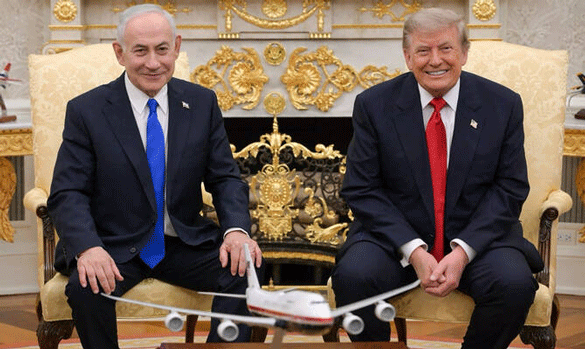
As tensions between the US and Iran continue to escalate, Washington faces a strategic choice that could determine whether the current confrontation remains a limited military operation or evolves into a broader regional conflict.
At the heart of that decision lies one crucial question: Should Israel become a direct participant in the war?
The answer, from both a military and political perspective, should be no.
For all the strength of the US-Israeli alliance, involving Israel directly in military operations against Iran would fundamentally alter the nature of the conflict. What is currently framed as a confrontation with defined military and strategic objectives could quickly transform into a wider regional war, driven by multiple agendas and increasingly difficult to control. Once that transition occurs, Washington’s ability to dictate the pace, scope, and eventual endgame of the conflict would diminish considerably.
President Donald Trump has consistently demonstrated a preference for maintaining control over escalation rather than allowing events to dictate American strategy. Despite his willingness to use military force when necessary, his approach has generally favored operations with clear objectives over open-ended military campaigns. That strategic discipline would be severely tested if Israel entered the battlefield as an active participant.
Iran has long sought to portray every regional confrontation through the prism of its conflict with Israel. Whenever Tehran faces growing international pressure or military setbacks, it attempts to shift the narrative from its own actions to what it describes as a broader struggle against Israel and its Western allies. Bringing Israel into the current conflict would hand Tehran exactly the political narrative it has spent decades trying to construct.
Instead of defending its own conduct, Iran would be able to recast itself as the leader of resistance against Israel, redirecting attention away from the original causes of the conflict. Such a shift would resonate across parts of the region, energize Iranian-backed proxy groups, complicate diplomatic efforts, and make deescalation significantly more difficult.
The challenge for Washington extends beyond Iran’s propaganda. It also concerns the broader international coalition the US may need if the crisis deepens.
Should Washington seek to build or expand a coalition involving Arab partners, Israel’s direct participation would dramatically increase the political cost for many governments considering joining such an effort. Although several countries have strengthened relations with Israel in recent years, public opinion throughout much of the region remains highly sensitive to military cooperation involving Israel.
Governments that might otherwise support US security objectives could face significant domestic political pressure if the conflict became widely perceived as an American-Israeli war rather than a limited operation addressing specific security threats.
Successful coalitions are built not only on shared military interests but also political legitimacy. The broader the coalition, the stronger its diplomatic credibility and operational flexibility. Introducing Israel into the battlefield risks weakening both. Instead of expanding international support, Washington could find itself narrowing its diplomatic options, while simultaneously strengthening Iran’s political messaging.
The US is primarily concerned with containing escalation, protecting its forces and allies, safeguarding international navigation, and preserving regional stability. Israel’s priorities, while overlapping in many respects, are necessarily broader and more immediate. Israel views Iran not only through the lens of current hostilities but also as a long-term strategic threat involving nuclear ambitions, ballistic missile capabilities, and an extensive network of regional proxies.
Conflating these two agendas would make defining success considerably more difficult. A limited campaign could gradually evolve into a broader military effort aimed at fundamentally reshaping Iran’s regional posture — an objective carrying far greater risks and uncertain outcomes.
Fortunately for Washington, there is little indication that Israel is likely to disregard US preferences under current circumstances.
The strategic relationship between the US and Israel is built on an extraordinary level of military coordination, intelligence sharing, technological cooperation, and political consultation. While Israel retains complete sovereignty over its national security decisions, major military operations of regional significance rarely occur without close coordination with Washington.
Given that level of strategic dependence, Israel is unlikely to launch a major campaign against Iran contrary to American wishes so long as Israel itself remains outside the conflict.
There is, however, one scenario capable of changing that calculation almost overnight.
If Iran were to launch a direct attack against Israel — even a single missile or drone strike that successfully reaches its target — the crisis would move beyond Israel’s accepted threshold of deterrence. At that point, Israeli leaders would almost certainly conclude that failing to respond decisively would undermine the credibility of Israeli deterrence.
Such a response would likely involve several days of sustained military operations, including extensive airstrikes against Iranian military infrastructure and potentially targeted assassinations of senior commanders responsible for the attack. The objective would be to restore deterrence quickly and convince Tehran that any direct attack on Israel carries unacceptable costs.
While such retaliation would be entirely predictable from Israel’s perspective, it would also dramatically expand the conflict and significantly reduce opportunities for diplomatic containment.
Wars rarely expand because of careful planning. More often, they grow because political leaders fail to recognize the consequences of introducing additional actors whose priorities differ from their own. Every new participant adds another set of political calculations, military objectives, and domestic pressures, making escalation increasingly difficult to reverse.
The US still enjoys an important strategic advantage: It largely controls the tempo and direction of the current crisis. Preserving that advantage requires resisting decisions that unnecessarily broaden the theater of operations or blur the distinction between American strategic goals and Israel’s legitimate, but distinct, security concerns.
If Washington’s objective is to contain Iran, preserve regional stability, maintain international support, and avoid another prolonged Middle Eastern conflict, then keeping Israel outside the direct theater of war is not merely a tactical choice — it is a strategic necessity.
https://www.arabnews.com/node/2652622
------
Complicity In Plain Sight: The West’s Scarlet Letter of Indifference
July 29, 2026
By Dr. M. Reza Behnam
The architecture of international justice was built upon a single uncompromising promise: never again. It was forged in the ashes of 20th-century atrocities, with the solemn vow that regardless of station in life, wealth, or power, no one is above the law. Today, that pledge is on the verge of collapse.
When global tribunals and human rights investigators document mass atrocities and expose the smoking ruins of bombed-out neighborhoods across Gaza, the response of the international community acts as an ultimate crucible. It is forced to decide: will international law stand as an immutable universal standard or collapse into a hollow instrument for the weak and an impenetrable shield for the powerful?
Granting absolute impunity to Israeli political and military leaders responsible for the agony inflicted upon the Palestinians in Gaza and the occupied West Bank has turned international jurisprudence into a grotesque farce and has reduced the sacred concept of universal justice into a depressed illusion.
The West has, for decades, championed the rules-based international order narrative. International courts have routinely issued warrants and pursued political and military leaders from developing nations and war-torn regions. That commitment mysteriously evaporates when the spotlight is shone on those backed by the West, exposing the selective enforcement that hobbles universal justice.
The issuance of arrest warrants by the International Criminal Court (ICC) for high-ranking Israeli officials—with charges ranging from the weaponization of starvation to systematic civilian targeting—marked a litmus test for global stewardship. Yet, political figures in Western capitals continue to offer safe harbor, exemptions, and political insulation to perpetrators.
This blatant double standard has created catastrophic precedents, including:
The rule of might over right: It telegraphs to those in power, and aspiring autocrats, that mass violence is permissible, as long as you possess the “right” geopolitical alignment.
The erosion of credibility: International law loses its moral authority when it is enforced selectively, transforming from an instrument of justice into a political tool.
The normalization of atrocity: Each day that the perpetrators of genocide walk free, the threshold of what humanity accepts shifts downward, gradually eroding the collective conscience of the international community.
The fact that Israeli leaders wanted by the ICC can travel safely to the United States exposes an ugly structural gap in which domestic power collides with human rights law.
The United States is not a party to the Rome Statute; it, therefore, conveniently maintains no legal mechanism to enforce Hague-based warrants. Washington relies on traditional doctrines of head-of-state and diplomatic immunity, along with domestic laws like the 2002 American Service-Members’ Protection Act (also known as the Hague Invasion Act), designed to protect US military and elected officials from detention and criminal prosecution by the ICC.
Inevitably, when geopolitical calculations override universal human accountability, international borders become nothing more than a welcome mat for war criminals. Those responsible for the atrocities—from the indiscriminate booby-trapping of communications devices across Lebanon to the ruthless leveling of Gaza and Beirut—remain untouched by justice.
The horrific number of Palestinians killed and starved in Gaza represents more than a humanitarian crisis; they are a monument to the failure of the West.
To wave away warrants issued by international bodies in the name of political alliances is to declare that human lives have variable value, depending on their passport.
Humanity cannot afford a system in which international law bends to accommodate political convenience. Justice delayed or denied to the victims in Gaza echoes as injustice to victims everywhere.
Without enforcement, laws against genocide and war crimes are nothing more than ink on paper. Security and lasting peace can never be built on a foundation of unpunished crimes and selective justice.
Despite widespread global criticism and condemnation, Israel has managed to remain exempt from international punitive sanctions and legal consequences for its prolonged and current violations of international and humanitarian law in Gaza, the occupied West Bank and Lebanon.
To understand why Israel’s actions have not been met with concrete measures such as economic and diplomatic sanctions and an arms embargo, we must move past simplistic narratives of political manipulation.
It is important to recognize the deeply entrenched institutionalized convergence of US and Israeli economic and military interests honed over decades. This powerful nexus—aggressively championed by influential lobbies like the American Israel Public Affairs Committee and the Christian Zionists—has framed Israel as an indispensable Western sentinel. Far from a passive pawn, this formidable alliance has vaulted Israel into a position of unmatched power in Washington, while granting the United States an unyielding military bridgehead in the fiercely contested resource-rich Middle East.
For Washington and Western capitals, backing Israel has long been treated as an article of faith tied to Cold War containment policies, intelligence sharing and a guilt-driven commitment, stemming from the Nazi Holocaust. Consequently, this relationship has created a dynamic in which shielding Tel Aviv from diplomatic censure and sanctions has taken precedence over their commitment to the rules-based legal system and long-term stability in the region.
Ultimately, the leverage Israel commands has been self-reinforcing. US administrations have invested a great deal of political capital into the narrative of an “unbreakable alliance” that challenging it has become domestically radioactive, trapping each administration in a state of compliance to Zionism and Zionist whims.
The question that figures prominently is: Will there ever be a Nuremberg for Israeli political and military leaders?
That Israel has escaped legal reckoning for its horrific crimes against humanity exposes a profound crisis not only in the execution of international law, but in our collective understanding of what the laws of justice and norms of decency demand. Tel Aviv’s three years of terror in Gaza have put to rest the myth of an impartial international justice system.
However, the United Nations’ documentation of mass atrocities, ICC arrest warrants, legal proceedings and historic rulings of the International Court of Justice have branded Israel’s current leaders with a permanent Scarlet Letter. They have been effectively confined to a shrinking circle of safe-haven states, transforming their global travel into a high-stakes legal gauntlet. Although the masterminds of Gaza’s destruction may never see the inside of a prison cell, their historical crimes will never be forgotten nor forgiven.
The catastrophic devastation of Gaza and daily massacre of Palestinians demand immediate international ownership and moral reckoning. When state-sponsored terror is met with impunity, foundational human rights are irrevocably eroded, creating a dangerous precedent that normalizes the destruction of civilian populations
True justice demands preemption, not postmortem penalties. Dismantling the structure of impunity and deterring repetition—the “never again”— of such horrendous violence against an embattled people is an urgent imperative for the present and the future.
https://www.palestinechronicle.com/complicity-in-plain-sight-the-wests-scarlet-letter-of-indifference/
--------
Report Warns Gaza’s Mothers Face ‘Reproductive Violence’ under Israeli Genocide
July 29, 2026
‘Reproductive Violence’
A new report has warned that Israel’s ongoing genocide in the Gaza Strip is inflicting catastrophic harm on pregnant women, breastfeeding mothers, and newborns, leaving pregnancy increasingly dependent on “luck rather than care.”
Published by the UK-based Palestinian Return Centre (PRC), the report, Pregnancy Under Fire: Reproductive Violence and the Destruction of Maternal Life in Gaza, draws on data from United Nations agencies and international humanitarian and medical organizations to document what it describes as the systematic destruction of maternal healthcare in the besieged enclave.
According to the report, the consequences of the genocide will extend far beyond the current military assault, with malnutrition, forced displacement, and psychological trauma likely to shape the health and development of an entire generation of Palestinian children.
A War that Begins before Birth
The report argues that the impact of Israel’s military campaign reaches into the earliest stages of life, affecting children before they are even born.
Thousands of pregnant women, it says, are carrying pregnancies under conditions of repeated displacement, bombardment, hunger, and the near-total collapse of healthcare services.
Citing figures from the United Nations Population Fund (UNFPA), the report projects that approximately 55,000 pregnant and breastfeeding women in Gaza will face severe malnutrition by mid-2026—more than three times the estimated 17,000 recorded a year earlier.
It also notes that one in every five babies born in Gaza is now either premature or underweight.
Maternity Services in Collapse
According to the report, Gaza’s maternity care system is in a state of “functional collapse.”
Of the Strip’s 37 hospitals, only 20 remain partially operational, and none is functioning at full capacity because of repeated attacks, fuel shortages, and the lack of medicines, blood supplies, and essential medical equipment.
As a result, many women are forced to give birth without anesthesia, skilled medical assistance, or basic sanitary conditions, often inside overcrowded displacement shelters or makeshift facilities.
“The line between survival and death has never been thinner,” the report states.
Malnutrition Threatens Mothers and Infants
The report identifies maternal malnutrition as one of the gravest threats facing women and newborns.
According to data from Save the Children cited in the study, 323 of 747 women screened during the first half of July were found to be malnourished—nearly half of those examined.
It also references a Médecins Sans Frontières (Doctors Without Borders) study following 201 mothers whose babies required neonatal intensive care between June 2025 and January 2026.
More than half of those women had suffered from malnutrition during pregnancy.
Among their infants, 90 percent were born prematurely, 84 percent had low birth weight, and mortality was twice as high as among babies born to adequately nourished mothers.
Long-Term Consequences
Beyond the immediate physical dangers, the report warns that the psychological effects of constant bombardment, displacement, bereavement, and hunger may have lifelong consequences.
It notes that prolonged exposure to severe stress during pregnancy can interfere with fetal development, potentially affecting children’s neurological, physical, and emotional health well into adulthood.
“The violence being inflicted today is being converted into biological harm that could follow children for life,” the report argues.
Echoing UN Warnings
The findings reinforce repeated warnings issued by the United Nations Population Fund, which has said that women and girls across the occupied Palestinian territory are facing rapidly deteriorating conditions due to the humanitarian crisis, movement restrictions, escalating violence, and chronic funding shortages.
UNFPA has repeatedly warned that the collapse of reproductive healthcare in Gaza is placing tens of thousands of women and newborns at immediate risk, while threatening the long-term health and resilience of Palestinian society.
The PRC report concludes that the destruction of maternal healthcare in Gaza is not simply a humanitarian emergency but a form of reproductive violence, with consequences that will continue to unfold long after the bombs stop falling.
https://www.palestinechronicle.com/report-warns-gazas-mothers-face-reproductive-violence-under-israeli-genocide/
-------
‘The Central Cause of Her Life’: Ben Affleck Honors Mother’s Palestine Activism
July 29, 2026
‘Central Cause’
Oscar-winning actor Ben Affleck has revealed that advocacy for the Palestinian people was “the central cause” of his late mother’s life, describing the suffering and injustice endured by Palestinians as her deepest source of distress.
Affleck shared the tribute in a private message to acclaimed Palestinian poet and writer Mosab Abu Toha, who had contacted him following the death of Chris Affleck.
Abu Toha later published the actor’s response on Instagram as part of a wider tribute to Chris, whom he described as a beloved friend and a steadfast supporter of Palestine.
“It’s a great pleasure to hear from you. You meant a great deal to mom,” Affleck wrote, adding:
“I very much appreciate the kind words and want to reaffirm that the central cause of her life — and the most meaningful cause of distress to her — was the suffering and injustice caused to the Palestinian people.”
Affleck added that Abu Toha’s message would have meant a great deal to his mother.
“I also know she would have wished no further heartbreak on you, and wished you only love and support,” he wrote. “Thank you for writing. It means a great deal to me.”
A Life of Activism
Chris Affleck died in early June at the age of 83, although news of her death only became public several weeks later.
A Harvard-educated elementary schoolteacher, she spent nearly four decades working in public education before retiring in 2008.
Beyond raising her sons Ben and Casey Affleck, Chris devoted much of her life to political activism and social justice.
She participated in the Freedom Summer literacy campaign during the US civil rights movement, protested against the Vietnam War and later campaigned for former US President Barack Obama.
Following a visit to Palestine in 2009, she also became involved with the Alliance for Water Justice in Palestine, an organization advocating for equitable Palestinian access to water.
Abu Toha described her as “one of the most steadfast advocates for Palestine,” noting that this side of her life was less publicly known than her identity as the mother of two prominent actors.
‘Like a Mother’
Abu Toha, who received the Pulitzer Prize for essays documenting life in Gaza, said Chris became like family to him, his wife Maram and their children while they lived in Cambridge, Massachusetts, in 2019 and 2020.
“Chris was far more than a friend,” he wrote. “She was like a mother to me and Maram, and a grandmother to our children.”
He recalled that she regularly helped the family during their time in the United States.
Chris took the children to museums, assisted Maram as she learned English and brought the family meals following the birth of their son in 2020.
Her support, Abu Toha said, ensured that they never felt entirely alone while living far from Gaza. He also remembered Chris arriving during the COVID-19 pandemic with a ‘Free Gaza’ poster displayed on her car.
Whenever he returned to Cambridge or Boston for public readings, she would often attend and offer her support.
Abu Toha also shared a message Chris sent him on October 13, 2023, days after Israel launched its devastating assault on Gaza.
In the message, she expressed fear for the safety of Abu Toha and his family and said she and her friends were lobbying members of the US Congress to demand a ceasefire.
“My friends and I are trying to speak up for Gaza and to write our people in Congress … to advocate for a ceasefire,” she wrote.
Ben Affleck’s Ceasefire Appeal
Ben Affleck has also publicly supported calls for a ceasefire in Gaza.
In October 2023, he joined hundreds of actors, musicians and cultural figures in signing an open letter organized by Artists4Ceasefire.
The letter urged then-US President Joe Biden and Congress to press for an immediate ceasefire, the release of captives and the delivery of humanitarian assistance to civilians in Gaza.
The initiative brought together prominent figures from the film, music and arts industries amid growing international outrage over Israel’s military assault.
https://www.palestinechronicle.com/the-central-cause-of-her-life-ben-affleck-honors-mothers-palestine-activism/
---------
The Ibrahimi Mosque Precedent: Why Palestinians Fear for Al-Aqsa
July 28, 2026
Palestinian experts and rights advocates are warning that a series of Israeli measures at Jerusalem’s Al-Aqsa Mosque compound reflect a broader effort to alter the site’s long-standing historical and legal status, raising fears of a permanent spatial division similar to that imposed at the Ibrahimi Mosque in Hebron.
According to Dr. Hassan Khater, head of the International Jerusalem Center, Israel has sought to consolidate its control over Al-Aqsa since occupying East Jerusalem in 1967, but current policies represent what he described as “a more dangerous phase.”
He argued that the objective is no longer limited to expanding security control, but to gradually transform parts of the compound into areas administered directly by Israeli authorities.
Focus on Eastern Section
Khater said recent measures have increasingly targeted the eastern section of Al-Aqsa, including the Bab al-Rahma prayer hall and surrounding courtyards.
He warned that restrictions imposed there could gradually isolate the area from the rest of the compound while placing it under permanent Israeli security administration.
According to Khater, such measures would further diminish the authority of the Islamic Waqf, which administers the site under Jordanian custodianship, while weakening the Hashemite custodianship over Jerusalem’s Islamic holy places.
The 2023 Proposal
Khater also pointed to a proposal introduced in 2023 by Likud Knesset member Amit Halevi.
The proposal envisioned Israeli control over major sections of the Al-Aqsa compound, including the Dome of the Rock, central courtyards and northern areas stretching between the Lions’ Gate and the Gate of the Chain, while limiting Muslim worship primarily to Al-Qibli Mosque in the southern section.
According to Khater, implementation of such a proposal would effectively place roughly 70 percent of the 144-dunam Al-Aqsa compound under Israeli control.
Changing the Status Quo
Palestinian officials argue that Israeli authorities have steadily expanded measures affecting the historical status quo governing Al-Aqsa.
The arrangement recognizes the entire mosque compound as an Islamic holy site administered by the Jerusalem Islamic Waqf under Jordanian supervision.
In recent years, Israeli authorities have increased restrictions on Waqf employees and mosque guards through arrests, expulsions and limitations on restoration work, while facilitating increasingly frequent visits by Israeli settlers under police protection.
Rights advocates argue that these developments are gradually changing both the practical administration of the site and patterns of access.
Echoes of Hebron
Palestinian analysts increasingly compare the situation at Al-Aqsa to the Ibrahimi Mosque in Hebron, where access and administration were permanently divided following the 1994 massacre of Palestinian worshippers by an Israeli settler.
They warn that temporary security measures can evolve into permanent spatial arrangements that fundamentally alter control over religious sites.
For Palestinian experts, the debate is therefore no longer limited to individual Israeli measures but concerns what they see as a cumulative process that could redefine the future of one of Islam’s holiest sites.
https://www.palestinechronicle.com/the-ibrahimi-mosque-precedent-why-palestinians-fear-for-al-aqsa/
------
New Age Islam, Islam Online, Islamic Website, African Muslim News, Arab World News, South Asia News, Indian Muslim News, World Muslim News, Women in Islam, Islamic Feminism, Arab Women, Women In Arab, Islamophobia in America, Muslim Women in West, Islam Women and Feminism