
Middle East Press On: Israel, Tanakh, US-Iran war gives Syria's global economic, Palestinian children, War on Iran, Trump's 'Historic' Iran Operation, Palestine, New Age Islam's Selection, 07 April 2026

By New Age Islam Edit Desk
07 April 2026
Israel's turning a blind eye to world will only bring isolation
Who benefits from ideological reading of Tanakh in Mid East?
US-Iran war gives Syria’s global economic pitch more urgency
Israel moves toward executing Palestinian children
‘Day after the War’ – Strategic Shifts After the War on Iran
‘I Did It My Way’: What Really Happened in Trump’s ‘Historic’ Iran Operation?
Palestine Chronicle Launches ‘Thinking Palestine’ – Journalism Meets Scholarship
------
Israel's turning a blind eye to world will only bring isolation
BY ORHAN SALI
APR 06, 2026
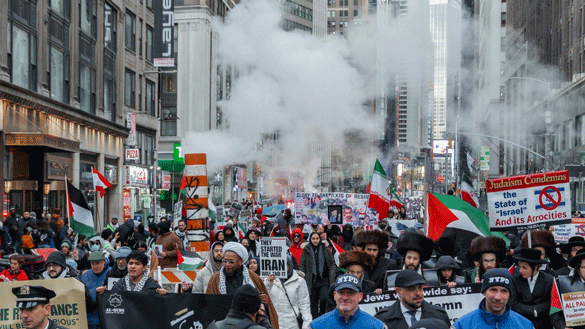
Israel’s military strategy is no longer confined to defense or limited operations. The war against Iran has evolved into a large-scale conflict in which the United States has been directly involved.
This situation brings two critical consequences: A regional war is turning into a crisis involving global powers, and every step Israel takes is making it increasingly controversial. And this is where the core contradiction emerges: A war that expands in the name of security is, in reality, accelerating Israel’s strategic isolation.
Each new front not only increases military risk but also raises political costs, strains alliances and erodes legitimacy.
The factor Israel ignores is that in the international system, power is not measured by military capacity alone. Legitimacy, perception and networks of relationships are just as decisive as firepower. At this point, Israel appears to be rapidly losing at least two of these three pillars.
Radicalized nation
Particularly after the Gaza process, Israel’s image in global public opinion has changed. Once framed as “a state with legitimate security concerns,” Israel is now increasingly seen in many capitals as an actor that uses disproportionate force and disregards international norms.
This change in international position is no longer confined to diplomatic language. It is visible on the streets. Global public opinion is now more vocal and far more critical.
Against this backdrop, a transformation has unfolded within Israel. A social climate has been gaining strength that dismisses criticism as hostility, excludes the outside world and constructs its own reality. Moderate, rational voices are gradually fading. In their place, sharper, more ideological and more rigid narratives are rising. Alongside the current leadership, more hard-line tendencies have been gaining ground and this language is spreading across broader segments of society.
Today, a significant portion of the Israeli public appears aligned with the political line of Israeli Prime Minister Benjamin Netanyahu and that has a cost.
Overlooking reactions
Once seen as one of the most open and Western-oriented cities in the Middle East, Tel Aviv is now perceived differently. The image of a globally integrated, liberal hub is giving way to a security-driven mindset that is increasingly closed to criticism and reactive toward the outside world.
External criticism is swiftly labelled as “anti-Semitism” or “double standards.” While this reflex may strengthen internal cohesion in the short term, it risks creating a dangerous form of strategic blindness in the long run, which would eventually bring isolation.
Isolation in the international system does not happen overnight. It unfolds step by step: First, public support erodes, then, political backing weakens. Finally, economic and strategic costs emerge.
Israel appears to have already moved through the first two stages. The growing fracture in Western public opinion is likely to translate into political pressure on governments over time.
The greatest risk for any state is misreading the outside world. Structures that over-believe their own narrative, interpret criticism as hostility and turn inward inevitably face reality, often abruptly. This trajectory recalls past examples such as North Korea and Iran.
The critical question for Israel today is clear: Is this isolation a deliberate strategy, or an uncontrolled drift? If it is the latter, the consequences will extend far beyond diplomacy. They will be economic, security-related and deeply societal.
Israel may still be militarily strong. But in the international system, legitimacy, balance and reason are as important as power. Above all, when the connection to reality is lost, even the strongest structures become fragile.
https://www.dailysabah.com/opinion/op-ed/israels-turning-a-blind-eye-to-world-will-only-bring-isolation
------
Who benefits from ideological reading of Tanakh in Mid East?
BY ZAFER DUYGU
APR 06, 2026
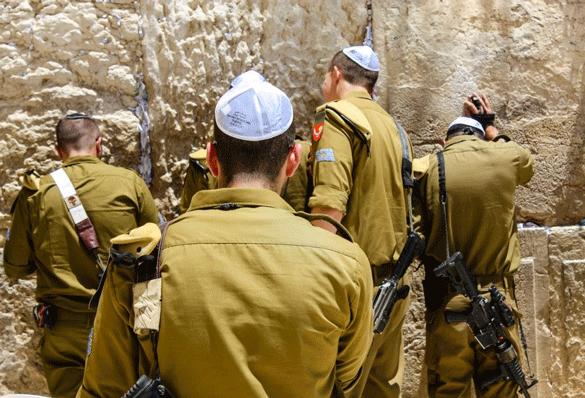
In an interview conducted on March 23, 2026, with the American commentator Tucker Carlson, former speaker of the Knesset Avraham Burg remarked, while commenting on the current war and developments in the Middle East, that Israel lacks both the mindset and the vocabulary necessary to speak about peace.
Similarly, Israeli journalist and intellectual Gideon Levy, speaking on March 13, 2026, on the international independent news program Democracy Now!, drew attention to a survey conducted in Israel, noting that 93% of the public supports the current war.
The first of these examples points to Israel’s foreign policy orientation away from diplomacy, while the second highlights the popularity of war discourse and practice among the public. Based on the statements of Burg and Levy, it can be concluded that both politics and the social sphere in Israel are centred on conflict, and that an understanding distant from a culture of coexistence prevails at both the governmental and societal levels. This situation seriously threatens the prospect of sustainable coexistence with other societies in the region, a reality already reflected across various parts of the Middle East.
Jews above everyone else
When we consider the Middle East, we observe that for thousands of years, numerous religions, languages, ethnic identities and cultures have participated in a shared practice of life. These lands have not historically been structured as a space where “everyone merely defends their own rights;” rather, despite periodic conflicts, they have long constituted a geography in which different beliefs and communities have built a culture of coexistence. In this context, Muslims and Christians of various sects, and Jews, alongside other faith groups, have experienced living together over millennia. This reality is clearly visible both in historical sources and in the patterns of traditional social structures.
By contrast, under the influence of anti-Semitism and nationalism, the Zionist ideology that emerged in late 19th-century Europe – particularly articulated by figures such as Theodor Herzl with the aim of establishing a national homeland for Jews – has long advanced claims that contradict this historical culture of coexistence. According to this discourse, a vast geography in the Middle East was promised thousands of years ago to the Jews. Within this region, Jews alone can – and indeed must, by divine will – establish sovereignty, regardless of existing states and nations.
Furthermore, statements circulating on social media and the press, especially those attributed to Jewish religious figures and even Israeli leadership, suggest that other nations are expected to acquiesce to this claim. It is evident that such teachings and demands have influenced the shaping of Israel’s foreign policy, yet this discourse and practice stand in serious contradiction with historical realities.
Zionist distortion of history
Israeli Prime Minister Benjamin Netanyahu frequently employs historical and religious references, implying that the region belongs exclusively to Jews. For instance, in a speech delivered in the autumn of 2025, he made striking remarks about Jerusalem, saying, "We’re here, this is our city, Mr. Erdogan. It’s not your city. It is our city. It will always be our city. It will not be divided again."
Netanyahu’s statements indicate a politicized and unilateral interpretation of the region’s historical and cultural heritage, reflecting a discourse that disregards or distorts both the long-standing culture of coexistence and historical realities. As will be discussed below, Jerusalem has not been a city belonging exclusively to Jews over the past 2,500 years.
Another example emerged during Netanyahu’s meeting with the Indian leader Narendra Modi. Referring to World War I, he stated: “While we were under Ottoman occupation, it was Indian soldiers and commanders who helped us achieve our freedom. We will not forget those who advanced and gave their lives in the Battle of Haifa.”
These statements contain three historical distortions. First, during the period of World War I, there was no state called Israel; thus, claims of “Ottoman occupation” and “liberation” from an Israeli perspective do not align with historical facts.
Second, at that time, the region was under Ottoman administration, and Indian soldiers fighting as part of the British colonial army were primarily fulfilling military duties within the broader struggle among imperial powers; the matter was not directly related to Jews. Third, there is the question of whether Jews truly required or asked for “liberation” from Muslim rule, which is an issue that can be analyzed in conjunction with the 2,500-year history of Jerusalem.
Let us return to facts
Zionist ideology is grounded in the concept of the “Promised Land” in the Torah, referring to a sacred region promised in the Tanakh to the descendants of Abraham, Isaac and Jacob. Accordingly, it is a central tenet of Jewish thought that the land of Canaan was granted by God to the Israelites in perpetuity.
In reality, however, according to the narrative of the Tanakh, it is evident that following the destruction of the northern Kingdom of Israel by the Assyrians in 722 B.C. and the southern Kingdom of Judah by the Babylonians in 586 B.C., the Israelites were never again able to establish a continuous sovereign state in these lands.
Except for the relatively brief Hasmonean rule (140-63 B.C.) toward the end of the Second Temple period, the Israelites did not exercise sovereignty in this geography for approximately 25 centuries, living instead under the rule of various foreign powers. During these periods, governance was assumed by the Persians, Hellenistic kingdoms, Romans and later Muslims.
More importantly, ancient texts such as I and II Maccabees demonstrate that Jews, while striving to preserve their monotheistic belief and identity, were at times subjected to the pressures of pagan Hellenistic rulers, as exemplified by Antiochus IV Epiphanes (175-164 B.C.).
First-century Jewish authors such as Flavius Josephus and Philo of Alexandria record numerous instances of persecution during the Roman period. As is well known, the Temple was destroyed by the Romans in 70 A.D., countless Jews were killed in wars and revolts against Rome, and many were sold in slave markets. During the reign of Emperor Hadrian (117-138 A.D.), Jews were even banned from entering Palestine.
This historical trajectory contradicts the claim that the region was divinely granted to the Israelites in perpetuity. History demonstrates that many different political powers have ruled these lands, while Jews, often living in diaspora, constituted one of the subject populations within them.
Consequently, assertions such as “Jerusalem has historically belonged solely to Jews” or that “Jews were liberated from Ottoman rule” have little grounding in the discipline of history.
When we also consider the periods under Muslim rule in the Middle East, it becomes evident that Jews and Christians, in most cases, lived under relatively peaceful and tolerant conditions. During the eras of the Rashidun Caliphs, the Umayyads, the Abbasids, the Seljuks and the Ottomans, different religious groups – despite occasional difficulties arising in the course of life –were generally able to maintain their ways of life and practice their faiths freely, without facing forced exile or systematic extermination policies.
In contrast, from the Rhineland massacres to the Khmelnitsky uprising, and from Spain to the Holocaust, Jews were subjected to systematic violence in many Western and European contexts. No comparable pattern of persecution is observed under Muslim administrations, which stands as an indication of the region’s culture of coexistence.
Promised according to whom?
Reconsidering Netanyahu’s historical discourse, it emerges not only as a theological reference but also as a political instrument. This reflects a tendency to replace the culture of coexistence with a narrative of “land belonging exclusively to a single group.”
This approach is concretized in Israel’s foreign policies. Aggressive strategies on the international stage, a preference for the use of force over diplomacy and practices resulting in the deaths of countless people and the displacement of millions all weaken the culture of coexistence.
Certainly, religious references such as the “Promised Land” may form part of a historical narrative and archaeological findings can provide evidence illuminating the historical presence of the Israelites in this ancient geography. However, employing such narratives as standalone instruments of territorial claim in modern politics generates serious problems. It amounts to the direct application of theological and historical texts to contemporary border policies, an approach that clearly contradicts both historical realities and the rights of neighbouring peoples to exist.
Neither historical processes nor the millennia-long practice of coexistence in this geography can be interpreted through the lens of exclusive ownership by a single group. An understanding grounded in respect for the presence of all peoples and equality of rights constitutes the foundation of a just and sustainable peace. Therefore, priority must be given to peace rather than war, and to coexistence rather than destruction.
The Middle East is not a “possession” to be claimed solely by reference to religious texts. It is a historical geography in which diverse beliefs and cultures have lived together for extended periods. Preserving and sustaining this heritage today is both a human and a political imperative.
https://www.dailysabah.com/opinion/op-ed/who-benefits-from-ideological-reading-of-tanakh-in-mid-east
-----
US-Iran war gives Syria’s global economic pitch more urgency
CHARLES LISTER
April 06, 2026
When the US and Israel launched military operations against Iran a month ago, the Middle East was plunged into debilitating conflict, with retaliatory Iranian missiles and drones striking at least 12 countries across the region. In addition to thousands killed through US-Israeli action in Iran, Lebanon and Iraq, at least 37 people have reportedly been killed in Iranian attacks on the UAE, Saudi Arabia, Kuwait, Bahrain, Qatar, Turkiye and Iraqi Kurdistan.
Iran’s strikes on Gulf energy infrastructure and its de-facto closure of the Strait of Hormuz, furthermore, have triggered global economic shockwaves that leading experts warn could “send the world economy plummeting into a deep recession.”
It is in this context of escalating regional conflict that Syria has remarkably just completed its most stable month in 15 years. After nearly 14 years of civil war, Syria’s transition has been far from peaceful, and two brief but horrifically deadly chapters of violence on the coast and the southern governorate of Suweida served as a reminder of the fragility of the country’s transition. Even so, the general trajectory has been one of stabilization.
According to data collected by Syria Weekly, deadly violence in Syria declined by 30 percent between January and August 2025, and then plummeted by 73 percent in the final third of the year.
Notwithstanding a brief period of fighting in Syria’s northeast in January 2026, the months of February and March 2026 have set consecutive record lows in violence, with March seeing a total of 23 people killed in direct acts of violence. That is 60 percent lower than the February 2026 record low of 58 deaths and 94 percent lower than the post-Assad average of 356 deaths per month.
Fortunately, the horrific violence that struck the coastal regions and Suweida in the first half of 2025 has not been repeated. Furthermore, having been the most significant and consistent factor behind deadly violence in Syria in 2025 — causing an average of 75 deaths per month — vigilante violence and targeted assassinations have declined by 87 percent so far in 2026, with an average of 10 deaths per month between January and March.
In fact, Syria’s coastal region transformed from the most unstable region in the first half of 2025 to the most consistently stable in the second half of the year. That positive trend has continued into 2026, with violence in Latakia and Tartus declining by a further 71 percent compared to July-December 2025.
While Daesh remains a persistent domestic challenge, the group has taken a big hit since the fall of Assad’s regime in December 2024. In fact, compared to 2024, Daesh attacks and resulting casualties in 2025 declined by 50 percent and 76 percent, respectively. In 2026, Daesh attacks have, so far, declined by a further 26 percent and casualties by a further 13 percent.
Although it has a long way to go, and significant internal challenges remain, Syria’s increasing stabilization is extremely encouraging news — not least for Syria and its people, but also for the Middle East and the world at large.
For far too long, Syria offered little to its neighbours beyond terrorism, threats, organized crime and corruption, fuelling the popular saying: “What happens in Syria never stays in Syria.” The prospect of Syria’s transition stabilizing and succeeding promises to flip the proverb on its head by making Syria an exporter of stability, prosperity and connectivity.
Despite the obvious challenges associated with Syria and its transition, it has won over many in America, Europe, Russia, the Middle East, and China. With the US-Iran war now entering its second month, Syria appears to be making an increasingly credible economic argument. Since the spring of 2025, it has presented itself as the key to unlocking more reliable, efficient and direct connectivity between Asia and Europe — whether for trade, energy, telecoms or other sectors.
And given the effective closure of the Strait of Hormuz and Houthi threats to close off the Red Sea, Syria could emerge as a corridor and conduit to bypass these embattled maritime chokepoints. Saudi Arabia is championing this alternative, having already inked several billion-dollar contracts to position Syria as the linchpin of a regional telecommunications revolution.
In backing what Syria’s government has called “Project Silk Link,” fiber optic cables will run from Spain across the Mediterranean (through the Medusa Cable, contracted in October 2025) and then throughout Syria and onto the Gulf and Asia. Once accomplished, Silk Link will reduce internet latency across the region by 30-40 milliseconds, creating opportunities in sectors like AI, financial trading, and remote robotic medicine that are otherwise impractical with the speeds currently provided by cables traversing the Red Sea and the Suez Canal.
The prospect of Syria becoming a regional hub for interconnectivity has rallied a diverse range of regional and international actors behind Damascus.
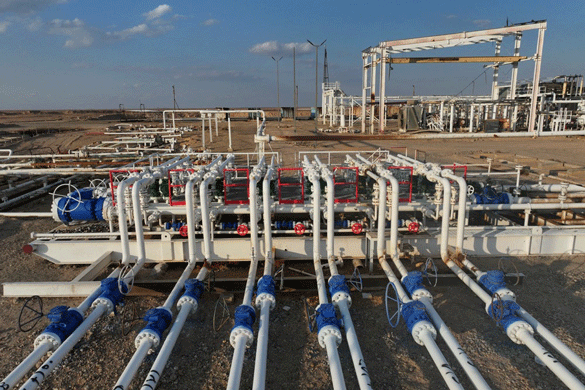
But beyond telecoms, the Trump administration has also invested significant effort in positioning Syria as the future “hub” or transit “corridor” for Middle East energy flows into Europe — again, bypassing less efficient, and often more costly and risk-laden, maritime routes. In 2025 alone, the US-backed revitalization of Syria’s energy sector secured $28 billion of investment contracts, with the world’s biggest companies involved in those talks, including Chevron, ConocoPhillips, Total, Qatar Energy, ENI, ADES Holding, TAQA and Dana Gas.
Since Assad’s fall, a new Azerbaijan-Turkey-Aleppo pipeline has already been established and activated, and talks are underway to revive or establish the Qatar-Turkey Gas Pipeline, the Arab Gas Pipeline and the Kirkuk-Baniyas Pipeline — all of which would pass into and through Syria and then onward to European markets.
If realized, these projects would transform regional energy markets and help to resolve the globally crippling dilemmas associated with reliance on the Strait of Hormuz and Red Sea channels. The Iraqi government has also committed to exporting 650,000 metric tons of fuel oil via land routes through Syria each month through the summer of 2026.
But while Syria is becoming increasingly stable, the country remains fragile, and its political transition faces numerous internal and external challenges. While 2025 saw the transitional government invest heavily and succeed in securing Syria’s legitimacy on the world stage, 2026 will be the year in which domestic challenges associated with the economy as well as the unity of its diverse society will come to the fore.
Looming questions around transitional justice and the need for a further broadening of governing representation, as well as the formation of a parliament and the successful integration of the northeast, will all determine whether stabilization continues.
Syria also faces the world’s largest unexploded ordnance (UXO) threat, the persistence of which not only threatens lives but also challenges economic recovery, particularly in rural areas. Since Assad’s fall, more than 700 people have been killed in nearly 850 UXO incidents, primarily from landmines. The Syrian government has worked hard to deal with the UXO issue, including alongside NGOs.
Through public awareness campaigns and localized demining efforts, the impact of UXO declined steadily in 2025, with 329 killed in Q1, 154 killed in Q2, 87 killed in Q3 and 56 killed in Q4. However, the first quarter of 2026 has seen UXO incidents rise, with a further 81 Syrians killed, underlining the need for international help.
Syria’s recovery and stabilization also require regional and international stability. So far, Syria has stayed almost entirely out of ongoing regional hostilities, with the exception of four Iranian proxy drone attacks from neighbouring Iraq and one artillery strike by Hezbollah in Lebanon, none of which caused casualties.
But the broader ripple effects of regional conflict are certain to constrain or slow the pace of investment and the ability of international investors to visit Damascus to explore new prospects. Syria’s position at the heart of the Middle East offers a great many economic opportunities, but it also means that Damascus International Airport has been closed for a month.
While the nature of Syria’s transitional authorities remains a source of concern for many, the prospect of Syria becoming a linchpin of regional economic interconnectivity and prosperity has unified a diverse range of regional and international actors behind Damascus.
To ensure that vision becomes a reality, Syria’s transitional government must navigate a great many domestic hurdles and responsibilities, but decisions taken by the international community will also play a decisive role in determining how realistic the vision for Syria can become.
In this sense, the US-Iran war may have highlighted the potential advantages of Syria’s economic pitch to the world, but if it continues for too long, it may also make the realization of that pitch increasingly unlikely.
https://www.arabnews.com/node/2638991
------
Israel moves toward executing Palestinian children
DR. RAMZY BAROUD
April 06, 2026
Under Israel’s new death penalty law, Palestinian children, like adults, could find themselves facing the gallows. This might take some by surprise or even be dismissed as an exaggeration. Sadly, it is neither.
The law, passed by Israel’s Knesset on March 30, mandates capital punishment for Palestinians convicted of carrying out deadly attacks. The legislation, often referred to as the “Death Penalty for Terrorists” law, requires that executions be carried out swiftly, within 90 days, while sharply limiting avenues for appeal or commutation, according to human rights organizations including Amnesty International and Human Rights Watch.
It resolves a long-standing political demand by Israel’s far-right leadership to formalize execution as a tool of control over Palestinians. As extremist National Security Minister Itamar Ben-Gvir has repeatedly argued, those accused of such acts “deserve death,” framing the law not as an exception but as a necessary policy.
Though the law itself does not explicitly mention children, it does not exclude them either. Knowing Israel’s treatment and legal classification of Palestinian children, this distinction is not minor — it is decisive.
Under Israel’s military court system, Palestinian children as young as 12 are prosecuted. They are often treated as adults within a system that offers few safeguards and operates with an extremely high conviction rate.
Defense for Children International-Palestine reported in its 2023 briefing, “Arbitrary by Default,” that the Israeli military detention system subjects Palestinian minors to “systematic,” institutionalized and “widespread ill-treatment.”
Reports by Amnesty International, Human Rights Watch and other rights organizations describe consistent patterns of abuse, including night arrests, physical violence, threats and psychological pressure. Many children, these groups note, are interrogated without adequate legal safeguards and in conditions that facilitate coercion and the extraction of confessions.
Under international law, children are protected persons, entitled to special safeguards under the Fourth Geneva Convention and the Convention on the Rights of the Child — both of which prohibit cruel, inhuman or degrading treatment.
Not in Israel, however — a state that has consistently treated international law not as binding but as an obstacle to its political and military objectives.
For Israel, Palestinian children are often framed not as civilians but as potential threats. This framing represents a profound assault on basic humanity and fundamental rights — one that goes even further than the cynical language of “collateral damage” by pre-emptively stripping children of their civilian status.
Israeli officials have made such views unmistakably clear.
In 2014, lawmaker and future Justice Minister Ayelet Shaked shared and endorsed a text declaring that “the entire Palestinian people is the enemy,” including its children, and that Palestinian mothers should not give birth to “little snakes.” This was not an aberration but a reflection of a political discourse in which dehumanization is normalized.
This has often been dismissed as routine racism in Israeli politics. It is not.
Since Oct. 7, 2023, Gaza’s children have been killed in staggering numbers: at least 21,289 children are among the more than 71,800 Palestinians killed, while 44,500-plus have been wounded, according to UNICEF’s February 2026 update.
In the West Bank, the pattern persists, with Palestinian children increasingly killed during Israeli military raids and settler violence.
With this in mind, it should not be surprising that the death penalty law does not exempt children from the horrific fate it envisions for Palestinians who resist Israeli occupation.
To be clear, the death penalty law is about neither punishment nor deterrence. Israel does not require a law to kill Palestinians — whether they are engaged in armed resistance or, as has often been the case, are civilians with no involvement in hostilities.
For decades, Israel has carried out assassinations, extrajudicial killings and large-scale military operations that have resulted in thousands of Palestinian deaths.
The killing of Palestinians in Israeli prisons is no longer incidental. Since October 2023, at least 98 detainees have died in custody — many under conditions linked to torture, abuse and medical neglect, according to Physicians for Human Rights-Israel.
The death penalty law is, therefore, about something else: the projection of power.
It is not fundamentally different from the performative brutality associated with figures like Ben-Gvir, whose rhetoric and conduct toward Palestinian prisoners have emphasized domination, humiliation and control.
But within this projection of power lies a deadly consequence: many people stand to be killed — including children.
Though some voices in the international community have spoken out against the law, these reactions have been limited and short-lived, quickly overshadowed by other developments.
Without sustained pressure, Israel has no reason to refrain from carrying out executions — decisions that will be made by military courts that lack even the most basic standards of fairness or adherence to international law.
Once this is normalized, the threshold will shift again. And children will inevitably be drawn into it.
Israel has already normalized practices once deemed unthinkable. If it normalizes the execution of children, it will cross a threshold not even many colonial regimes openly breached.
There must be a limit — because its continuation will not only devastate Palestinians but reverberate far beyond, eroding the most basic protections of human life itself.
https://www.arabnews.com/node/2638972
------
‘Day after the War’ – Strategic Shifts After the War on Iran
April 7, 2026
By Wissam Abu Shamala
As the sixth week of the war on Iran begins, what had previously been anticipated before the outbreak of war has now become evident to the entire world. The war has not been as swift, decisive, or rapid as the duo of Donald Trump and Benjamin Netanyahu had envisioned.
The initial strike against the Iranian leadership neither led to regime change nor even created a leadership vacuum. The Iranian street did not turn against the government; rather, there was broad mobilization against the aggression.
What began as a war aimed at overthrowing the regime has shifted into a struggle centred on restoring access to the Strait of Hormuz—ironically, a waterway that had been open prior to the war. Instead of achieving a rapid resolution that would consolidate US-Israeli regional and global hegemony, the ongoing war may ultimately be recorded as a turning point in the decline of American power and its regional allies, particularly Israel.
The war has proven not to be a limited confrontation, as initially assumed in Washington and Tel Aviv, but one with wide-ranging regional and global repercussions. Beyond its immediate military dimension, its outcomes will shape the balance of power in the Middle East, influence control over trade and energy routes, and contribute to the reconfiguration of the global order amid intensifying competition between major powers.
In this confrontation, US-Israeli strikes have targeted Iran’s military capabilities, though the extent of the damage remains unclear. However, Iran’s continued ability to strike American and Israeli targets at distances of approximately 2,000 kilometres—using ballistic missiles and drones, some of which have penetrated advanced air defence systems—undermines claims of the near-total destruction of its capabilities.
Similarly, the downing of several American aircraft challenges assertions of full control over Iranian airspace. Iran’s continued ability to influence maritime movement through the Strait of Hormuz also casts doubt on claims regarding the destruction of its naval capabilities.
Iran has demonstrated sustained capacity in missile production, drone warfare, and nuclear infrastructure. Despite narratives of total degradation, its forces continue to exhibit significant defensive and offensive capabilities, as well as operational control, even after more than six weeks of war.
The failure to achieve a rapid resolution appears to be pushing Washington toward deeper involvement. This includes threats of a ground operation targeting Kharg Island—a critical hub for Iranian oil exports—and renewed efforts to reopen the Strait of Hormuz, through which roughly 20 percent of global oil supply passes. These moves suggest an attempt to assert broader strategic control over regional energy flows.
For the United States, Israel, and Iran alike, the war is about shaping the strategic landscape of the post-war order. In the context of US competition with China and Russia—both of which maintain strong economic and military ties with Iran—the confrontation extends beyond the regional level. It is part of a broader struggle over global leadership.
Should the United States fail to defeat Iran, the outcome could accelerate the erosion of American global dominance while strengthening Russia, China, and Iran’s regional position.
For Israel, the primary objective remains the destruction of Iran’s nuclear and missile capabilities, as well as the dismantling of its alliance network across the region—either through regime change or by rendering the Iranian state dysfunctional.
Israeli strategic thinking assumes that the survival of the Iranian regime will allow it to rebuild and further develop its capabilities. Some analysts speculate that future leadership in Iran could revisit existing religious restrictions on nuclear weapons development.
The United States, however, views the conflict through a broader geopolitical lens. Its objective is not merely to neutralize a security threat, but to reshape Iran’s position within the international system—potentially replacing a hostile regime with one aligned with US interests.
This would involve distancing Iran from China and Russia and integrating it into a US-led economic and political order. To this end, Washington appears to be considering a shift from military pressure to comprehensive economic targeting aimed at forcing unconditional concessions.
Yet current indicators do not support these assumptions. Instead, Iran appears prepared for a prolonged war of attrition, with no signs of capitulation.
After six weeks of war, even American and Israeli circles increasingly acknowledge that key objectives have not been met. The Iranian government remains intact, retains control, and faces no credible internal alternative. Iran continues uranium enrichment, missile launches persist, and its influence over the Strait of Hormuz remains significant.
Meanwhile, the conflict is expanding across multiple fronts—including Lebanon, Iraq, Yemen, and the Gulf—while economic and geopolitical consequences intensify. Opposition to the war within the United States is growing, alongside a decline in Trump’s domestic political standing ahead of midterm elections.
The original US-Israeli vision was to secure a decisive strategic shift: replacing the Iranian regime with a cooperative one, weakening ties with Russia and China, and consolidating Israel’s role as a central power within a US-led regional order.
However, Iran’s resilience—military, political, and societal—has thus far obstructed these objectives.
This leaves Washington with two difficult options. The first is to declare victory without achieving fundamental change, withdraw, and leave Israel engaged in a prolonged multi-front war of attrition. The second is deeper escalation, leading to a sustained regional war involving Iran and its allies, continued disruption in the Strait of Hormuz, and escalating global economic consequences.
Both options carry significant costs and fall short of delivering the strategic transformation sought by the United States.
Globally, the perception of American power may be weakened, potentially emboldening China in East Asia and encouraging Russia to expand its ambitions in Ukraine.
Regionally, Israel’s standing could decline, while Gulf states may reassess their reliance on the United States and their alignment with Israel, particularly in light of a war that has exposed their vulnerabilities.
A failed war on Iran could therefore mark a turning point: diminishing prospects for normalization with Israel and reinforcing the perception that US and Israeli policies contribute to regional instability.
In such a scenario, Gulf states may increasingly question the strategic value of hosting American military bases, recognizing that such arrangements have drawn them into conflicts rather than ensured their security.
This could open the door to a broader regional realignment, including the possibility of a quieter strategic dialogue among regional powers—such as Iran, Türkiye, Saudi Arabia, and Egypt—aimed at establishing new frameworks for stability beyond American dominance.
https://www.palestinechronicle.com/day-after-the-war-strategic-shifts-after-the-war-on-iran/
------
‘I Did It My Way’: What Really Happened in Trump’s ‘Historic’ Iran Operation?
April 7, 2026
Washington’s presentation of the April 6 operation in Iran as a “historic” rescue was meant to project clarity, strength, and control. Instead, it has opened the door to deeper scrutiny.
Speaking from the White House, US President Donald Trump described the mission as “very historic,” likening it to “finding a needle in a haystack,” while senior officials framed it as a demonstration of the United States’ ability to recover its personnel “anywhere in the world.”
Yet, the details emerging from both the press briefing and the battlefield itself suggest something far more complicated—and far less successful.
The scale of the operation, the geography of the confrontation, and the visible aftermath in Iran all point to a narrative that cannot sustain its own claims.
The most immediate contradiction lies in the scale. By Washington’s own admission, the operation involved more than 150 aircraft, supported by what officials described as an “air armada.”
A mission of this magnitude does not correspond to the logic of a rescue. Extraction operations are designed around precision, speed, and minimal exposure, particularly when carried out in hostile territory.
Trump himself acknowledged the risks, noting that “there were military people that said you just don’t do this,” before adding, “I decided to do it.” This is “I did it my way” recast as doctrine—where impulse is elevated above judgment, and where the burden of that decision is exported outward, onto a landscape already shaped by US-Israeli violence.
This admission is revealing. It points to internal hesitation and underscores the extraordinary nature of the decision. Far from reinforcing the narrative of a calculated success, it suggests a high-risk gamble—one that appears to have unfolded under pressure rather than certainty.
Geography further complicates the official account.
While the downed aircraft was reportedly located in mountainous terrain, the most intense phase of the confrontation—and the destruction of multiple US aircraft—occurred near Isfahan.
These are not minor discrepancies that can be overlooked. They indicate that the operation extended beyond a single rescue point, unfolding across multiple locations with distinct operational dynamics.
Iranian reporting has consistently treated the events near Isfahan as central to the mission, not peripheral to it. Washington, however, has offered no coherent explanation for this divergence.
The visual record emerging from Iran reinforces this dissonance.
Images circulating widely show burned aircraft, destroyed equipment, and what appears to be the remnants of a large-scale military engagement.
Iranian accounts describe the operation as a failure, and while Washington has attempted to counter this by arguing that aircraft were destroyed intentionally or that images are misleading, these explanations strain credibility when viewed against the scale of the destruction.
A successful mission does not typically leave behind a landscape that requires such extensive clarification.
This is where the narrative begins to unravel most clearly. The administration continues to insist on success, yet the argument sustaining that claim rests on a series of assumptions that become harder to defend when examined closely.
Several elements, taken together, make it increasingly difficult to accept Washington’s version at face value.
First, the scale of deployment remains fundamentally incompatible with the stated objective. A mission involving more than 150 aircraft cannot be reasonably framed as a narrowly defined rescue. The size of the force suggests planning for contingencies far beyond extraction, pointing instead to a broader operational design.
Second, the geographic spread of the operation introduces a contradiction that has not been resolved. The distance between the location of the downed pilot and the site of the most intense confrontation raises the possibility that multiple objectives were pursued simultaneously. This alone weakens the coherence of the official narrative.
Third, the visual evidence emerging from the ground cannot be dismissed as incidental. The destruction of aircraft, the apparent abandonment of equipment, and the scale of the damage collectively suggest that the operation encountered serious setbacks.
Fourth, the administration’s own language reflects a degree of strain. The repeated insistence on success, combined with the need to explain away contradictory details, creates a narrative that feels constructed rather than self-evident. Trump’s acknowledgment of internal disagreement within the military further reinforces this impression.
Fifth, and perhaps most consequentially, the scale and location of the operation align with interpretations that point to objectives beyond the rescue of a single pilot.
Iranian reporting has indicated that the mission may have been connected to sensitive sites, including uranium-related assets. Whether or not this interpretation is ultimately confirmed, it offers a more coherent explanation for the scope of the operation than the official account provided by Washington.
Finally, the broader political language surrounding the operation adds another layer of context. In a Truth Social post, Trump wrote:
“Open the Fuckin’ Strait, you crazy bastards, or you’ll be living in Hell – JUST WATCH! Praise be to Allah.”
This statement, combined with his warning that Iran “could be taken out in one night,” reflects a tone of panic and desperation rather than resolve. It is not the language of a leader consolidating a clear victory, but of one navigating a rapidly evolving and uncertain situation.
Taken together, these elements do not merely challenge the official narrative—they render it increasingly untenable.
The April 6 operation was presented as a demonstration of strength. In reality, it exposed a series of contradictions that cannot be easily reconciled: a rescue mission that resembles a large-scale incursion, a success that requires continuous explanation, and a narrative that becomes less convincing the more it is examined.
If this is what Washington calls a “historic” success, then the conclusion is difficult to avoid.
The failure is not hidden. It is embedded in the details.
https://www.palestinechronicle.com/i-did-it-my-way-what-really-happened-in-trumps-historic-iran-operation/
-----
Palestine Chronicle Launches ‘Thinking Palestine’ – Journalism Meets Scholarship
April 6, 2026
By Romana Rubeo
The Palestine Chronicle has launched Thinking Palestine, a new platform dedicated to rigorous analysis and deeper reflection on the Palestinian struggle.
The initiative emerges at a time of rapid political, social, and military transformation, where developments unfold at a pace that increasingly limits opportunities for sustained interpretation. In this context, the project aims to provide a structured space for critical engagement grounded in both immediacy and depth.
Developed in coordination with the European Centre for Palestine Studies (ECPS) at the University of Exeter, the platform brings together academic research and journalistic practice to examine unfolding realities in Palestine and beyond.
Institutional Context
Founded in September 1999, The Palestine Chronicle has long positioned itself as a forum addressing issues of human rights, national struggles, freedom, democracy, and culture.
Its work spans daily news reporting, in-depth commentary, feature writing, and multimedia production, with a consistent focus on connecting current developments to their broader historical and political contexts.
The ECPS, established in 2009 by Ilan Pappé and Ghada Karmi, operates as an interdisciplinary research centre focused on Palestine. Based at the University of Exeter, it emphasizes academic rigor, decolonial approaches, and scholar-activism.
The collaboration between the two institutions forms the foundation of Thinking Palestine.
Bridging Journalism, Scholarship
According to the project’s framework, Thinking Palestine is conceived as a space where urgent developments are not only documented but critically examined and contextualized.
While The Palestine Chronicle has historically combined reporting with analysis, the new platform introduces a more structured approach to intellectual inquiry, reflecting the need for sustained engagement amid accelerating events.
The initiative seeks to bridge the gap between scholarship and journalism by creating a forum where both intersect, allowing for more comprehensive interpretations of ongoing developments.
Thematic Structure
Each edition of Thinking Palestine will be organized around a central theme, enabling focused exploration of key political, cultural, and historical questions.
These thematic issues will be developed in collaboration with academic institutions, research networks, and independent contributors, ensuring a balance between scholarly depth and accessibility.
Contributors will include scholars, researchers, journalists, analysts, and historians, offering diverse perspectives on Palestine as both a lived reality and a global political issue.
Editorial Approach
The platform is grounded in the editorial principles that define The Palestine Chronicle, including independence, intellectual integrity, and a commitment to fact-based discourse.
It aims to provide a space free from partisan affiliation, where complex ideas can be examined in relation to realities on the ground.
At its core, Thinking Palestine is presented as both a continuation and an expansion of The Palestine Chronicle’s work—extending its analytical dimension while opening a dedicated space for deeper, collective reflection.
Broader Objective
Through this initiative, the platform seeks to contribute to a wider intellectual project focused on challenging dominant narratives and advancing historically grounded understandings of Palestine.
By amplifying critical voices and fostering interdisciplinary dialogue, Thinking Palestine aims to engage with the present moment while situating it within broader historical and political frameworks.
The platform is now live and open for participation.
https://www.palestinechronicle.com/palestine-chronicle-launches-thinking-palestine-journalism-meets-scholarship/
------
New Age Islam, Islam Online, Islamic Website, African Muslim News, Arab World News, South Asia News, Indian Muslim News, World Muslim News, Women in Islam, Islamic Feminism, Arab Women, Women In Arab, Islamophobia in America, Muslim Women in West, Islam Women and Feminism